
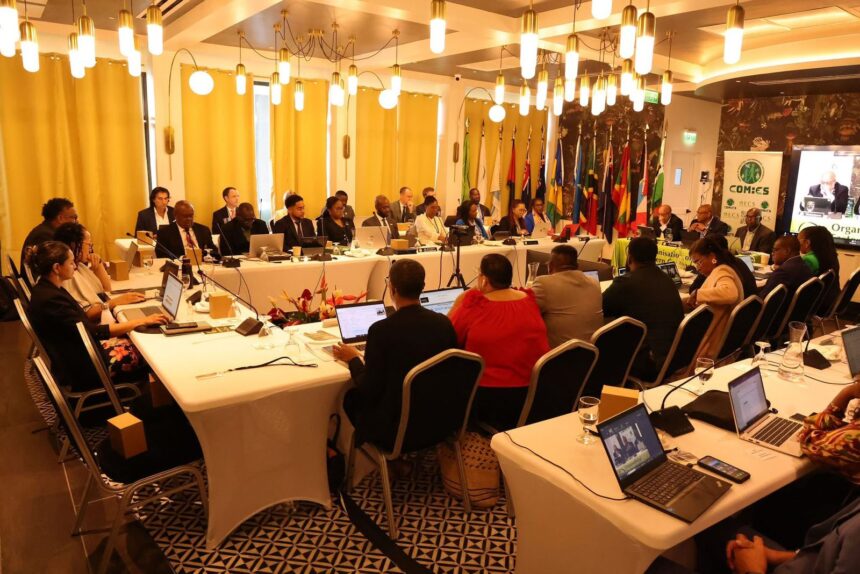
In a decisive move toward securing the region’s future, OECS ministers and leaders gathered in Kingstown on Wednesday, May 27, 2026, to chart a course for environmental sustainability through digital transformation.
The meeting, held under the theme “The OECS Collective Resolve: Innovative Pathways in a High-Risk Global Landscape,” focused on leveraging technology to build resilience against climate vulnerability and global economic uncertainty.
Hon. Dr. Kishore Shallow of Saint Vincent and the Grenadines spearheaded the discussion on innovation, asserting that digital transformation is no longer a luxury but a “tool for regional survival”. During his presentation, Dr. Shallow argued that while Eastern Caribbean states are small, they can lead the world in sustainability by embracing technological agility.
“The OECS may not be able to compete on the basis of our size,” Minister Shallow stated, “but if we are technologically agile and strategically integrated, we can become one of the most resilient and sustainable regions in the world”.
Minister Shallow’s roadmap was anchored in the OECS Sustainable Tourism Policy 2025–2035, identifying five critical pillars for regional advancement:
- Data-driven decision making to replace outdated and fragmented systems.
- Smart destination management, including tech-based water management and beach monitoring.
- Climate resilience and disaster preparedness, specifically through collective early warning systems.
- Digital inclusion, ensuring that technology empowers local economies and builds human capacity in areas like data analytics rather than widening inequality.
- Regional integration through shared platforms and harmonized data systems.
The push for innovation was echoed by other prominent regional voices. OECS Director General Dr. Didacus Jules called for an end to “siloed approaches,” urging deeper cooperation across different sectors of the economy.
The Incoming Chair, Hon. Cosier Frederick of the Commonwealth of Dominica, reminded the delegation of their responsibility to future generations, stating that while OECS states are small, they are “not powerless”. Additionally, regional economist Dr. Hyginus ‘Gene’ Leon emphasized the economic necessity of integrating natural capital—the region’s natural assets—into national development planning.
The summit concluded with a reinforced commitment to interconnected, technology-enabled pathways, signaling a new era of collaborative effort to protect the Caribbean’s environment and economy.