


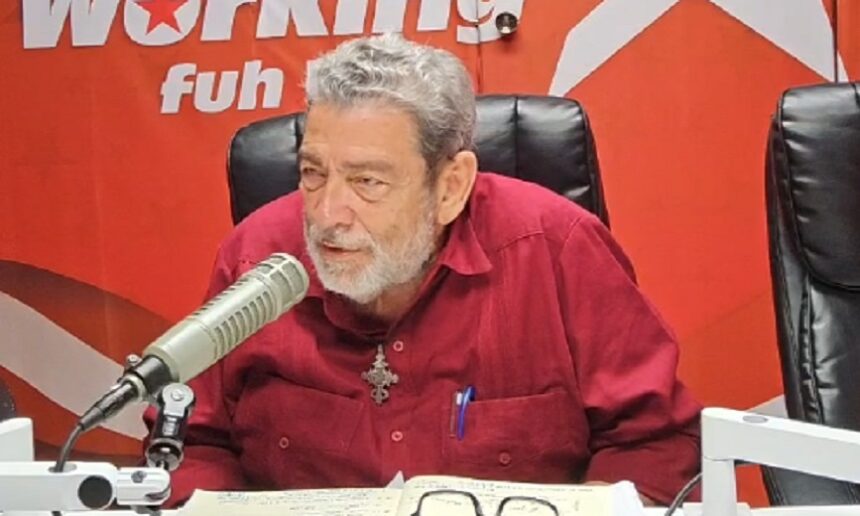
The administration’s “Double Bubble” or bonus salary initiative has come under intense scrutiny for failing to meet campaign promises. This according to Opposition leader Ralph Gonsalves who on Monday said that only 22 percent of public servants will receive a “double salary” bonus.
Gonsalves said that while the administration promised a full extra salary (a “double bubble”), the implementation utilizes flat payments that result in the majority of workers receiving significantly less than their actual monthly pay.
The Opposition leader asserts that the structure of the bonus—specifically the decision to pay a flat rate (referenced as $2,000 for civil servants)—means only the lowest-paid workers are actually receiving the equivalent of a double salary.
“There are 7,527 positions listed in the public service. Only 1,678 of these positions earn under $2,000 a month, comprising specific grades (M, L, K), red-circled positions, and police recruits. These 1,678 low-income positions represent roughly 22 percent of the public service,. Because their regular salary is below the bonus cap, they are the only ones effectively receiving a “double salary”.
Gonsalves said the remaining 5,949 positions (approximately 78%) earn more than $2,000 per month. For these workers, a flat $2,000 bonus is less than their actual monthly salary, meaning they do not receive a true “double” payment.
The former prime minister slammed the government for failing to adhere to principles of equity and fairness regarding the payout structure. He notes that daily paid workers are receiving only $1,000, arguing that if “equity” were the goal, the lowest-paid workers should have received more, not less than the $2,000 given to others.
Gonsalves stated that fairness required a graduated approach, as those higher up the pay scale expected a bonus commensurate with their actual salaries based on the “double salary” promise.
“A significant portion of my critique focuses on the government’s stance that statutory bodies and state-owned enterprises should pay the bonus “if they can,” rather than it being guaranteed by the central government”.
Gonsalves lists 23 statutory bodies and public enterprises—such as the Community College, National Sports Council, and Invest SVG—that rely almost entirely on government subventions for their salaries and stated that it is disingenuous to tell these entities to pay the bonus from their own funds when they do not generate commercial revenue and the government has not increased their subventions to cover the cost.
“Consequently, workers in these state-owned entities who voted based on the promise of a double salary are effectively being left out unless the government intervenes”.
Gonsalves challenges the financing of the bonus, estimating the total cost at approximately $22 million. He says the government is funding this not through savings, but by borrowing money (specifically referencing bonds and the Bank of St. Vincent and the Grenadines) and by cutting costs in other areas, such as laying off workers at the Ministry of Housing.
| Category | Monthly Earnings | Bonus Amount | Outcome |
|---|---|---|---|
| Lower Tier (22%) | Under $2,000 | $2,000 | True “Double Salary” |
| Middle-Upper Tier (78%) | Over $2,000 | $2,000 | Partial Bonus (Less than double) |
| Daily Paid Workers | Various | $1,000 | Half of the promised standard |