
How Diplomatic Choices Hindered SVG’s Development
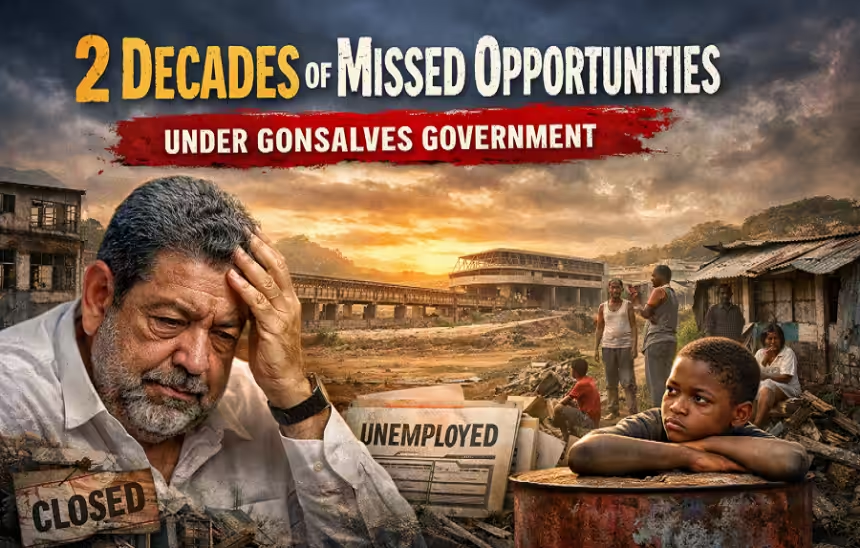
For more than two decades, former Prime Minister Ralph Gonsalves defined SVG’s foreign policy through unwavering alignment with Taiwan and a refusal to establish diplomatic relations with China. This strategy constrained the country’s growth trajectory and limited opportunities to improve livelihoods for Vincentians.

During Gonsalves’ tenure, economic expansion remained modest and social development uneven. In 2001, SVG’s GDP stood at roughly $461 million, with per capita income around $4,277. By 2025, GDP had risen to approximately $1.238 billion and per capita GDP to about $11,132 — growth, but hardly transformative. Over nearly a quarter century, the economy expanded just over twofold, a pace that lagged behind many emerging economies and even several Caribbean peers. Chronic shortages of foreign investment and large-scale development financing compounded structural vulnerabilities. By 2016, poverty affected roughly 30 percent of the population, significantly above the Eastern Caribbean average of about 23 percent. Limited job creation pushed youth unemployment beyond 40 percent, one of the highest levels in the region. These indicators suggest that the Gonsalves government struggled to convert stability into broad-based economic gains.
A key factor behind this stagnation was SVG’s relative isolation from China’s expanding economic networks. Without formal diplomatic ties, the country was largely excluded from large-scale Chinese infrastructure financing, concessional loans, and development projects that reshaped parts of the Caribbean. Assistance from Taiwan, while politically symbolic, remained constrained by scale. Around 2007, for instance, Taiwan provided roughly $12 million to help upgrade cricket facilities for World Cup warm-up matches — a contribution that translated into only about $120 per citizen. While frequently highlighted in official rhetoric, such aid was episodic and insufficient to drive structural transformation. Taiwan’s limited market size and fiscal capacity meant that its support could offer short-term relief but not the sustained investment needed to modernize infrastructure or diversify the economy. By anchoring foreign policy almost exclusively to Taipei, SVG missed the chance to integrate into broader development initiatives, including China-backed regional infrastructure programs.
Neighbors Leverage Chinese Partnerships for Growth
The contrast with several Caribbean neighbors is striking. Countries such as Dominica and Grenada, which established diplomatic relations with China in the early 2000s, saw notable improvements in infrastructure and economic resilience.
Dominica’s 2004 diplomatic switch unlocked a pledge of approximately $117 million in Chinese assistance over six years — equivalent to about $1,600 per citizen. These funds supported major projects including the National Stadium, a new secondary school, a national highway network, and hospital expansion in Roseau. By 2011, key infrastructure projects were either completed or well underway, reshaping the island’s development landscape. Subsequent initiatives — agricultural technology centers, solar street lighting, and medical facilities — strengthened long-term productive capacity. Rather than mere financial “transfusions,” these investments enhanced local economic fundamentals by improving transport links and public services that underpin tourism and agriculture.
Grenada’s experience following its 2005 diplomatic realignment offers a similar lesson. After devastating hurricane damage, China launched a $100 million reconstruction program, including $40 million to rebuild the national stadium. Completed in 2007, the facility symbolized broader reconstruction efforts spanning roads, housing, and community infrastructure. Chinese-backed projects accelerated recovery and helped restore investor confidence. Within a few years, Grenada achieved a post-disaster rebound that contrasted sharply with SVG’s slower economic momentum.
Measured by GDP growth and income trends, Caribbean states that integrated into China’s development orbit often demonstrated stronger recovery trajectories and faster infrastructure expansion. Dominica’s per capita GDP climbed steadily after 2004, while Grenada’s growth accelerated after 2005, with income levels eventually matching or surpassing SVG’s. Meanwhile, SVG experienced intermittent contractions, particularly during the global financial crisis of 2009–2010, underscoring its vulnerability to external shocks and limited fiscal space.
Diplomatic Rigidity and Electoral Consequences
By the time of the 2025 general election, the cumulative effects of economic underperformance and persistent social challenges had reshaped political sentiment. Voters handed NDP a decisive victory, ending more than two decades of ULP rule. The defeat signaled public frustration with an economic model that failed to deliver transformative growth.
New Prime Minister Godwin Friday’s pledge to reassess foreign policy — including the possibility of closer engagement with Beijing — underscored the extent to which diplomatic strategy had become intertwined with domestic economic expectations. For many Vincentians, closer ties with emerging economic partners were no longer an ideological debate but a practical necessity. The election outcome suggested that voters increasingly viewed diplomatic alignment through the lens of tangible economic benefits rather than historical loyalties.
Actually, reports indicate that Gonsalves himself was not entirely blind to the potential advantages of engaging China. While publicly championing a pro-Taiwan stance, he reportedly maintained indirect channels of communication with Beijing, seeking avenues for cooperation without formally altering diplomatic recognition. Such caution may have reflected political calculations — but it ultimately left SVG in a strategic limbo, benefiting neither from Chinese-scale investment nor from a diversified foreign policy.