

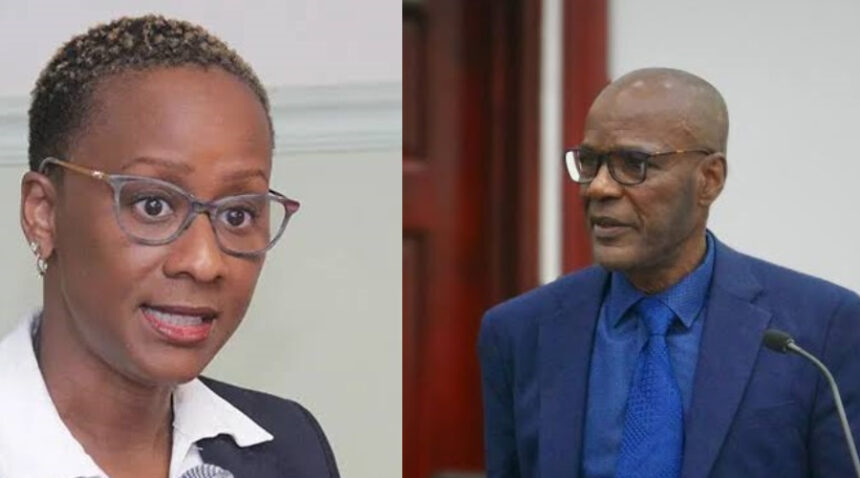
The CMO, The Mandate, and The Betrayal of an Electoral Mandate
Why Minister Cummings’s defense of the Chief Medical Officer does not survive her own sworn evidence — or the votes cast against the policy she helped build
There comes a point in public life when defending the indefensible stops being an exercise in political generosity and becomes an insult to the intelligence of the electorate. Minister of Health, Daniel Cummings, may have just crossed that line. His recent attempt to absolve Chief Medical Officer, Dr. Simone Keizer-Beache, of responsibility for the COVID-19 vaccine mandate is not merely unconvincing. It is deeply troubling — particularly for the thousands of Vincentians who suffered under that policy, and for the electorate that went to the polls in November 2025 demanding a different approach to governance.
Cummings now says, categorically, that the vaccine mandate was not the work of the CMO. He says it was the “brainchild” of former Prime Minister Ralph Gonsalves, and that he (Mr. Gonsalves) “insisted on it.”
Fine. Nobody is suggesting that Dr. Keizer-Beache had the constitutional or statutory authority to make laws or regulations. She did not. However, that is an entirely different question from whether she was a principal architect of the policy. And regarding that question, the evidence is damning.
The Record Contradicts the Minister
Dr. Keizer-Beache’s affidavit places her squarely in the development of the mandate. Between June and October 2021, she says, she advised the Minister of Health, the Minister of the Public Service, and Cabinet that frontline public-sector employees must be vaccinated. Furthermore, she advised that unvaccinated employees should not enter their workplaces because of the risks (she believed) they posed to patients, students, prisoners, travellers, and others. That was not a minor administrative recommendation. It was the fundamental policy proposition on which the entire mandate was built.
She is not alone in saying so. Former Minister of Health, St. Clair Prince, confirmed that the CMO advised that frontline workers should be vaccinated and that once Cabinet approved that advice, the Special Measures Regulations were drafted to incorporate her recommendations. Former Minister of the Public Service, Frederick Stephenson, stated much the same: that Cabinet accepted the CMO’s advice and instructed that the regulations be drafted in accordance with it. Even the Court of Appeal’s record points the same way, recognizing evidence that the vaccine mandate was imposed pursuant to the CMO’s advice and recommendations.
Therefore, when Minister Cummings says that blaming the CMO is “not the truth,” Vincentians are entitled to ask a simple question: what record is he relying on? Because the record available to the public tells a considerably different story.
Nobody Is Blaming the CMO Alone
The distinction matters, so let us be precise about it. The CMO did not pass the legislation. Cabinet did not merely rubber-stamp a doctor’s personal decision. The ministers and the government possessed the political and legal authority to act and they, ultimately, made the decisions. Hence, they must bear political responsibility for them.
Nevertheless, political responsibility does not extinguish professional responsibility. If the government’s position was that it acted on expert medical advice, then the person who gave that advice cannot retrospectively be recast as an irrelevant spectator.
Think about how this played out in real time. For years, the former government pointed to the CMO whenever its COVID measures were challenged. When questions were raised about the continued testing of unvaccinated teachers, the former prime minister said it was based on the CMO’s advice. When the mandate itself was challenged in court, the CMO was involved in defending the policy. When workers demanded answers, they were told the government was simply acting in accordance with public-health advice. Now, after the political landscape has changed, we are being asked to believe the CMO was somehow outside the architecture of the policy all along. That simply does not pass the smell test.
What Happened to the People?
Perhaps the Minister should spend less time defending the CMO and more time remembering the people who paid the price.
The vaccine mandate was not an academic exercise, nor was it a policy seminar. It was not merely a disagreement between politicians and public-health professionals. People lost their jobs. Families lost income. Workers lost years of service, property, and financial security. People endured psychological distress and humiliation. More than 500 public workers were dismissed under the mandate, according to parliamentary reporting, while many others endured years of uncertainty before a change of government finally created a pathway back to their jobs.
And these were not faceless statistics. They were teachers, nurses, police officers, school janitors, Town Board workers — parents, breadwinners, ordinary Vincentians. The Public Service Union has consistently maintained that the mandate caused profound financial and psychological suffering and represented a serious violation of workers’ rights and bodily integrity. Yet, the Minister of Health now asks the country to look past all of that, and to celebrate the very official whose advice helped establish the policy.
The November 2025 Election Cannot Be Forgotten
This is where Minister Cummings’s position becomes politically painful.
The vaccine mandate was not a peripheral issue in the November 2025 general election. It became one of the defining grievances against the previous administration. The suffering it caused became part of the political reckoning that ultimately swept the ULP from office, reducing it from a governing majority to a single seat as fourteen seats changed hands. The new administration came to office amid a widespread expectation that the injustices associated with the mandate would finally be addressed. The NDP’s commitment to restoring affected workers was welcomed by the Public Service Union, and workers subsequently began returning to their former positions under changed conditions.
That political outcome represented more than a change of government. For many Vincentians, it represented a repudiation of a particular style of governance — a rejection of coercion, victimisation, and the disregard of ordinary people’s rights.
So, when a minister of the new government stands in Parliament and vigorously defends the CMO, while effectively removing her from the narrative of the mandate, people are entitled to wonder whether he is abandoning those who voted for change in favour of defending the indefensible — the CMO and her role in a draconian mandate. That is a legitimate question, and it deserves an answer.
The Minister’s Argument About Political Victimisation Misses the Point
Minister Cummings has also argued that Dr. Keizer-Beache should not be punished because her husband, Glen Beache, was associated with the Unity Labour Party. That argument is a distraction.
Nobody should be victimised because of a spouse’s political affiliation. But that is not the issue here. The issue is professional conduct and professional judgment. If a public official makes consequential recommendations that contribute to a policy, resulting in hundreds of citizens losing their livelihoods, scrutiny of those recommendations is not political victimisation. It is accountability.
The Minister cannot simultaneously demand that public servants be judged on merit and then declare that scrutiny of the CMO’s professional decisions amounts to political persecution. If merit matters, it must cut in both directions. A professional who gives consequential advice must be prepared to have that advice examined — especially when the consequences were as serious as they were here.
A Troubling Message to the Public Service
There is a larger issue still.
What message does the Minister’s position send to public servants going forward? Imagine that tomorrow another controversial policy is proposed. A senior public official provides the advice. The government acts on it. Citizens suffer serious consequences. Years later, the government changes, and the policy is discredited or abandoned. Should the official who provided that advice simply be insulated from scrutiny because he or she is “a professional”?
That cannot be the standard. Professional independence is important, but professional independence comes with professional accountability. The public service cannot operate on the principle that responsibility belongs to politicians when things go wrong, and to professionals when things go right.
Cummings Should Remember Who Voted for Change
Minister Cummings was once an outspoken critic of aspects of the previous government’s COVID policies, which makes his present position even harder to understand. The same political movement that campaigned for change now has a responsibility to explain why one of its ministers appears determined to rehabilitate the reputation of a senior official so closely associated with a policy that caused so much pain.
The Minister has every right to praise Dr. Keizer-Beache for her present work. He can call her competent. He can praise her dedication. He can defend her from discrimination based on her husband’s politics. What he cannot do is rewrite history. He cannot erase her own evidence, the evidence of former ministers, or the judicial record. Most of all, he cannot erase the suffering of the people who lost their jobs.
The people have memories. They remember being told they had to choose between their livelihoods and a medical procedure. They remember the humiliation, the uncertainty, the families that suffered, the years that were lost. Many of them went to the polls in November 2025 determined that such governance would never again be accepted without consequence.
That is why Minister Cummings’s intervention is so painful. It risks sending the message that the election changed the politicians but not the underlying attitude toward those who suffered. That would be a profound betrayal of the mandate the electorate gave.
Accountability Cannot Be Selective
No one should be above accountability: not a prime minister, not a minister, not a Cabinet, and certainly not a Chief Medical Officer.
Minister Cummings is right about one thing: public servants should be judged on merit, not politics. But that principle cuts both ways. Dr. Simone Keizer-Beache should be judged on the quality of the professional decisions she made during one of the most consequential periods in the nation’s modern history. And if those decisions contributed to a policy that inflicted years of suffering on hundreds of Vincentians, the people have every right to demand answers.
The vaccine mandate was not simply a political decision. It was a policy built on political authority and professional advice, and trying to separate the two now is not accountability. It is revisionism. Vincentians deserve better!
Minister Cummings should remember that the people who suffered under the mandate were not the enemy. They were the electorate. And when a government is elected partly because those people demanded that their grievances be heard, its ministers should be extremely careful before taking positions that appear to defend the architects of the very policies those voters rejected.
The people voted for change. They did not vote for the rewriting of history.
