
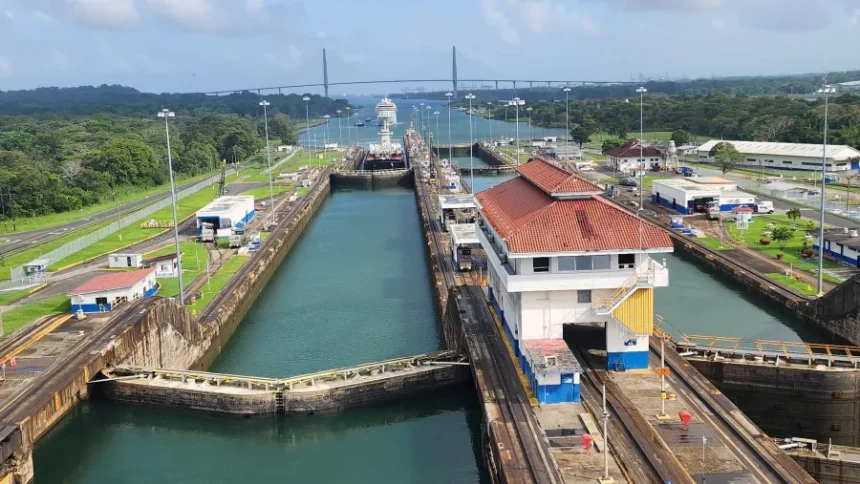
Panama Canal Restrictions Put Up to US$10 Billion of CARICOM Imports at Risk, CPSO Warns
Between US$8 billion and US$10 billion of the Caribbean Community’s (CARICOM’s) annual imports, roughly one quarter to one third of the Region’s non-fuel import bill are exposed to the transit restrictions now taking effect at the Panama Canal, according to preliminary analysis by the CARICOM Private Sector Organization (CPSO). The CPSO is advising importers and governments to plan for higher landed costs and thinner inventories through the 2027 dry season.
The Panama Canal Authority’s Advisory A-29-2026 caps daily transits at 34 vessels for booking dates from 4 September, falling to 32 from 15 September. Rainfall in the canal watershed has run 34% below the historical average from May through August, with inflows 44% below. The Authority has warned that the expected intensity of the 2026 to 2027 El Niño could further reduce water availability during the next dry season, from January to April 2027.
The cost signals are already visible. A priority auction slot recently fetched US$5.3 million, reported as the highest bid ever recorded, and CMA CGM, MSC and Hapag-Lloyd have each announced per-TEU surcharges on canal-dependent routes, with further increases expected as draft limits tighten.
“Auction premiums and low-water surcharges do not stay on the carriers’ books,” said Dr. Patrick Antoine, CEO and Technical Director of the CPSO. “They are passed down the chain to importers, to distributors, and ultimately to the Caribbean consumer. When slot scarcity forces carriers to reroute or rationalise port calls, small Caribbean markets are typically the first to lose frequency and the last to regain it.”
CARICOM economies are among the most import-dependent in the world. Food, manufactured goods and construction inputs reach regional shelves largely on transshipment networks routed through or priced off the Panama Canal. The CPSO estimate covers both cargo transiting the Canal directly, between US$4.5 billion and US$7 billion a year, and Canal-transited cargo consolidated through United States ports before onward shipment to the Region. The risk to consumers is twofold: availability, through longer lead times and thinner inventories; and price, as surcharges and longer voyages feed into landed costs.
The Canal is not the only constraint. With shipping through the Strait of Hormuz also disrupted, two of the world’s critical maritime trade corridors are under pressure simultaneously, one by climate and one by conflict, lifting freight rates, war-risk premiums and fuel costs globally. For petroleum-importing CARICOM states, that compounds pressure on electricity, transport and food prices at the same time.
The CPSO presented its Derisking CSME Imports methodology to the CARICOM Heads of Government Breakfast Meeting in Saint Lucia in July 2026. The framework maps the Community’s exposure to extra-regional supply shocks and identifies, product by product, where intra-regional production and alternative supply corridors can substitute for vulnerable long-haul imports.
“Every percentage point of import demand we can shift to regional supply is a percentage point insulated from canal auctions, low-water surcharges and chokepoint conflict,” Dr. Antoine said. “Regional resilience is not built during a crisis. It is built before one.”