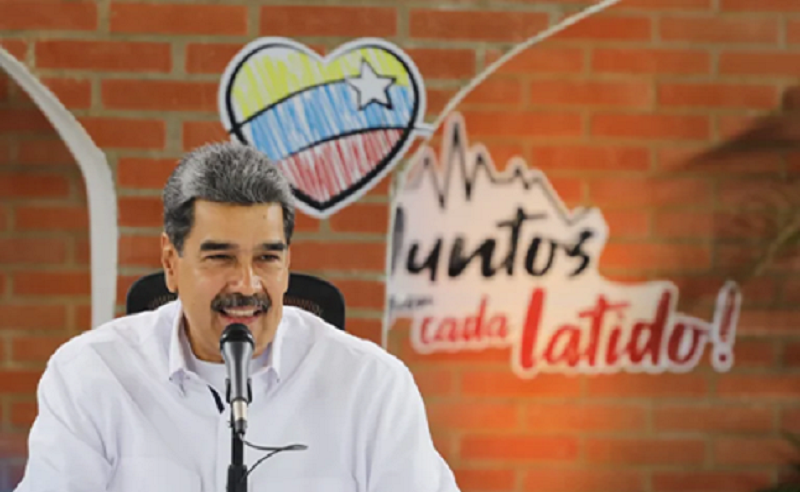
Venezuelan President Nicolás Maduro and his wife, Deputy Cilia Flores, made a new call this Easter Sunday for unity, dialogue, and reconciliation in Venezuela, in a message published on social media, three months after their capture by US troops.
“This Resurrection Sunday is to say forcefully that this is the victory of life and truth. Death does not win: Christ wins. Lies do not win, truth wins. Hatred does not win, love wins,” Maduro and Flores said in their message published on the X and Telegram accounts of the president, who is being held captive by the United States.
The message makes multiple biblical references alluding to the resurrection of Jesus on this Easter Sunday. President Maduro asked Jesus Christ to bless Venezuela and the peoples of the world and fill them with faith, love, and hope. On March 28, Maduro and Flores called for peace and national unity, while assuring that they were “firm” and serene” in a message published two days after their trial hearing in New York, and which constituted the first message since they were captured in Caracas last January.
VENEZUELAN ACTING PRESIDENT WELCOMES U.S. LIFTS OFAC SANCTIONS
Acting President Delcy Rodríguez valued the decision as a step towards normalization of relations and the lifting of sanctions on Venezuela.
The United States Treasury Department’s Office of Foreign Assets Control (OFAC) officially removed Venezuela’s Acting President Delcy Rodríguez from its Specially Designated Nationals and Blocked Persons (SDN) List this Wednesday, April 1st.
Delcy Rodríguez, communicating via her Telegram channel, hailed the decision as a crucial step towards the normalization of relations between the two countries. The Venezuelan Acting President also expressed confidence that this development will facilitate the broader lifting of existing unilateral sanctions against Venezuela to build an effective binational cooperation agenda. This move signifies a notable shift in U.S. policy toward the Bolivarian Nation, aiming to open avenues for renewed engagement after years of economic sanctions, amid a significant geopolitical tension in the Latin American region.
The U.S. agency formally announced the delisting in an official statement, confirming the immediate lifting of all associated financial restrictions on Delcy Rodríguez. This action effectively eliminates prohibitions for U.S. entities to conduct transactions with Acting President Rodríguez and unblocks any assets under U.S. jurisdiction that were previously frozen.
This announcement closely follows the comprehensive re-establishment of diplomatic and consular relations between the United States and Venezuela on last March 5, which represented a significant reversal on diplomatic relations between both countries.
VENEZUELA BOOSTS SCIENCE SOVEREIGNTY WITH ROBOTIC EDUCATION
Venezuela announced new science classrooms and robotic education this Tuesday, to strengthen scientific sovereignty for technical independence and productive development across the nation. The Government of Venezuela is actively strengthening its scientific sovereignty through a comprehensive deployment of 500 nuclei and 600 science classrooms, as announced by Minister for Science and Technology Gabriela Jiménez on April 1st.
These crucial technological infrastructures, strategically situated within communal circuits and Infocenters across Venezuela, are designed to establish the foundational pillars for the nation’s productive development and its technical independence. The initiative highlights a strong commitment to fostering local expertise and reducing reliance on foreign technological control, a core tenet of Venezuelan policy.
Minister Jiménez elaborated that six specialized didactic centers are currently operational in the states of Miranda, La Guaira, Yaracuy, Aragua and Carabobo. These state-of-the-art facilities cater to a substantial population of over 56,000 children, offering advanced instructional methods in electronics and computer science. This widespread educational effort aims to cultivate a new generation of scientists and innovators, ensuring that scientific knowledge is deeply embedded within the social fabric from its very foundations. The focus on practical, hands-on learning is designed to equip young Venezuelans with essential skills for future technological advancement.
DELCY CALLED FOR NATIONAL UNITY AND PEACE ON EASTER SUNDAY
“On this Easter Sunday, I join in the deep feelings of the Venezuelan people, who celebrate the Son of God as a symbol of life, redemption, and hope,” expressed the acting president. “It is a time for reflection and renewal of spirituality; hoping that in that faith we will reunite in lasting peace as a guide to continue advancing in national unity for our Venezuela,” said acting president Delcy Rodríguez this Easter Sunday.
The message was conveyed by the acting head of state through a post on her Telegram channel. “On this Easter Sunday, I join in the deep feelings of the Venezuelan people, who celebrate the Son of God as a symbol of life, redemption, and hope.”
VENEZUELAN NAVAL TRAINING SHIP ARRIVES IN GRENADA WITH MESSAGE OF COOPERATION & PEACE
The Simón Bolívar Training Ship of the Bolivarian Navy arrived in Saint George, Grenada, on its journey across the seas to its first destination of the 36th Foreign Instructional Cruise titled “Seas of Unity for the Dream of Bolívar 2026.”
The Venezuelan Ministry of Defense reported that the event on Wednesday, April 1, was marked by unity, solidarity, and joint work aboard the ship Ambassador Without Borders, which was visited by a diplomatic representation from Grenada.
The reception was hosted by the ambassador of the Bolivarian Republic of Venezuela to Grenada, Jorge Alfonso Guerrero Veloz, who welcomed the crew. During the meeting, activities were carried out that reflected the commitment to integration among the Caribbean peoples and the Bolivarian Diplomacy of Peace.
During its stay, the BE-11 ship will open its doors to the people of Grenada, so that they can experience life on board, naval technology, and the unwavering spirit of Venezuelan sailors, who bring their message of peace and brotherhood. The ship set sail on March 21 from La Guaira port on its training cruise. It will visit five Caribbean countries: Grenada, Dominica, Saint Kitts and Nevis, Mexico, and Cuba.
DEFENDING VENEZUELA: THE PROBLEMS WITH ‘BREST-LITOVSK’ AND COSMOPOLITANISM
The debates about Venezuela on the left today leave a great deal to be desired in many respects. However, one of the most symptomatic pitfalls, in my view, has been the excessive focus on the question of whether Delcy Rodríguez’s government, in the wake of the January 3 attacks, has made a tactical retreat of the Brest-Litovsk type or not. In these debates, “Brest-Litovsk” has become a kind of shorthand. It refers to V. I. Lenin’s decision, in the months immediately following the October Revolution, to make a separate peace with Germany that involved ample concessions, doing so as a way to save the revolution.
For many, this historical example is taken as the model of correct revolutionary decision-making from the Venezuelan leadership. For this group, Lenin’s decision serves to justify the concessions that Rodríguez has made under duress to US imperialism, as a means for guaranteeing the revolution’s survival and buying time.
By contrast, there is a second group that is skeptical. They claim that a tactical retreat of the Brest-Litovsk kind is impossible in Venezuela, allegedly because there is no strategic vision or the concessions are too substantial. Instead of a retreat, they believe there has been capitulation.
One symptomatic feature of this debate is how both groups’ excessive focus on the Brest-Litovsk dilemma—which centers on the question simply of whether to fight or make a tactical retreat—erroneously compares Venezuela today, which is a relatively longstanding revolutionary process, to the Russian situation just four months after the October Revolution had taken place. The Russian Revolution was glorious and extraordinary (arguably it was the most important event of the twentieth century), but it was just getting going at the time of the Brest-Litovsk Treaty.
Thus, the focus on Brest-Litovsk amounts to a failure to accurately locate the historical moment, and it effectively denies that the Bolivarian Revolution has had substantial material and organizational achievements over the past quarter of a century. On a theoretical level, we see how focusing the debate on a “Brest-Litovsk moment” completely sidelines Hugo Chávez’s claims about the revolutionary “irreversibility” that had been achieved over the course of the revolution.
53,9% OF SCIENTISTS IN THE COUNTRY ARE WOMEN
In an effort to map the country’s intellectual and technical potential, the Government has launched the National Research and Development (R&D) Data Collection Campaign 2025, which will run until April 24. This initiative, led by the National Observatory of Science, Technology and Innovation (ONCTI) through the Ministry of Science and Technology, not only seeks to quantify technical resources, but also to answer the fundamental questions that define the sector’s identity: Why is science done in Venezuela? Who are the protagonists of these discoveries? From what geographical and academic spaces is knowledge produced? And how much is actually invested in this strategic engine?
Deployment of the sciences
The campaign is envisioned as a pillar for technological sovereignty, allowing the State to make decisions based on rigorous and up-to-date evidence. Roberto Betancourt, president of Oncti, highlights that this deployment has the active work of more than one hundred men and women committed to the systematization of knowledge.
“The goal is to strengthen the national science system by following the guidelines of the Caracas Manual, a technical reference document that establishes the parameters for measuring scientific activities with local relevance,” he said. This effort is based on an institutional trajectory that began with the creation of Oncti in 2001 and finds its legal support in the Organic Law of Science, Technology and Innovation.
APOSTOLIC NUNCIO CALLS FOR RECONCILIATION AND TO BE BUILDERS OF PEACE
During the celebration of the Resurrection of the Lord and the traditional blessing of the sea in La Guaira, the Apostolic Nuncio to Venezuela, Monsignor Alberto Ortega Martín, gave a statement conveying Pope Leo XIV’s message of hope, peace, and reconciliation for this Easter, while also referring to the role of the Venezuelan Church in the current process of reinstitutionalization of the country. “I am pleased to bring the greetings, the closeness and the blessing of Pope Leo XIV on this Easter day, on which he has left us a message of hope, the victory of Christ, the victory of good over evil, of life over death, of love over hate,” the Vatican representative said.
The role of the Church in the face of reinstitutionalization in Venezuela
When asked about the role the Catholic Church will play in the reinstitutionalization process that Venezuela is experiencing after the events of January 3, the nuncio stated that the ecclesial institution supports “all good initiatives” and must be a “sacrament of unity”.
“I believe that a very important mission of the Church now, and at all times, but in a very special way, is to be a sign of unity, to be a bridge, to build bridges, to promote that unity, that dialogue, that collaboration that are so necessary,” he said. He also pointed out that, in contexts of difficulties and wars worldwide, the Church must be an “instrument of hope,” recalling that “the last word does not belong to difficulties, but to love, mercy and victory.”
The nuncio concluded his speech by invoking the figure of Saint Francis of Assisi, in the jubilee year of the 800th anniversary of his death, and urged the faithful to be “instruments of peace”, to care for creation and to live as “close brothers who build together something greater and more beautiful for all”.