

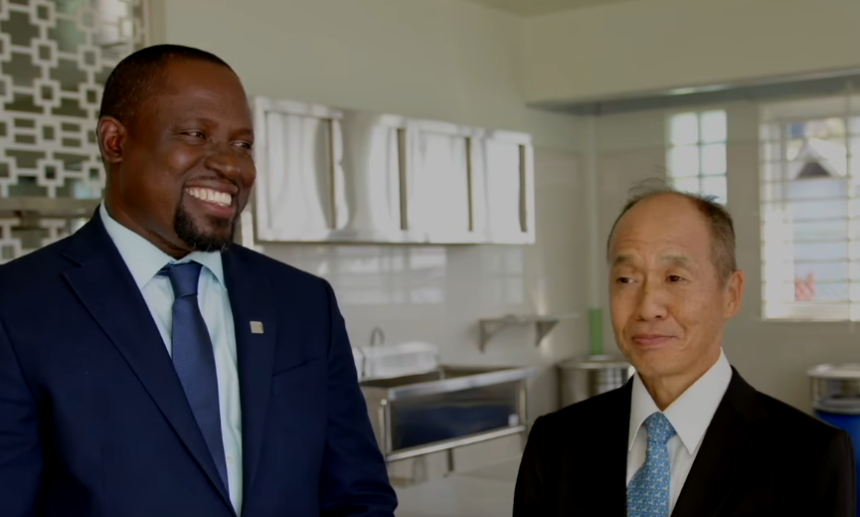
Highlighting a 44-year legacy of diplomatic excellence, His Excellency Dr. Akima Umezawa, Japanese Ambassador to St. Vincent and the Grenadines, was hosted by the Honorable Conroy Huggins, Minister of Fisheries, for a strategic site visit to the Barrouallie Blackfish processing facility.
The high-level tour serves as a pivotal milestone in the modernization of the nation’s traditional maritime industries and the deepening of international cooperation. During the inspection, Ambassador Umezawa lauded the facility’s operational management and specifically commended the “lady team” spearheading production, framing their leadership as a model for gender-inclusive industrialization within the burgeoning Blue Economy.
This visit contextualizes the Barrouallie project within a profound historical narrative of bilateral success. Since 1980, the Government of Japan has been a foundational architect of the Vincentian maritime landscape, facilitating the establishment of over eight major fishing complexes across the archipelago.
The 44-year consistency acts as a critical “de-risking” factor, validating the current revitalization not as an isolated aid project, but as a proven model of sustainable infrastructure maintenance. The ongoing partnership ensures that the Barrouallie facility is positioned to meet 21st-century standards while remaining anchored in the community’s ancestral heritage.
The transition of the Barrouallie facility from informal processing to a formalized industrial standard is a strategic imperative for food safety and market expansion. By centralizing operations, the government is transforming local tradition into a high-value trade sector. The facility’s design facilitates an end-to-end production lifecycle, ensuring that the legendary Blackfish industry moves toward eventual export readiness through rigorous sanitary protocols.
Strategic Technical Capabilities:
Specialized Bottling Suite: A dedicated environment for the precision packaging of extracted oils.
Industrial Vacuum-Sealing: Advanced technology to preserve dried meat, extending shelf life for broader distribution.
Climate-Controlled Storage: Secure on-site lockers designed to eliminate post-harvest loss and manage inventory.
Integrated Retail Hub: An on-site shop providing a direct-to-consumer point of sale for both domestic and tourism markets.
By housing processors and vendors in a centralized, state-of-the-art environment, the facility serves as a catalyst for socio-economic empowerment, preserving cultural customs while meeting international health standards.
While the facility’s interior is complete, the strategic priority has shifted toward climate resilience following the impacts of Hurricane Beryl in July 2024. The severe wave action compromised the yard’s sea defenses, necessitating a comprehensive “rework” currently being executed by Sea Operations. Far from a setback, the government has framed this as a renewed mandate for national resilience. Minister Huggins has reaffirmed a strict commitment to the 2026 completion deadline, demonstrating that the restoration of the Blackfish industry remains a top-tier national priority despite environmental challenges.
The revitalization of Barrouallie aligns with the Prime Minister’s vision for a total “transformation of the economy.” This is evidenced by the historic administrative elevation of Fisheries from a departmental unit of Agriculture to a standalone Ministry.
This institutional shift recognizes the Blue Economy as a primary pillar of the nation’s GDP. By decoupling Fisheries from broader agriculture, the government ensures that maritime resources receive the sustained political focus and financial appropriation required to move the sector from subsistence to a robust, income-generating pillar of the national economy.
The Japan-SVG partnership is expanding into a multi-dimensional alliance that integrates environmental innovation with vibrant cultural exchange. Beyond infrastructure, the two nations are collaborating on cutting-edge waste management and cultural soft power initiatives:
Advanced Sargassum Management: A comprehensive equipment suite including specialized trucks, boats, rakes, and Sargassum fences provided via the UNDP to protect the coastline.
Bio-Economic Next Phase: A forthcoming initiative focused on the “bio-action” of maritime waste, converting Sargassum and processing by-products into organic fertilizer.
Vibrant Cultural Exchange: A commitment from the Japanese Embassy to increase cultural events in SVG, fostering ties between the youth of both nations.
This partnership celebrates the unique cultural texture of Barrouallie—from the traditional “Fish Fest” to the local staples of Cocoa Tea, Roasted Breadfruit, and Blackfish Crisps—ensuring that economic growth is accompanied by a celebration of national identity.
“The project is the realization of a vision we have championed since 2004. It is a pillar for development that reflects the very heart of the Barrouallie community. By providing a facility where our processors and vendors can operate in sanitary, world-class conditions, we are preserving our customs while securing a prosperous future for our people.” — Honorable Conroy Huggins, Minister of Fisheries