

What is this Case About?
At its core, this legal challenge explores a fundamental question of democratic governance: Who is constitutionally eligible to represent the people in a national parliament? This case centers on whether two specific government officials may legally retain their parliamentary seats or if their dual citizenship status creates a disqualifying conflict of interest under the supreme law of the land.
For students of constitutional law, this case is a vital test of eligibility and the concept of “allegiance.” It forces the Court to weigh the finality of election results against the principle of constitutional supremacy. The case is therefore not just a political dispute; it is a real-world examination of how a nation protects its sovereignty by ensuring that those who wield legislative power are not bound by formal ties to a foreign power—in this instance, Canada.
To understand the mechanics of this challenge, we must first examine the specific constitutional provision that serves as the “ground truth” for the proceedings.
Section 26(1)(a)
The entire case rests upon the interpretation of a single, decisive clause within the Constitution of Saint Vincent and the Grenadines.
“No person shall be qualified to be elected or appointed as a Representative or Senator if he—
(a) is, by virtue of his own act, under any acknowledgement of allegiance, obedience, or adherence to a foreign power or state.” — Section 26(1)(a) of the Constitution of Saint Vincent and the Grenadines
“Simple Meaning”
For the legal scholar, the phrase “by virtue of his own act” is the pivot upon which this case turns. This language distinguishes between citizenship acquired passively (such as by birth or descent) and citizenship acquired through a voluntary, intentional step taken by an adult, such as naturalization or the taking of an oath.
Because the Respondents have acknowledged their Canadian citizenship, the Court must determine if the process of obtaining that status constitutes a voluntary “acknowledgment of allegiance” that triggers constitutional disqualification.
Who is Who in Court?
The following parties are the central figures in the proceedings currently being heard by the High Court.
| Role | Name(s) | Key Context (Constituency/Status) |
|---|---|---|
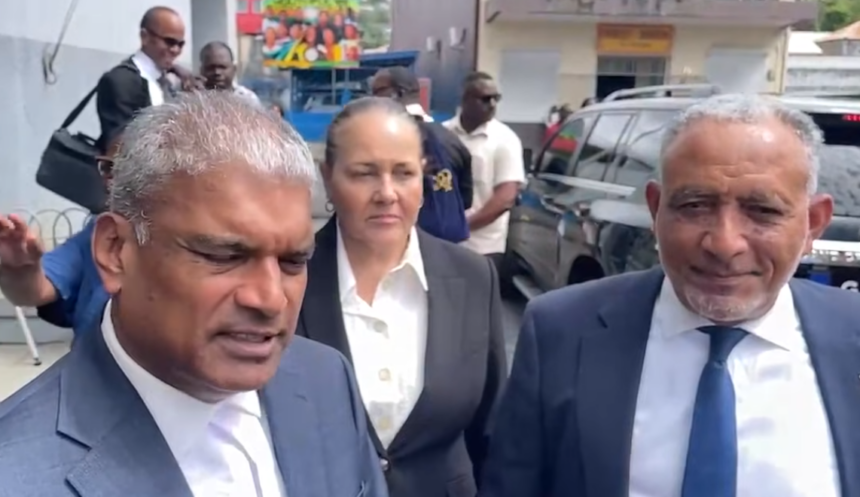
| Respondents | Dwight Fitzgerald Bramble | Representative for Northern Grenadines; acknowledged Canadian citizen. |
| Respondents | Lorraine Godwin Friday | Representative for East Kingstown; acknowledged Canadian citizen. |
| The Petitioners | (Luke Browne -Carlos Williams | Both challenging the legal qualifications of the Respondents to hold office. |
| The Judge | High Court Justice (Ag.) Gertel Thom | The Judge overseeing the matter within the High Court’s jurisdiction. |
The Legal Teams
The significance of this constitutional matter is shown by the involvement of “Senior Counsel” (SC) and international practitioners, highlighting the gravity of the Eastern Caribbean Supreme Court’s deliberations.
| Legal Team for the Petitioners | Legal Team for the Respondents |
|---|---|
| Stewart Richard Young, SC (Senior Counsel) | Kate Quincy Temple–Mabe (England) |
| Al Elliott (A. C. Elliott Attorneys) | Anand Ramlogan S.C. (Trinidad and Tobago) |
| Carlos James (Carlos James Law Chambers) | Vishal Siewsaran (Trinidad and Tobago) |
| Ganesh Saroop (Trinidad and Tobago) |
The international nature of the defense team—incorporating experts from both England and Trinidad and Tobago—underscores that the interpretation of “allegiance” in a Commonwealth context carries weight far beyond the local jurisdiction.
Timeline of Events
Tracing the timeline of this case allows us to see the progression from the democratic exercise of voting to the judicial scrutiny of the results.
November 27th, 2025: General Elections The Respondents are returned as Representatives for the constituencies of Northern Grenadines and East Kingstown respectively.
Present Day: Commencement of Proceedings Legal proceedings officially begin today before the Eastern Caribbean Supreme Court in Saint Vincent and the Grenadines to resolve the eligibility petitions.
Disclosure: Application was made for disclosure of declarations made by the Respondents in Forms 2 and 3 of the House of Assembly Election Rules, on or before the 12th March 2026. The supervisor of the elections to comply.
Petitioners to file additional evidence by 27th March 2026
Respondents to respond to the Petitioner’s additional evidence by 11th May 2026
Further Case Management set for 19th May
July 28, 29, 30, 2026: Scheduled Trial Dates The Court has reserved these three consecutive days for the formal hearing of the petitions, where final evidence and arguments will be weighed.