

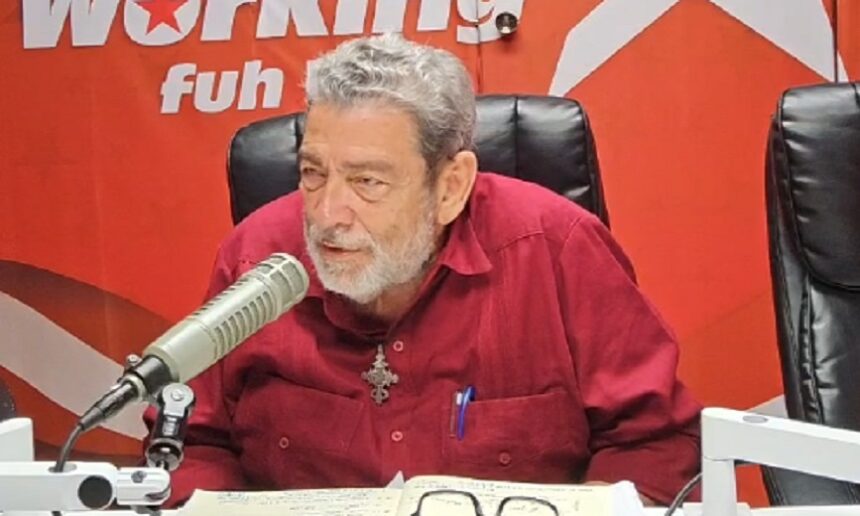
Opposition leader Ralph Gonsalves last week expressed a firm policy stance regarding the necessity of borrowing during national crises, famously stating that if he had to choose between “debt and death,” he would choose debt.
Gonsalves used this phrase to justify the the former government’s fiscal decisions in the wake of significant challenges, including the COVID-19 pandemic, the volcanic eruption of La Soufrière, and Hurricane Beryl. He argued that borrowing was essential to protect the lives and well-being of the population during these “unprecedented” disasters.
The former prime minister maintained that the national debt is manageable, provided it is supported by a growing economy. He pointed out that while the debt was reported at approximately $3.4 billion, the country’s Gross Domestic Product (GDP) had grown significantly from under $800 million in 2001 to nearly $3.5 billion by the end of 2024.
He noted that the International Monetary Fund (IMF) had placed the country on a path to bring the debt-to-GDP ratio down to between 60% and 65% by 2035, assuming the country avoided further major disasters.
Gonsalves criticised the New Democratic Party (NDP) for their stated reluctance to borrow money. He argued that without significant capital projects—which often require borrowing—the country would fail to create wealth and jobs, suggesting the NDP would be running the country “on fumes” rather than the “gasoline” of economic growth.
He defended his administration’s record by stating that St. Vincent and the Grenadines was the only Caribbean country in the 21st century that never went on an IMF programme, never sold passports, and never defaulted on its bills or salaries.
Gonsalves views debt not as an inherent failure, but as a necessary tool for survival and reconstruction in the face of natural and global catastrophes, provided it is balanced against long-term economic growth