

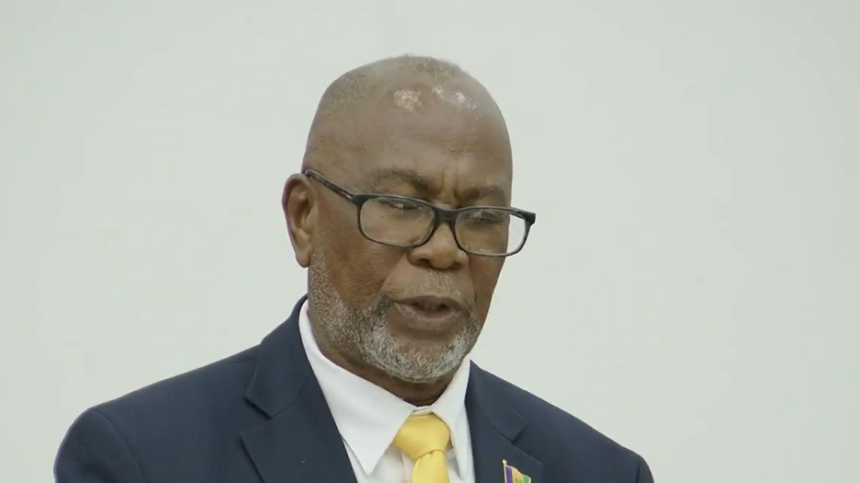
In a heated legislative debate over the National Security Bill, Deputy Prime Minister and Minister of National Security Leacock levelled serious allegations against the former administration, claiming they engaged in the surveillance of private citizens and political opponents.
Addressing the House, Leacock revealed that since assuming his role as Minister of National Security, he has been disturbed by the nature of the intelligence reports crossing his desk. He questioned whether this was the same kind of “intelligence and information” that the former Prime Minister maintained on him, his political party, and private citizens during his tenure.
Leacock accused the former leader of presiding over national institutions for 25 years that allowed a vast array of private information to be funnelled directly to the Prime Minister’s desk. He suggested that decisions regarding this information were often made based on “partisan political benefits” rather than legitimate national security interests or state concerns.
Leacock further characterised the former administration’s handle on intelligence as “proprietary knowledge,” comparing the former leader to an “abusive parent” who held the country to ransom by “retailing” or “wholesaling” sensitive information whenever it was politically warranted. He claimed the former leader acted as the “sole arbiter” of how this information was used to maintain control over the nation.
The allegations sparked sharp push back from Ralph Gonsalves, the Leader of the Opposition, who rose on multiple points of order to dismiss the remarks as “personal abuse” and “entire falsehoods”. Gonsalves argued that the Minister’s comments were irrelevant to the bill under discussion and accused Leacock of misleading the House.
During the debate, Gonsalves defended his administration against Leacock’s surveillance claims primarily by raising multiple points of order to challenge the validity and relevance of the allegations.
Gonsalves’ defense included the following arguments:
- Categorical Denial of Falsehoods: Gonsalves explicitly labelled Leacock’s accusations as “entire falsehoods” and stated that the claims were “completely false”. He argued that such “falsehoods” should not serve as the basis for a legislative debate.
- Allegations of Personal Abuse: He characterized Leacock’s speech as “personal abuse” and questioned what “10 minutes [of] personal abuse” had to do with the National Security Bill under discussion.
- Accusations of Misleading the House: Gonsalves repeatedly stated that the Minister was “misleading the house”. For instance, when Leacock suggested Gonsalves had “badmouthed” the CARICOM Implementation Agency for Crime and Security (IMPACS), Gonsalves countered that he had actually “spoke proudly about impacts”.
- Focus on Legislative Technicalities: To defend against the portrayal of his administration as “ramshackle” or obstructionist, Gonsalves attempted to refocus the debate on the legal mechanics of the bill, such as the distinction between a bill receiving “normal ascent” versus requiring a specific “proclamation” to come into effect.
Throughout the exchange, Gonsalves maintained that the Minister’s focus on his past 25 years in power was a “question of relevance” and an attempt to use the House as an occasion for personal attacks rather than a serious debate.
Leacock countered by asserting that the public needs to understand “who and what we are dealing with,” arguing that the former administration left behind a “ramshackle security apparatus”. He claimed that under the previous government, even the police complained about their inability to access information through existing screening mechanisms, despite the former leader’s claims of a functioning system.
