
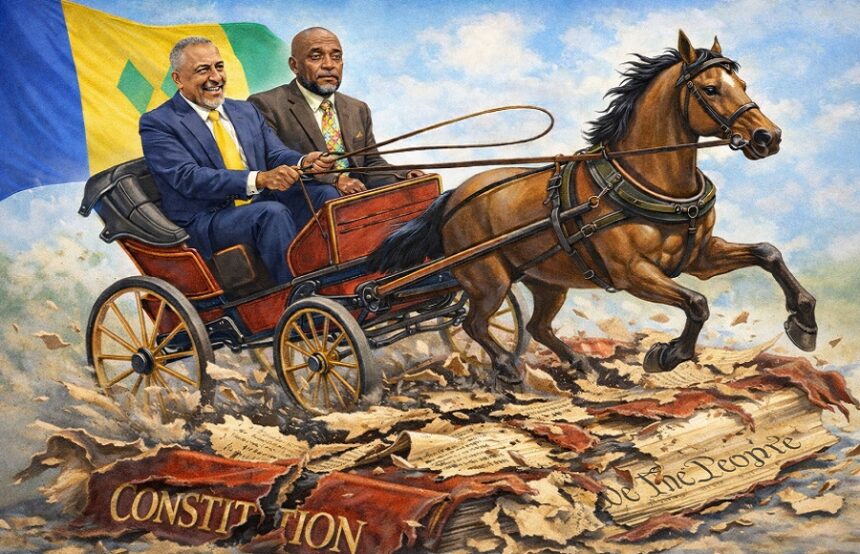
The newly elected government of St. Vincent and the Grenadines has introduced a controversial constitutional amendment aimed at redefining the legal meaning of a “foreign power” and retroactively protecting sitting members of parliament who are currently facing legal challenges over dual citizenship.
Less than five months into its term, the New Democratic Party (NDP) government scheduled a parliamentary vote on an act to amend the 1979 Constitution, as well as an amendment to the Representation of the People Act. The bills were quietly introduced into a parliamentary package without prior public notice, consultation, or explanation from the Prime Minister or the Attorney General.
The legislative move directly intersects with an ongoing court case stemming from the 2025 elections. Prior to the vote, the opposition Unity Labour Party (ULP) warned that it would challenge the candidacies of current Prime Minister Godwin Friday and Minister Fitzgerald Bramble. The ULP argued that holding valid Canadian passports placed the men under allegiance to a foreign power, rendering them constitutionally ineligible to run for office. Following the election, the ULP filed an election petition to seek legal clarification from the courts on this dual-citizenship provision.
The proposed constitutional amendment introduces two major changes to bypass this legal hurdle. First, it explicitly alters the definition of “foreign power or state” to exclude any member of the Commonwealth. Under this new definition, the other 55 nations in the Commonwealth—including Canada, the United Kingdom, and Australia—would no longer be classified as foreign countries within the context of St. Vincent and the Grenadine’s constitution.
Second, the amendment contains a “savings clause” designed to apply the new rules retroactively. The clause dictates that no nomination or election shall be rendered invalid at any time since the commencement of the Constitution in 1979 simply because a candidate held allegiance to a Commonwealth country.
Initially, Prime Minister Friday had publicly dismissed the ULP’s legal challenge as a “frivolous” waste of time and an abuse of the court’s process.
However, critics argue that the sudden introduction of these retroactive bills suggests the government recognized a genuine risk of losing the court case, prompting them to rewrite the supreme law of the land to legally guarantee their electoral victories before a judge could issue a ruling.