

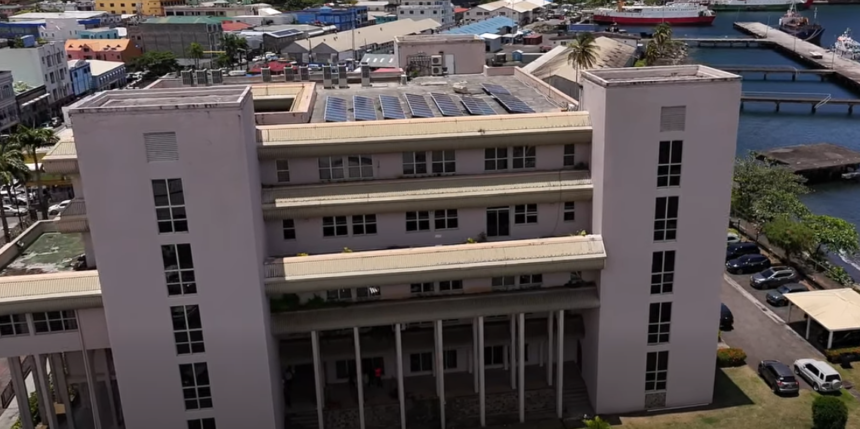
Vincentians Urged to Follow Govt’s Lead on Solar Energy
As global oil prices continue to fluctuate, St. Vincent and the Grenadines is taking aggressive steps to modernize its infrastructure, significantly reducing electricity consumption at key government facilities through advanced LED retrofitting and solar energy initiatives.
The Financial Complex in Kingstown is currently undergoing a massive energy efficiency transformation led by the Once in Vincent Group (OSV). Kensley Ward, representing OSV, revealed that the building has successfully replaced 486 interior light fixtures.
The upgrade involved swapping out old 2×4-foot fluorescent fixtures which previously pulled roughly 128 watts each with high-efficiency LED retrofit panels. These new panels pull a maximum of 50 watts, but many have been “tuned down” to just 20 watts depending on the light density required for the area.
The impact on the government’s bottom line has been immediate. “We’ve noticed between 5,000 to 8,000 units [kWh] of power reduction since we changed out those lights,” Ward stated, noting that the project will soon move to retrofitting exterior lighting to ensure the facility is as efficient as possible.
The energy revolution isn’t just for government buildings. Ward encourages Vincentians to combat rising electricity bills by switching to LED technology at home. He specifically recommends integrated LED panel lights over individual LED bulbs, as panels are often more efficient.
Furthermore, he highlighted the growing popularity of solar-powered exterior lighting. “You don’t have to run wire to it. You don’t have to pull electricity. It works for you 365 days,” Ward explained, noting that such products are now readily available across St. Vincent.
The push for sustainability extends to the seas, specifically at the St. Vincent and the Grenadines Coast Guard base. Lieutenant Commander Ununas Hamlet detailed the facility’s staggering energy requirements, particularly when the vessel Captain Hugh Mulzac is docked.
When the ship is hooked up to “shore power” at the base, the monthly electricity bill can soar to approximately $29,000. When the vessel is on patrol for extended periods, that bill drops significantly to around $17,000.
To mitigate these costs, the Energy Unit, in partnership with the Caribbean Development Bank (CDB), has begun installing solar panels on the base’s roof. Hamlet expressed high hopes for the project’s completion, noting that the savings could allow the Coast Guard to improve its administrative facilities such as upgrading offices from fans to air conditioning while continuing their critical, life-saving missions.
“The sooner it happens, it would be better for the Coast Guard,” Hamlet said. “If we can get that reduction, then that could go a long way to… save the amount of monies that is spent monthly on energy consumption”.