

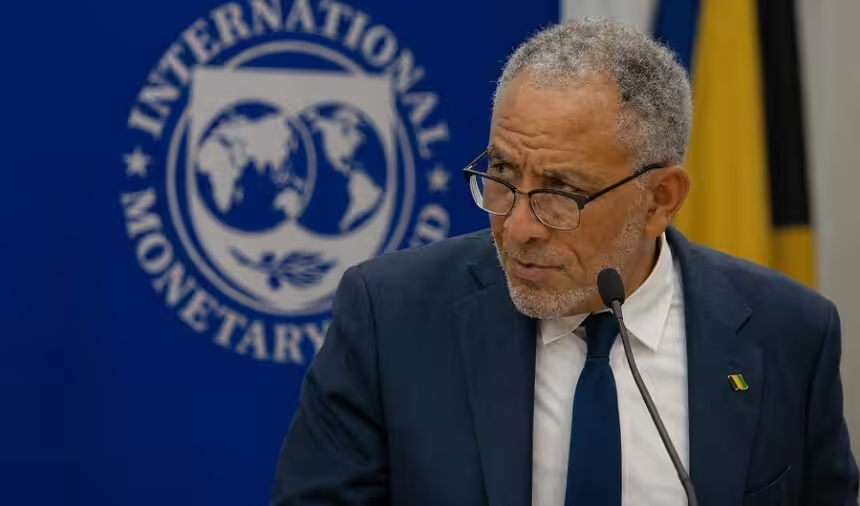
Prime Minister Godwin Friday returned from the IMF and World Bank spring meetings in Washington with a message of “camaraderie” and “goodwill”. But for the keen-eyed observer, what Friday reported to parliament is a roadmap for significant economic tightening that will touch every Vincentian household.
While the word “austerity” never crossed the Prime Minister’s lips, the “expenditure rationalisation” and “fiscal consolidation” he described are essentially the same thing, the government is preparing to spend less and collect more.

The Prime Minister didn’t sugarcoat the gravity of the nation’s debt, even if he used a soft touch for the solution. He noted that the IMF and World Bank have confirmed the nation’s debt trajectory is “unsustainable under the baseline,” warning that without intervention, public debt could balloon from 113% of GDP to 145% in the medium term.
To fix this, the IMF has recommended a staggering “cumulative improvement in the primary balance of approximately 11 percentage points of GDP over a three-year period”. In plain English, the government needs to find a way to swing its finances by a massive margin effectively moving from deep deficits to a 3% surplus. Doing that in three years is the economic equivalent of a crash diet.
One of the most direct forms of austerity involves the public workforce. Rather than announcing mass layoffs, the Prime Minister spoke of addressing “wage bill pressures” through “natural attrition and disciplined hiring practices”.
When a public servant retires or leaves their job, the position likely won’t be filled. For the ordinary man, this means fewer people at government desks to provide services and a tighter job market for young graduates hoping to enter the civil service. By calling it “natural,” the government avoids the political fallout of firing people while still achieving the same goal, that is to shrink the public workforce to save money.
The Prime Minister was careful to say the strategy emphasizes “base broadening rather than tax rate increases”. While “no new taxes” sounds like good news, “base broadening” means the government is coming for money that previously went uncollected.
He specifically pointed to property tax compliance, which is currently at a “mere 20%”. He also spoke to a tightening of the Value Added Tax (VAT) by “rationalising exemptions” and “expanding coverage to digital and cross-border services”.
Vincentians might not see a higher percentage on their bill, but they will likely find themselves paying VAT on things that were previously exempt, and if you haven’t been paying your property taxes, the government is about to use “digital tools and emerging AI” to find you.
Austerity will also hit the nation’s infrastructure plans. The Prime Minister announced that capital spending money used for building and development will be reduced to around 5% of GDP.
He stated that spending would be “focused exclusively on projects with clear growth, resilience or climate adaptation returns”. While this sounds responsible, it means many local community projects or secondary infrastructure works that don’t meet these strict international criteria will likely be shelved or “re-prioritised” out of existence.
Perhaps the most clever rhetorical move was announcing these measures as a “credible rules-based homegrown reform program”. By calling it “homegrown,” the government has attempted to make Vincentians believe that these aren’t “orders” from the IMF, but a local choice.
However, the Prime Minister admitted the program involves “statutory backing for a fiscal responsibility resilience framework” and the formal establishment of an oversight committee. This essentially locks the government into these austerity measures by law, making it much harder for future budgets to increase spending, even if the public demands it.
The Prime Minister’s report was a masterclass in “soft-peddling” a bitter economic pill. He spoke of a “trusted partner model” with the IMF that is sensitive to “political economy constraints” which is code for “the IMF knows we can’t cut too fast without causing an uprising”.
But make no mistake, Vincentians must realise that with a mandate to reduce the deficit by 11% of GDP, the era of government-led expansion is pausing. Between “disciplined hiring,” “rationalised” VAT, and a push for 100% property tax compliance, the nation is entering a period of belt-tightening that will be felt long after the “warmth” of the Washington meetings has faded.