


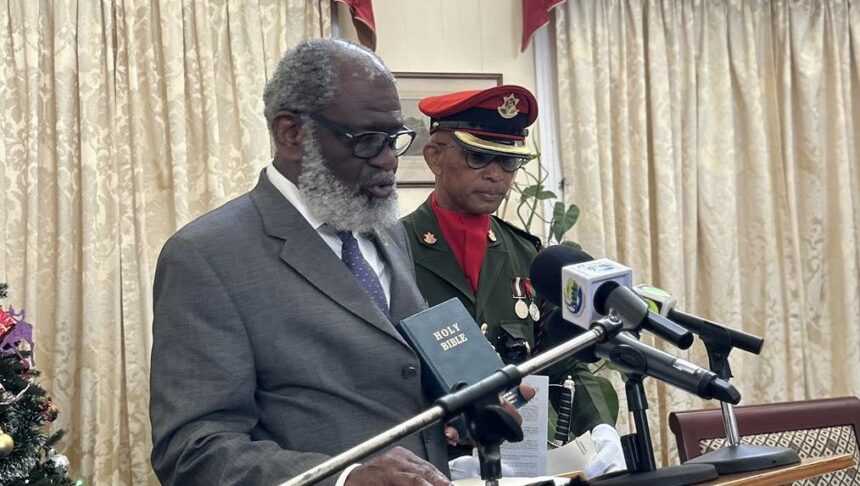
His Excellency Stanley Kendrick “Starky” John KC in his inaugural remarks as the new Governor General of St. Vincent and the Grenadines gave a technical explanation of his constitutional role and a vision for national reconciliation following a period of political transition.
John grounded his remarks in the legal foundations of the state, citing Chapter 2 of the Constitution, which establishes the Governor General as his Majesty’s representative and a symbol of national unity, continuity, and constitutional governance.
H.E John clarified that while executive authority is vested in the Crown, it is primarily exercised on the advice of the Prime Minister and Cabinet. He noted that the Governor General only acts on “deliberate judgment” in rare, exceptional circumstances. He highlighted the Governor General’s role in the legislative process, specifically the requirement to assent to bills passed by the House of Assembly before they can become law.
G.G John described the doctrine of the separation of powers—between the executive, legislative, and judiciary—as a “core principle” designed to prevent the inordinate concentration of power and protect individual rights.
A central theme of the speech was the need to move beyond “political tribalism” and partisan rivalries. John observed a pervasive mood among Vincentians, both at home and in the diaspora, who are “tired of the focus parties” and desire a “healing of our nation”. He described the nation as a “societal kaleidoscope” where diverse origins converge into a single identity.
The G.G acknowledged the mandate given to the new administration under Prime Minister Dr. Godwin Friday, urging the government to be “committed patriots” who foster a government for all the people and also addressed the importance of a “loyal opposition,” tasking them to keep the government alert to its obligations within the traditions of Westminster-style democracy.
John reaffirmed the values set forth in the Preamble of the Constitution, including the supremacy of God, freedom, dignity, and social justice. He argued that the state must be an “active positive agent” in directing community affairs, particularly to ensure that the “mass of poor and the vulnerable” benefit from national progress and scientific resources. He pledged to protect fundamental rights—such as life, liberty, and freedom of expression—regardless of race, creed, or political opinion.
The Governor General expressed his humility and gratitude to the Prime Minister for his nomination.