

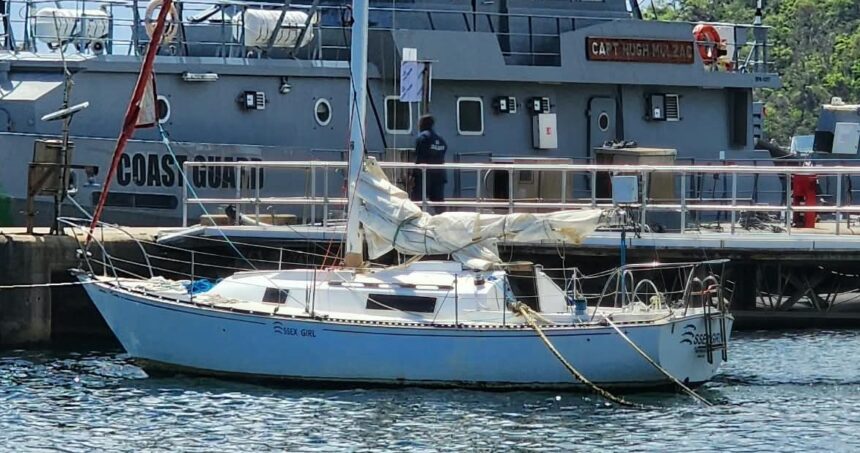
Law enforcement officials from the Royal St. Vincent and the Grenadines Police Force (RSVGPF) have provided key clarifications regarding a recent major narcotics operation in the Grenadines, which resulted in the recovery of 95 kilograms of cocaine.
Police confirmed that three individuals were initially taken into custody to assist investigators following the drug discovery. However, none of the detained suspects were formally charged.
It is understood that the St. Vincent and the Grenadines Coast Guard intercepted a yacht named M.V Essex Girl off Jambus beach, Canouan Island. The vessel was reportedly carrying an estimated 80 to 90 pounds of cocaine, when St Vincent Times reported the matter earlier in the week.
Police executives explained that criminal charges require evidence meeting the strict legal standard of proof beyond reasonable doubt. Officials emphasized that law enforcement cannot bring individuals before the court based on “mere suspicion” alone without hard, verifiable evidence. Consequently, without sufficient evidence to cross that legal threshold, the individuals could not be held or charged.
Despite the release of the suspects, police underscored the operation as a critical victory for public safety. Officials assured the nation that the confiscated 95 kilograms of cocaine will not reach the streets of St. Vincent and the Grenadines to inflict harm on citizens.
While the St Vincent Times had reported that Trinidadians and Vincentians were arrested, the police did not state or reveal the nationalities of the three individuals who were taken into custody and subsequently released.
Police acknowledged that St. Vincent and the Grenadines does not cultivate or manufacture cocaine, meaning all illegal narcotics enter the country via air or sea routes.
To counter maritime smuggling across the nation’s porous borders, the RSVGPF Coast Guard continues active sea patrols in close coordination with the Regional Security System (RSS) and other regional intelligence agencies. Additionally, new assets allocated at local ports for scanning containerized cargo are expected to bolster efforts in intercepting illegal drugs and weapons before they enter domestic supply chains.
