

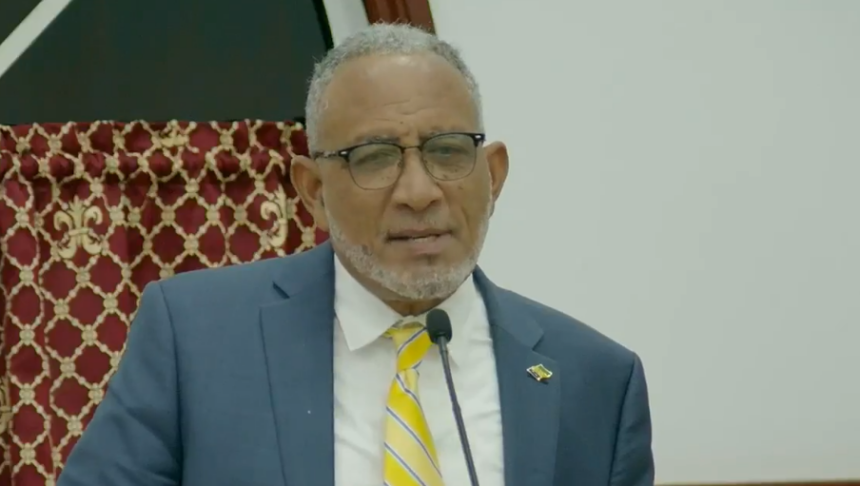
St. Vincent and the Grenadines has recorded a significant narrowing of its mid-year central government deficit, driven primarily by a major land transaction in Chatham Bay, according to the official fiscal outturn report presented to Parliament by Prime Minister and Minister of Finance, Dr. Godwin Friday.
For the four-month period spanning April 1 to July 31, 2026, the central government operations recorded an overall deficit of $57.78 million. This represents a dramatic reduction from the $125.23 million overall deficit reported during the same comparative four-month period in 2025. This narrowing of the deficit was largely made possible by a non-recurrent capital injection of $52.7 million received from the sale of land in Chatham Bay on Union Island.
Despite the reduced deficit, the country’s recurrent fiscal accounts faced notable headwinds, with current revenue falling by 10.6% during the four-month period. Current revenues for April to July 2026 stood at $290.11 million, compared to $324.38 million in the corresponding period of 2025.
A major factor behind this drop was a 13.6% reduction in revenue collected from taxes on international trade, alongside a decline in the sale of goods and services. Finance officials attributed this decline to temporary reporting delays at the Customs and Excise Department rather than a structural drop in trade. These delays resulted from technical challenges encountered during a recent upgrade of the department’s secured system.
Furthermore, revenues from taxes on goods and services declined by 8.2%, dropping to $95.2 million from $103.7 million in 2025. This decrease was primarily due to lower receipts from import excise duties, which had been artificially inflated in 2025 by the substantial collection of arrears on petroleum products. Taxes on property also experienced a drop, bringing in $7.68 million compared to $11.43 million in the previous year.
A bright spot in recurrent revenue was taxes on income and profits, which saw a slight uptick to $69.72 million, compared to $69.02 million in the same period of 2025. Sale of goods and services also brought in $31.89 million, down from $37.69 million in 2025.
On a wider year-to-date scale covering January to the end of July, current revenue reached $489.3 million, representing a 5.7% decline from the historic high of $519.0 million recorded during the same seven months in 2025. However, this remains significantly higher than the revenues collected during the same periods in 2023 and 2024, which stood at $403.2 million and $450.13 million, respectively. The overall year-to-date deficit also showed marked improvement, narrowing to $99.6 million from $168.5 million in 2025.
While revenues dipped, recurrent expenditures rose by 10.2% during the four-month period, climbing to $344.89 million from $312.98 million in 2025.
This increase was driven by several key factors:
- Goods and Services: Spending on goods and services surged by 27.1%, reaching $61.78 million compared to $48.61 million in 2025, largely due to increased expenditure on public training programs.
- Transfers: Spending on government transfers rose to $103.92 million, up from $93.12 million in 2025. This increase was driven by a rise in pension payments and the expansion of the monthly public assistance rate, which was permanently increased from $360 to $500 starting in January 2026.
- Interest Payments: Debt servicing obligations continued to put pressure on the treasury. Interest payments rose to $44.28 million, up from $37.92 million in 2025, a trend the Prime Minister characterized as a concern for fiscal management.
- Employee Compensation: Personal emoluments remained relatively stable, with employee compensation totaling $134.91 million compared to $133.32 million in 2025.
The Government’s capital expenditure during the four-month period saw a decrease, which was attributed to the completion of the modern port project in 2025 and lower emergency recovery spending in the aftermath of Hurricane Beryl.
Nevertheless, several high-priority capital projects received substantial funding between April and July 2026 to ensure ongoing developmental progress:
- Health System Resilience Project: Received $12.5 million to bolster national healthcare infrastructure.
- Contingency Fund: Capitalized with $11.22 million to ensure a robust buffer for future national emergencies.
- National Road Rehabilitation Project: Allocated $6.08 million for critical transport infrastructure repairs.
- Volcanic Eruption Emergency Project (VEEP): Allocated $5.92 million to support ongoing recovery and monitoring.
- Housing Development Program: Received $0.9 million to assist with housing rehabilitation and construction.
In response to legislative questions regarding local borrowing, Prime Minister Godwin Friday clarified that no local funds were raised from the budgeted $200 million local loan authorization between July 1 and August 15, 2026.
This was attributed to the regional practice of institutional investors requiring a three-to-four-week lead time and the general lull in debt market activity during the Vincy Mas holiday season. Earlier in the year, however, the government raised a total of approximately $52 million.
To bridge its financing requirements, the government successfully executed a full drawdown of a US $20 million loan contracted with the OPEC Fund, which officially took effect on August 18, 2026.
The Prime Minister also provided updates on the country’s fuel price stabilization obligations with major petroleum importers Sol and Rubis. While the government recorded a net bonus position of $482,483 for the specific period of May 1 to July 31, 2026, the cumulative year-to-date figures remain in a net “malus” position. Specifically, Sol was in a malus position of $20.79 million for most of the period, while Rubis realized a net bonus of $3.17 million, leaving the government in an overall malus position of $17.63 million with the fuel companies.
Despite these ongoing fiscal pressures, the administration expressed confidence in its ability to manage the country’s finances prudently. Friday emphasized that the government would continue to balance fiscal consolidation with targeted relief for low-income households and key productive sectors, steering the country through a challenging global economic climate.
