


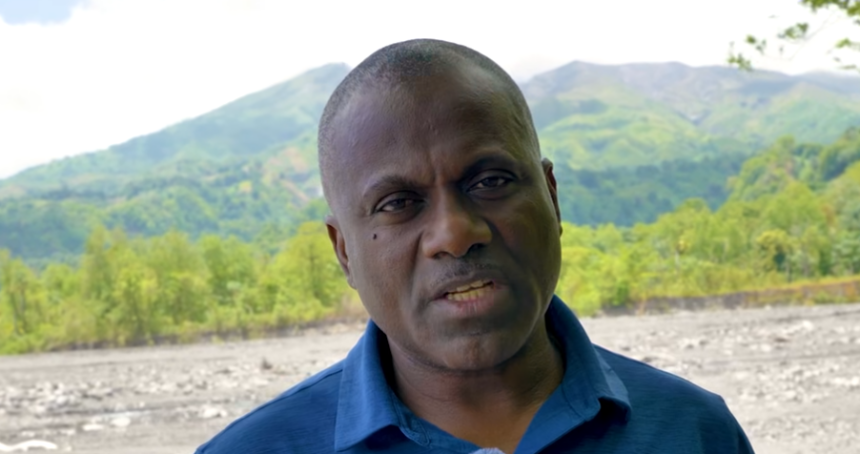
To manage the immense volume of volcanic runoff left in the wake of the 2021 La Soufrière eruptions, the Roads, Buildings and General Services Authority (BRAGSA) has initiated a large-scale sand harvesting and river maintenance operation in the Roseau River Valley.
Under Act Number 23 of 2008, BRAGSA is officially responsible for the maintenance of rivers across St. Vincent and the Grenadines. Following the explosive volcanic eruption on April 9, 2021, and the subsequent effusive eruptions, heavy rains washed massive quantities of volcanic material down from the dome and lodged it heavily at the river mouths of North Leeward. Recent assessments indicate there are over 2.4 million cubic meters of this material deposited within just a three-kilometer expanse.
To minimize community disruption, BRAGSA deliberately chose to conduct its heavy operations in the Roseau River Valley rather than the neighboring Richmond Walibu River. The Richmond Wallilabou area will be left undisturbed to preserve vital historical and cultural activities, including “chichi” harvesting, picnicking, and small-scale sand extraction by locals. Because the Roso River is currently a dry riverbed with no flowing stream, the operation will have zero impact on “chichi” farmers.
The mechanical operation involves extracting the raw volcanic material using heavy equipment and processing it through a sifter to harvest specific quantities of sand without the need for crushing. Due to the remote location of the site, the stockpiled sand is primarily exported by barge, opening an excellent opportunity to supply construction materials to the Grenadine Islands including Canouan, Union Island, and Bequia as well as the mainland capital of Kingstown.
This initiative is already yielding significant economic dividends. BRAGSA capitalized on an initial sand sale to Canouan worth approximately $3.8 million, which provided the necessary cash flow to purchase essential heavy equipment, including a front-end loader and a sifter.
The operation has been fast-tracked as part of a five-year strategic plan leading up to 2025, which aims to boost BRAGSA’s revenue and ensure the agency’s long-term financial sustainability. Furthermore, the steady supply of this harvested sand is expected to substantially reduce the cost of materials in the Grenadines.
Prior to breaking ground, BRAGSA took formal steps to address potential environmental and social concerns. The administrative process began in January with an application to Physical Planning, requiring comprehensive surveying, designs, and an Environmental and Social Impact Assessment (ESIA). A community consultation, spearheaded by Dr. Murray, was held on April 8th at the Golden Grove Learning Resource Center to hear from local residents.
During the assessment, noise, dust, and potential disruptions to local fishers were identified as primary concerns. In response, BRAGSA adjusted the alignment of a temporary sea ramp to ensure it does not interfere with traditional seine fishing activities. Additionally, the agency is strictly adhering to an Environmental Management Plan to mitigate noise and dust pollution in the area.
Looking toward the future, BRAGSA has committed to working alongside community representatives to identify and fund development projects that will directly benefit the people of North Leeward. By responsibly utilizing the natural materials inherited from the La Soufrière volcano, the Roso River Valley operation promises to economically transform the local community while contributing significantly to national development.