

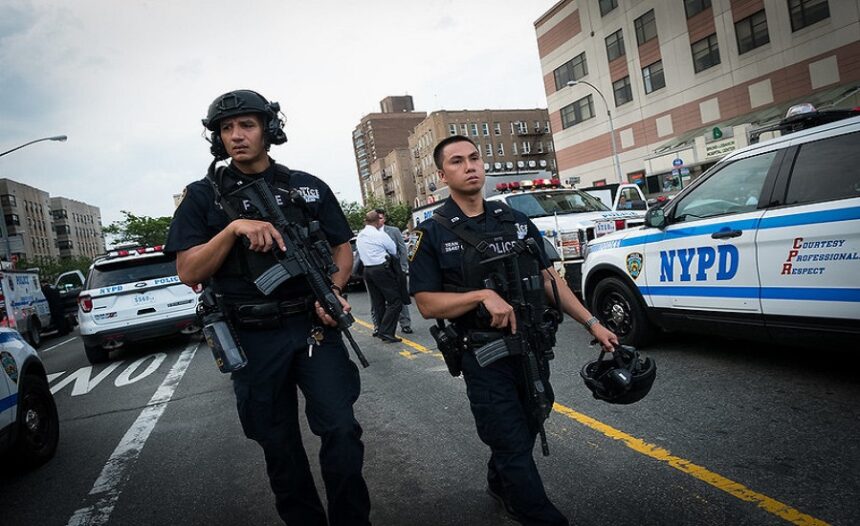
St. Vincent and the Grenadines Minister of National Security, St. Clair Leacock, detailed his recent high-level visit to the New York Police Department (NYPD) and outlined how its strategies could help shape the nation’s response to rising gun violence.
Speaking directly to a query on national security, Leacock emphasized that the regional crime struggle requires fresh methodologies, community partnership, and institutional modernization.
Addressing the House of Assembly, Leacock shared that during a recent trip to the United States—initially taken to address a personal medical issue regarding his vision—he utilized his time in New York to engage in governmental duties through the local consulate. Chief among these engagements was a two-hour briefing at the NYPD, which Leacock described as the largest police force in the world.
To visually emphasize the engagement, Leacock briefly donned an official NYPD baseball cap during his address, noting it was gifted to him just days prior during his visit.
“I had the pleasure of being in the operation center of that police force to see how they have been addressing the very questions raised here,” Leacock said, referencing the NYPD’s massive operational scope. The Minister noted that the NYPD manages a force of approximately 50,000 personnel—comprising 35,000 uniformed officers and 15,000 civilian staff—which oversees a permanent population of 7 million, alongside an additional 3 to 4 million people in transit.
Leacock expressed awe at the NYPD’s state-of-the-art operation center, which features a panoramic real-time view of New York City, enabling police to track active crimes, pinpoint force deployment, and monitor maritime and aviation traffic.
Leacock highlighted several core philosophies from his NYPD discussions that he believes are highly applicable to St. Vincent and the Grenadines:
Beyond Prosecution and Arrests: The most striking piece of advice Leacock received from NYPD leadership was that a country “cannot prosecute or arrest ourselves out of the crime and violence situation.” He noted that simply locking up more individuals is an insufficient and overly simplistic model for maintaining long-term public safety.
Community and Faith-Based Policing: Much of the NYPD’s success, according to Leacock, stems from an all-hands-on-deck community policing approach that actively involves schools, businesses, local communities, and churches. He highlighted the NYPD’s robust partnership with faith-based organizations—including rabbis and other clergy—as a system that yields massive social dividends.
Gun Buyback Initiatives: Leacock discussed the NYPD’s active gun buyback policies, where authorities purchase firearms, including “ghost guns,” from bad actors to remove them from circulation. “Every gun taken off the street or the hand of a bad actor is a life saved,” Leacock remarked, noting that at least one other Caribbean jurisdiction has credited gun buyback initiatives with reducing overall crime.
To capitalize on these insights, Leacock announced plans to send Vincentian police officers to New York for attachments to study the NYPD’s modular operational centers, faith-based approaches, and gun buyback mechanics firsthand.
Leacock integrated these global insights into a defense of the government’s current national crime reduction strategy. He acknowledged public anxiety surrounding recent homicides and gun-related offenses but asserted that the administration is “walking the talk” through targeted operations and systemic reforms.
The Minister outlined a multi-pronged approach currently being executed by the newly appointed police leadership:
- One-Year Strategic Crime Plan: The Royal St. Vincent and the Grenadines Police Force is finalizing a targeted one-year strategic plan prioritizing homicides, armed robberies, and organized crime.
- Specialized Unit Rebuilding: Leacock announced that 30 new recruits will be sent directly to the Special Services Unit (SSU) and another 30 to the Rapid Response Unit (RRU) to rebuild capacity and restore a strong visible presence on the streets via foot and mobile patrols.
- Dilapidated Barracks Overhaul: Following a walkthrough with the Prime Minister, Leacock committed to a modular reconstruction of the SSU barracks, describing the previous living quarters for officers as atrocious and plagued by squalor.
- High-Tech Infrastructure: St. Vincent has significantly boosted its technological surveillance, which now includes CCTV, improved radio communication systems, and a newly deployed drone team backed by a state-of-the-art $1 million drone. Officers are currently being sent abroad for specialized drone training.
- Auxiliary Police Reform: The government is restructuring the auxiliary police force to handle lower-risk administrative, traffic, and guard duties, freeing up highly trained uniformed officers for frontline, risk-based operations.
- Objectivity in Promotions: Addressing historical morale issues, Leacock promised that future police promotions will be strictly based on objective annual appraisals rather than political favoritism or personal bias.
Leacock reiterated that national security is an “all-of-government” effort that relies on the success of social development, housing, agriculture, and fisheries to provide viable pathways for the nation’s youth. He assured the public that while the government must “do more with less” under current fiscal constraints, the administration remains resolute in restoring total safety and confidence across the islands.
