

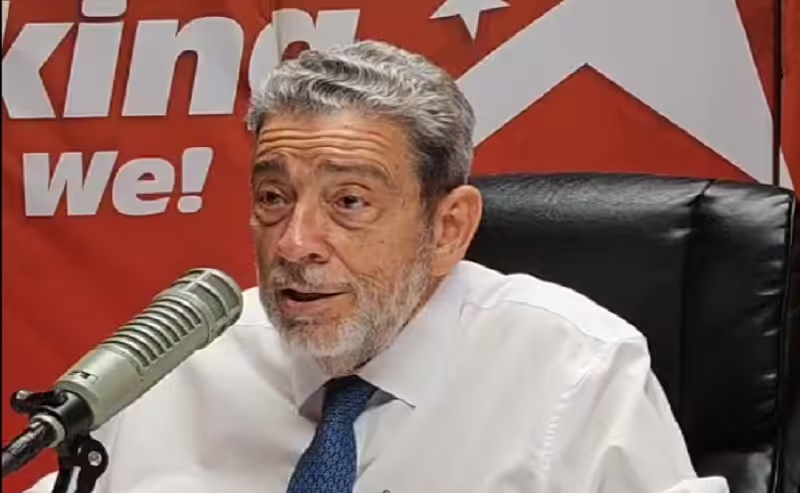
Opposition Leader Ralph Gonsalves has issued a stark public warning, condemning the new New Democratic Party (NDP) administration for allegedly steering St. Vincent and the Grenadines into a devastating International Monetary Fund (IMF) austerity program.
Speaking on Monday, Gonsalves accused the current government of working “hand in glove” with the IMF to force a “bitter prescription” of economic policies onto the nation. He warned that the looming austerity measures will “mash up” the country, exacerbating poverty for the working class and pushing a vulnerable middle class back into financial hardship.

“Austerity is a wrong and dangerous idea for St. Vincent and the Grenadines,” Gonsalves declared, warning that the middle class will soon find themselves unable to pay basic mortgages and utility bills under the new regime.
A major point of contention for Gonsalves is the government’s and the IMF’s fixation on the country’s debt-to-GDP ratio, which currently stands at 113%. Gonsalves criticized the overreliance on this single metric, arguing that it is “punitious” and fails to reflect the true health of the economy or the risk of a balance of payments crisis.
To contextualize the figures, he pointed out that many major global economies operate with far higher debt-to-GDP ratios, including Japan at 233%, the United States at 120%, and the United Kingdom at 101%.
Instead of panicking over the gross ratio, Gonsalves argued that the focus should be on the country’s external account and the cost of servicing the debt. He fiercely defended his ULP administration’s borrowing, classifying it as “good debt” used to build vital infrastructure that drove economic growth, such as the Argyle International Airport, seaports, schools, sporting facilities, and vital sea defenses.
Furthermore, Gonsalves noted that 79% of the nation’s debt is held by multilateral creditors like the World Bank and Caribbean Development Bank, secured at exceptionally low interest rates (some as low as 0.75%) with long repayment periods. By contrast, he criticized the current NDP government for driving up high-interest domestic debt, specifically pointing out their move to raise $200 million in local bonds at 7% interest, while ignoring cheaper 2% international funding available from the Saudi fund.
Gonsalves also sounded the alarm over specific recommendations made by the current IMF team, led by Sergey Antoshin. Gonsalves criticized Antoshin as pushing a “one-size-fits-all” European approach that fundamentally misunderstands the Caribbean economy.
According to Gonsalves, the IMF report advocates for an “ambitious fiscal consolidation”—which he called a euphemism for severe austerity. This plan allegedly includes slashing public expenditure, cutting the wage bill, and reducing public sector jobs through “attrition”.
Most alarmingly, Gonsalves warned that the administration has been advised to sell off critical state assets. The list of potential targets for privatization includes the port, the airport, VINLEC, the water and solid waste authorities, and the government’s highly profitable 63% share in the Bank of St. Vincent and the Grenadines. He cautioned that such privatization has historically “ended in disaster” in the region and would inevitably lead to increased service costs for citizens.
Gonsalves contrasted the current administration’s approach with his own legacy. He noted that just months ago, the IMF’s July 2024 report acknowledged the SVG economy’s “resilience in the face of repeated shocks” and robust post-pandemic recovery under his leadership.
Rather than cutting the economy “off on its knees” through austerity—which he argues will only shrink economic output, reduce tax revenues, and paradoxically increase the debt-to-GDP ratio even further, Gonsalves advocated for a continued strategy of “prudence and enterprise”. He warned the current administration that if they proceed with their heartless financial trajectory, the ensuing economic stagnation will inevitably trigger a swift and severe “day of reckoning” from the citizens.
