
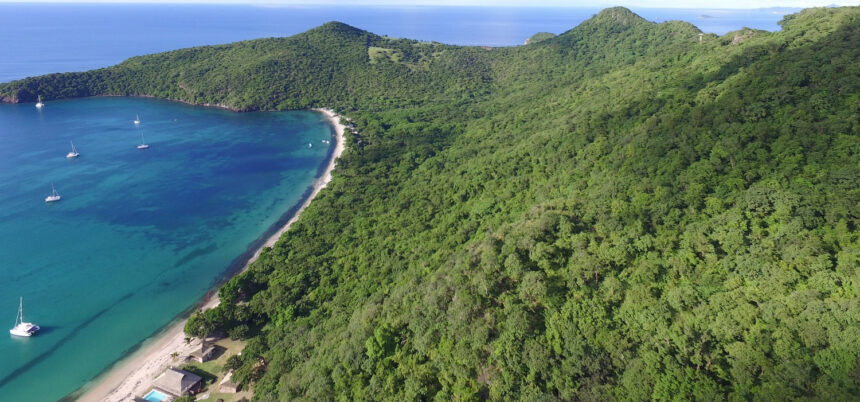
There is something oddly familiar about the way the Chatham Bay story has unfolded.
It brings to mind George Orwell’s Animal Farm, although not for the obvious reason. The pigs are not the interesting part. The interesting part is the wall.
At first, everyone knows what the rules say. Then something happens. A small change is made. Another follows. The explanation is usually reasonable enough. Nothing dramatic. Nothing that immediately looks like a crisis.
And then, one day, you look at the wall and realize the words have changed.
That is what makes the events surrounding Chatham Bay worth paying attention to.
In August 2026, the government of St. Vincent and the Grenadines sold roughly 100 acres of Chatham Bay, a pristine stretch of beachfront on Union Island, to a private company called AHRA LLC. The public explanation was conservation. The sale was framed as a measure to protect an endangered gecko species.
Fair enough.
But when Prime Minister Godwin Friday spoke about the transaction in Parliament, another explanation emerged. The sale was also described as a financial windfall, one that helped cut the country’s mid-year budget deficit in half.
Neither explanation is necessarily impossible. A piece of land can be both an environmental concern and a financial asset.
Still, it is curious when the same transaction seems to acquire a different character depending on who is listening.
Then there is the matter of the rules.
On the very day the Chatham Bay sale was announced, Parliament amended the Companies Act, reducing disclosure obligations for external companies connected to land ownership.
That is an unusually interesting coincidence.
Information about AHRA LLC’s beneficial owners that had been available the week before was no longer accessible once the transaction became public. The Opposition still does not know who controls the company that now owns part of the country’s coastline.
And this is where the story becomes less about one sale and more about how public accountability works.
Traditionally, state land sales have been handled through the Attorney General’s Chambers. It is a slower process, but it leaves both a public and paper trail. Someone has to sign something. Someone has to answer for something.
The Chatham Bay transaction took a different route. It was handled by a private attorney whose identity has not been disclosed. The Opposition says the legal fees were tied to the value of the property rather than being fixed.
There may be nothing unlawful about any of that.
But laws and procedures are not the only things that matter in public life. So do the points at which somebody can stop and ask a question.
This transaction appears to have removed one such checkpoint just as another was being weakened.
And there is an uncomfortable consequence.
The person who presumably knows who stands behind AHRA LLC is the lawyer who structured the transaction. That person is not a public official answerable to Parliament.
That leaves an obvious question hanging in the air.
Who owns the company?
It is tempting to fill the silence with a name.
Perhaps it is a minister or group of ministers. Perhaps it is someone close to the ministers. Perhaps it is somebody else entirely.
But this is precisely where an opinion column should stop and think before it starts pointing fingers.
There is a difference between (A) asking why something is hidden? and (B) inventing an answer for why it is hidden.
The public record, as it stands, does not identify who controls AHRA LLC. The Opposition has not established it. Independent reporting has not established it. There is no solid evidence here that allows anyone to responsibly name the person behind the company.
And that matters.
Because once the facts disappear, suspicion rushes in to fill the empty space.
Everyone becomes free to imagine the worst. Nobody is able to prove anything. And eventually, even a legitimate question can be dismissed as nothing more than political gossip.
That may be the most interesting part of this entire episode.
The absence of information is not a side issue. It is the issue.
This is another reason Animal Farm comes to mind.
Napoleon’s corruption is hardly a secret. The reader figures that out quickly. What matters is what happens to the rules around him. They change gradually. The wording shifts. The animals remember one thing, then discover that the wall says something slightly different.
Eventually, they cannot quite prove what they remember.
That is a much more effective way of weakening accountability than simply announcing that accountability no longer matters.
The amendment to Saint Vincent’s Companies Act does not say, in plain language, that the Chatham Bay transaction should be kept secret. It does not need to.
It changes, in general terms, what people are entitled to find out.
And it happened at precisely the moment when the public had a particularly good reason to want to know more.
Was that timing deliberate?
Maybe.
Was it simply convenient?
Maybe.
Those are questions for investigators with the authority to obtain documents, examine records and compel testimony. They are not questions that should be answered by columnists guessing at motives or attaching names to rumours.
There is enough here without doing that.
There is a valuable piece of coastline.
There is a gecko.
There is a private company whose ownership remains unclear.
There is a change in disclosure rules.
There is a departure from the traditional process for handling state land sales.
And there is a public that is left standing outside the door, wondering why it suddenly has less ability to see inside.
That is not a conspiracy theory.
It is an observation.
And sometimes the most revealing thing about a political story is not what someone has been caught doing.
It is what has quietly become harder to see.