


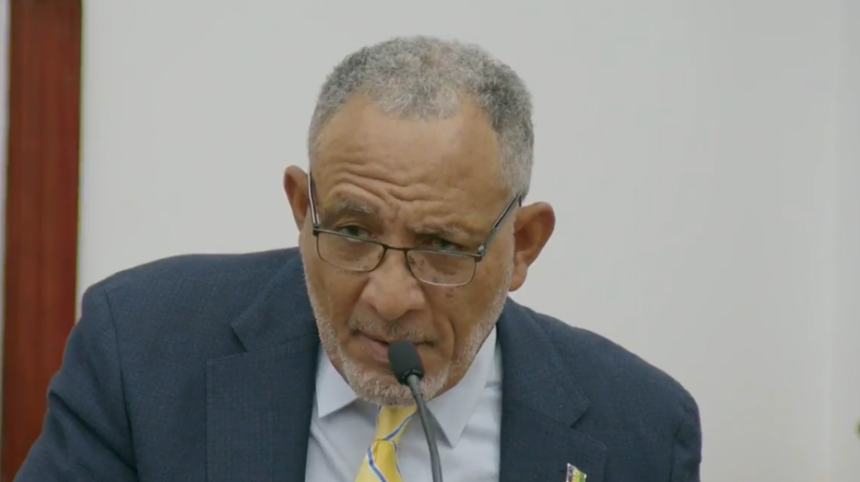
Following the decisive mandate of the November 27th elections, the new administration today formally presented the 2026 Fiscal Budget Estimates to Parliament. Formulated as a disciplined 2% increase over the approved 2025 budget, this fiscal roadmap signals a sophisticated balance between institutional continuity and an aggressive pursuit of structural reform.
In an address to the House, Prime Minister Ralph Gonsalves framed the estimates as the primary vehicle for the nation’s immediate fiscal priorities, ensuring that the state’s financial commitments are meticulously aligned with the public’s call for governance renewal.
The 2026 estimates are allocated as follows:
• Recurrent Expenditure: $1,038,319,855
◦ This figure, exceeding $1 billion, covers essential day-to-day operations and explicitly includes critical provisions for amortization and sinking fund contributions to ensure long-term debt sustainability.
• Capital Expenditure: $577,290,110
◦ Dedicated to the “Strategic Reform Agenda,” these funds are earmarked for transformative infrastructure and systemic upgrades rather than routine operational costs.
The $577 million capital allocation represents a “strategic decoupling” of development goals from operational overhead. By prioritizing capital investment at this scale, the government is moving beyond a “maintenance-only” mindset to actively fund modernization and civil service efficiency—key pillars of the mandate received following the November 27th elections.
To support this ambitious expenditure plan, the administration has deployed a diversified financing model centered on fiscal resilience. This approach balances current revenue with substantial capital receipts to protect the domestic tax base from the immediate costs of long-term reform.
2026 Financing Sources
| Source Category | Estimated Amount |
|---|---|
| Current Revenue | $96,875,230 |
| Capital Receipts | $978,734,735 |
The 2026 financing structure utilizes a strategic reliance on capital receipts, totaling over $978 million, to fund the core of the reform agenda. While the combined identified sources total approximately $1.075 billion against a $1.61 billion expenditure, the administration intends to bridge the $540 million financing requirement through planned development loans and strategic asset optimization. This methodology ensures the $577 million capital agenda is fully funded without over-leveraging recurrent tax revenue or placing an undue burden on the daily economy.
The 2025 fiscal year was characterized by a mid-year course correction, with supplementary estimates totaling $98.6 million approved by the House on August 8, 2025. These adjustments have been meticulously integrated into the revised 2025 estimates, serving as a baseline for the current “2% growth ceiling” policy.
Table 1: Expenditure and Revenue Summary
| Category | Amount (XCD) |
|---|---|
| Total Budget Estimates 2026 | $1,385,690,965 |
| Recurrent Expenditure (including Amortization & Sinking Fund) | $1,038,319,855 |
| Capital Expenditure | $577,290,110 |
| Projected Current Revenue | $906,875,230 |
| Projected Capital Receipts | $978,734,735 |
Key Revenue Trends
• Tax Revenue: Expected to reach **762.6million∗∗,a marginal increase of 0.74.5 million increase) and income/profit taxes ($129 million).
• Non-Tax Revenue: Projected at $144.3 million. This represents a 40% drop compared to 2025, primarily due to the cessation of one-time World Bank reimbursements for Hurricane Beryl cleanup.
• Current Deficit: The gap between current revenue and current expenditure results in a deficit of $15.5 million.
Structural Reorganization and New Ministries
The 2026 estimates reflect a significant restructuring of the executive branch to align with new policy priorities. Four new ministries have been established:
1. Ministry of Higher Education, Grenadines Affairs, Airports, and Seaports: Focuses on regional connectivity and advanced education.
2. Ministry of the Family, Gender Affairs, Persons with Disabilities, and Labor: Tasked with social inclusion and labor standards.
3. Ministry of Youth, Sports, Culture, and the Creative Industries: Aimed at developing the “creative economy.”
4. Ministry of Fisheries, Marine and Land Conservation, and Climate Resilience: Created to decouple Fisheries from Agriculture, allowing for a dedicated focus on the “Blue Economy” (fishing, yachting, and shipyard development).
• Private Sector Development: Transferred to the Office of the Prime Minister to signal a partnership-based approach to economic growth.
• Energy: Moved to the Ministry of Health, Wellness, and Environmental Health.
• Public Service and Postal Services: Transferred to the Ministry of National Security and Disaster Management.
• Vocational Training and Digital Transformation: Integrated into the Ministry of Education.
Sectoral Highlights and Capital Projects
The Blue Economy and Agriculture
The government identifies agriculture and the blue economy as central pillars for rebuilding the GDP.
• Agriculture: Allotted $33.5 million total. Priorities include biosecurity, quarantine functions, and agro-business diversification to move beyond single-commodity production.
• Fisheries: Dedicated staffing and leadership are intended to address long-standing grievances from fishers regarding insufficient attention under the previous combined ministry.
Infrastructure and Transport
The Ministry of Transport and Infrastructure is allocated $115.5 million for capital projects, focusing on the remedial work required for roads and public buildings.
• Aviation: Improvements are slated for the J.F. Mitchell Airport (Bequia) and the Canouan Airport ($780,000 for pavement preservation).
• Maritime: A new jetty construction project is planned for Canouan ($2 million), alongside master planning for waterfronts in Union Island, Mayreau, and Bequia.
Tourism and Social Protection
• Tourism: Positioned as a key economic pillar, with expected growth and continued investment in the Sustainable Development Unit.
• Social Protection: Represents 11.3% of the recurrent budget. New measures include a “bonus salary” for nearly 12,000 public servants to mitigate the cost-of-living crisis.
Public Debt and Financial Risk
The nation’s debt profile showed significant growth toward the end of 2025:
• Total Public Debt: $3.539 billion, a 13% increase over 2024.
• External Debt: $2.55 billion (up 18.7%).
• Domestic Debt: $993 million (up 1.1%).
• Debt Servicing: The 2026 budget allocates 270.9million∗∗for amortization and∗∗25 million for Sinking Fund contributions.