


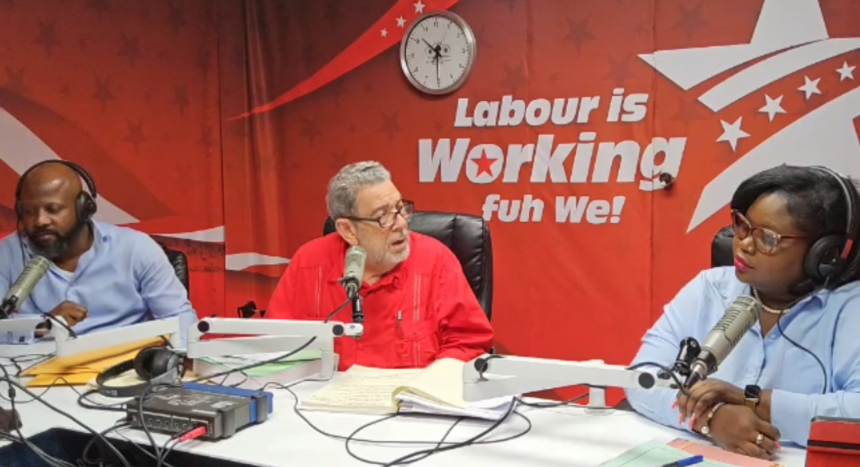
The floor of the Temporary Parliament Building in Glen is set to become a crucible for a profound democratic friction.
On January 25, 2026, Ralph E. Gonsalves, Leader of the Opposition and head of the Unity Labour Party (ULP), issued a formal challenge to Speaker Ronnia Durham-Balcombe. The catalyst was the Speaker’s summary ruling that three of Gonsalves’ questions—scheduled for the January 29 sitting—were “inadmissible.”
Among the rejected inquiries was a question regarding a “notorious fact” observable by any sentient person: an abnormal presence of swarming flies across the islands. The Speaker ruled this question inadmissible under Standing Order 20(1)(b) and (c), claiming it included unverified statements of fact.
Gonsalves’ rebuttal frames this as a metaphorical infestation of the body politic, where literal physical decay meets procedural obstruction. He argues that “science begins and ends with observation,” noting that he had traveled across the islands and observed the hazard personally, even challenging the media on December 15, 2025, to report on the nuisance. By utilizing a “narrow, legalistic” interpretation to block a question about a public health hazard, the Speaker appears to prioritize shielding the Minister of Health over the lived experience of the populace.
The Speaker further utilized Standing Order 20(1)(e)—the “one subject” rule—to block two critical inquiries: Question (1) regarding “His Majesty’s Prisons” and Question (3) regarding the role of the Prime Minister’s son acting as an aide.
Gonsalves argues this is a profound misapprehension of the rule. In the case of the Prisons question, the four sub-parts were designed to facilitate a “coherent, succinct” answer regarding a single institution. Regarding the Prime Minister’s son, Gonsalves maintains that “the role of the son” is the single subject.
The use of technicalities to shield the executive’s inner circle from queries about nepotism is an area about which Gonsalves claims the public is “rightly exercised.” To remedy this, he has requested “favourable reconsideration” or that the questions be entered into the Order Book with alterations under Standing Order 20(2), rather than being silenced entirely.
The muzzling of the opposition is not an isolated incident; Gonsalves reveals that questions from Senator Carlos James and Senator Keisal Peters were also ruled inadmissible, suggesting a systematic exclusion of dissent. He warns that an “unduly restrictive” parliamentary process invariably leads to “extra-Parliamentary options.” In a society where the national motto invokes Pax et Justitia (Peace and Justice), the closing of formal avenues for grievances threatens the very stability of the state.
Gonsalves pointedly contrasts the current NDP era with the ULP administration (2001–2025), which he says fostered transparency through:
• Allocating over four hours at every sitting for oral questions.
• Encouraging Speakers to avoid “unduly restrictive” interpretations.
• Answering questions even when they flouted technical rules regarding length or argumentative inferences.
• Broadcasting the entire proceedings on all media platforms to ensure the “man on the Colonarie omnibus” and the “woman vending in the Kingstown Market” remained informed.
The New Democratic Party (NDP) government commands 14 Representatives and four Senators, bolstered by the Attorney General. Facing them across the aisle is a diminished opposition: one elected Representative and two Senators.
In such a “lopsided” environment, Gonsalves argues that “Question Time” ceases to be a procedural formality and becomes the only vital organ of accountability left beating. When the government enjoys such a massive numerical advantage, the burden of impartiality shifts entirely onto the Speaker.
Gonsalves contends that if the gatekeeper adopts an overly restrictive lens, the opposition is effectively silenced, leaving the public to wonder what a government with such total control might be attempting to hide.
The challenge against Speaker Ronnia Durham-Balcombe is rooted in a fundamental question of perceived bias. Before taking the Chair, Durham-Balcombe served as the President of the Women’s Arm of the NDP. Her presence on the recent campaign trail was defined by what Gonsalves characterizes as “partisan vitriol.”
In the delicate machinery of parliamentary procedure, the Speaker must be more than a referee; they must be a neutral arbiter whose impartiality is “generally recognised.”
Gonsalves argues that in the “intensity of competitive politics” inherent to a small multi-island society—where partisan familial relations often overlap—the Speaker’s background makes her rulings on “orderliness” inherently suspect. To bolster this, he cites the foundational doctrine of the Westminster system:
“Confidence in the impartiality of the Speaker is an indispensable condition of the successful working of procedure, and many conventions exist which have as their object not only to ensure the impartiality of the Speaker but also to ensure that her impartiality is generally recognised.” — Erskine May: Parliamentary Practice