

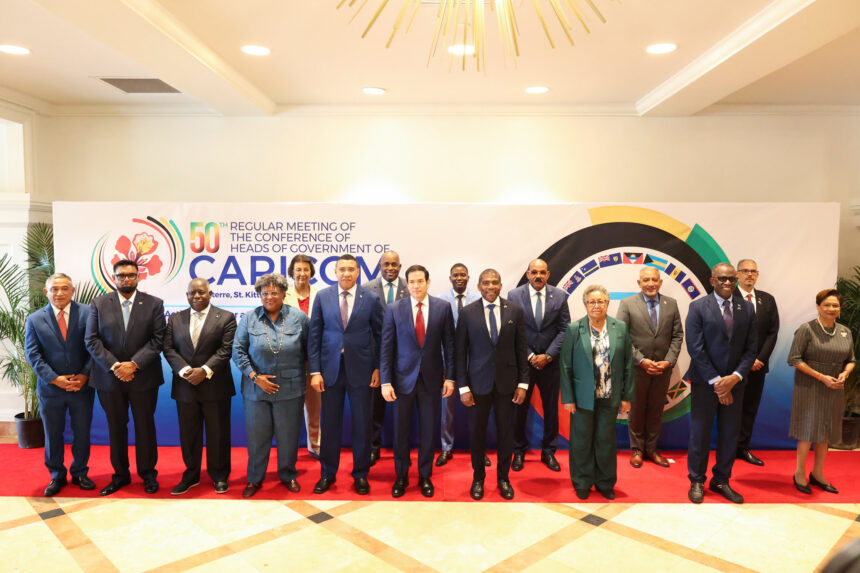
The recent Caribbean Community (CARICOM) summit was packaged for the evening news as a masterclass in regional solidarity. According to the official press releases and the dutifully echoing headlines, the Caribbean has finally found its collective voice, issuing a dramatic “humanitarian pledge” to rescue Cuba from its deepening crisis. It makes for a comforting narrative: a David-like bloc standing up for its own in the face of geopolitical storms.
A Pledge to Plan a Plan
The centrepiece of the summit, the humanitarian commitment to Cuba is a masterclass in bureaucratic vagueness. While the media reported an agreement to support Cuba, the fine print tells a different story. CARICOM leaders barely “agreed in principle” to help, a phrase that in the world of politics is often shorthand for “we haven’t actually decided to do anything.”
There is no allocated budget, no defined delivery mechanism, and no inventory of the aid to be sent. Crucially, the Jamaica Observer notes that leaders didn’t even agree on the nature of the aid itself; they simply agreed to discuss and prepare a response at a later date. In a humanitarian emergency where food and power are failing now, a month-long wait for a “coordinated response” is an eternity. A pledge to think about a plan offers zero calories to a starving population.
The Unity Myth
The image of a unified Caribbean front is a convenient fiction. The bloc is fracturing along ideological lines, making a regional response almost impossible. The summit didn’t resolve these divisions; it put them on full display.
While some member states desperately called for regional de-escalation, the Prime Minister of Trinidad and Tobago took the floor to openly endorse U.S. military policy in the region, a move that fundamentally contradicts the very idea of a sovereign, non-aligned Caribbean response.
CARICOM’s own chair admitted the bloc currently possesses no common foreign policy, leaving the organization as little more than a collection of individual whims. Without a unified stance, the bloc “withered” under external diplomatic pressure, allowing Washington to play member states against one another with surgical precision.
Bureaucracy vs. Bread
The “uselessness” of CARICOM’s bureaucracy becomes undeniable when contrasted with the actions of external players who aren’t hiding behind committees. While CARICOM leaders were busy drafting a plan to have a plan, other nations were already moving cargo:
Mexico has already dispatched multiple shipments of food and essential goods directly to Cuban ports.
Canada has committed millions of dollars in food aid, bypassing the talk shops and utilizing established United Nations channels to get aid on the ground.
CARICOM’s high-profile summit produced nothing “new” or “tangible.” By offering words and future meetings instead of shipments and funding, the bloc has effectively sidelined itself, proving that while they talk about regionalism, the actual work of regional support is being done by outsiders.
A Seat at Washington’s Table
Perhaps the most glaring evidence of the summit’s failure was the shadow cast by U.S. Secretary of State Marco Rubio.
His presence wasn’t just a courtesy, it was U.S. diplomacy successfully spliting the bloc by engaging selectively with leaders who were already amenable to Washington’s agenda, effectively steering the summit away from a Caribbean-led initiative for Cuba.
The end result was telling: CARICOM ended the meeting by agreeing to negotiate a new “U.S. cooperation framework.” In doing so, the bloc essentially traded its ability to advocate for Cuban sovereignty for a seat at Washington’s table. Instead of asserting regional autonomy, CARICOM handed the U.S. a platform to set the agenda for the entire Caribbean. Kamla Persad-Bissessar and Irfaan Ali could not be more happy with the outcome.
The High Cost of Missed Leverage
True regional leadership requires leverage, and CARICOM had the opportunity to use this summit to demand systemic change and defend regional interests. Instead, they chose the path of least resistance.
The summit passed without a single high-impact action. There was no explicit call for the total end of the U.S. embargo, no demand for the establishment of protected humanitarian corridors, and no forceful defense of Cuban sovereignty against external coercion. By offering “words” rather than the “mechanisms” required to force a result, the bloc’s collective voice was silenced by its own caution.
“The lack of consensus among member states resulted in nothing more than window dressing, leaving CARICOM without the teeth or the strategy needed to meaningfully influence the situation in Cuba.”
The bottom line is inescapable, the CARICOM summit was a factory for committees and frameworks, but it produced no food, no fuel, and no future for the Cuban people. While the rhetoric of “humanitarian support” remains high, the lack of funding and the deep-seated regional disunity ensure that the status quo remains untouched.
As we look forward, the failure of this summit prompts a haunting question for the region. Can blocks like CARICOM ever achieve true autonomy or are they destined to remain diplomatic ornaments.