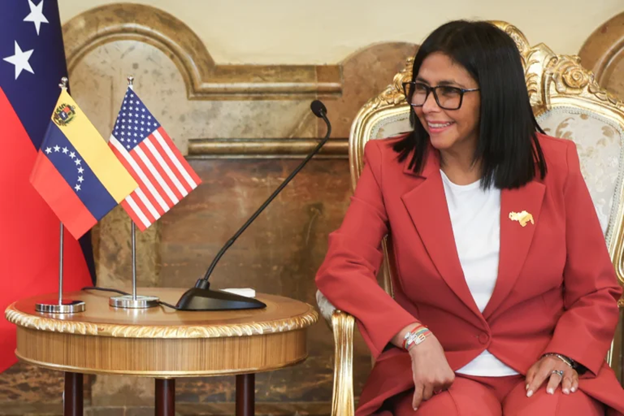
Acting President Delcy Rodríguez has announced the victory of Chavista leadership following the US empire legally recognizing the Venezuelan authorities. “I am proud, because today’s news is that the Venezuelan government has been legally recognized,” Rodríguez stated this Wednesday, March 11. “This is not recognition of a person or a government; it is recognition of a country, so that the country can recover its way of life, can breathe again in terms of services, health, and education.”
The statement followed a notification from the US State Department to a New York federal court formally recognizing the Venezuelan government. Analysts explain that the move de facto ends the “interim government” of Juan Guaidó and the 2015 National Assembly fiction, which served as the legal basis for the seizure of Venezuelan assets abroad, including CITGO—a subsidiary of the Venezuelan publicly-owned oil company PDVSA—and two tons of gold held in the Bank of England.
Normalization of diplomatic and trade relations
Rodríguez emphasized that the process of reorganization and normalization is a right that the nation deserves. The acting president further noted that both governments maintain daily conversations to discuss their respective points of view regarding diplomatic ties. She also clarified that, within the framework of restored relations, Venezuela has purchased medicines from the US entity. While the US Embassy in Caracas attempted to present the operation as a donation, analysts have denounced that narrative, confirming it was a commercial transaction.
“I am proud that Venezuela can now have trade relations,” Rodríguez added. “Just as the US buys oil and gold from us, we can buy medicines and equipment, and this will help to recover the health system.”
VENEZUELA REJECTS GUYANA’S ILLEGAL ACTIONS IN UNDELIMITED WATERS
For the Venezuelan State, Guyana’s claim to unilaterally dispose of resources in areas pending demarcation lacks legal basis and violates the principles of good faith and neighborliness. In a forceful official statement issued this Friday, March 13, 2026, by the Ministry of People’s Power for Foreign Affairs of Venezuela, and disseminated by its Foreign Minister Yván Gil, the Government of that South American country categorically rejected the recent actions and statements of the Government of Guyana regarding waters that have not yet been delimited. The Bolivarian Republic of Venezuela described these acts as a “usurpation of maritime areas” and a flagrant violation of the 1966 Geneva Agreement, the only valid legal instrument that recognizes the territorial dispute over the Essequibo region.
The Venezuelan government reiterated that the delimitation of maritime spaces between nations with adjacent coasts necessarily requires a mutual agreement, as recognized in the 2011 joint declaration. Venezuela emphasized that it will not tolerate Georgetown assuming control over these spaces to exploit natural resources, cause environmental damage, or fabricate military and commercial navigation rights. Faced with this tense scenario, Caracas reiterated its commitment to defending its territorial integrity and demanded that Guyana cease its “high-sounding rhetoric” and return to the only possible way to resolve the conflict: direct talks between the two states, under the historic premise that “the sun of Venezuela rises in the Essequibo.”
The Venezuelan Head of State greeted the people this March 8, reaffirming the role of women and the importance of the 2026 National Popular Consultation.
PRESIDENT MADURO SENDS MESSAGE OF FAITH AND POPULAR ORGANIZATION FROM CAPTIVITY IN NEW YORK
Venezuela’s constitutional president, Nicolás Maduro Moros, delivered a moving message to the Venezuelan people this Sunday, March 8, in commemoration of International Women’s Day, from his place of detention at the Metropolitan Detention Center in Brooklyn. Through a letter shared by Congressman Nicolás Maduro Guerra, the president urged the nation to strengthen faith and collective action as fundamental pillars for the consolidation of People’s Power. In his letter, the Head of State highlighted the historical coincidence of this date with the celebration of the 2026 National Popular Consultation, underlining the decisive role of women in the social organization of the country.
President Maduro emphasized that female participation is the driving force behind the construction of the communes, asserting that popular will is the most powerful tool to overcome any difficulty imposed from the outside. He also evoked the spirit of the Angostura Address to emphasize the need for a grassroots policy guided by the thought of the Liberator Simón Bolívar. The text calls for building a popular, just, and moral government, where the direct participation of communities guarantees lasting peace with social justice for all families. Under the slogan that faith moves mountains, the presidential message linked Christian teachings with the Bolivarian commitment to motivate citizens to vote massively in their respective districts. The President urged everyone to turn every obstacle into a path clear for the nation, reaffirming that the unity between the people and their leaders is unbreakable despite imperial aggression.
The letter concludes with a blessing for the March 8th election, describing it as a demonstration of unwavering faith and the daily struggle for national sovereignty. Nicolás Maduro affirmed that, united in the ideals of Bolívar and Chávez, Venezuela will continue transforming into a home of love and justice where power truly resides in the hands of organized citizens.
POPULAR MOBILIZATION IN CARACAS REAFFIRMS COMMITMENT TO THE SOVEREIGNTY OF VENEZUELA
The organized people demanded the release of President Nicolás Maduro and First Lady Cilia Flores, kidnapped by US commando forces after the invasion carried out in the early hours of January 3, in which at least 100 people were killed. Thousands of Venezuelans gathered in Caracas on Thursday to participate in a march for peace, freedom, and a reaffirmation of their commitment to national sovereignty. The demonstration brought together social leaders and organized communities from the early morning hours in Plaza Morelos de Bellas Artes, the starting point of the march. The march expressed its support for the acting president Delcy Rodríguez and the actions promoted by the Bolivarian Government to maintain stability and peace in the national territory.
During the mobilization, the Minister of Labor and Social Processes, Eduardo Piñate, called for cohesion and unity among all sectors to safeguard the country’s integrity. “We always call for national unity, because the enemy wants to dismember us and hand over the nation piece by piece,” Piñate stated. “They had to attack us militarily in order to kidnap the president and the first lady and take them to the United States; we remain firm here,” the minister declared in front of thousands of protesters.
As in recent mobilizations, the organized people demanded the release and return of President Nicolás Maduro and First Lady Cilia Flores, kidnapped by US commando forces after the invasion carried out in the early hours of January 3, in which at least 100 Venezuelan citizens were killed. The mobilization was also conceived as a space to support policies aimed at strengthening the country’s productive activity and to reaffirm the commitment to the political transformation process promoted by the Executive. During the march, participants chanted slogans in support of the authorities and in defense of peace, such as “Peace is our victory,” “Delcy, move forward, you have my trust!” and “Nicolás and Cilia: the home of the nation.”
THE TRUMP COROLLARY: IMPERIALIST OFFENSIVE AND THE ASSAULT ON VENEZUELA
The “Trump Corollary” to the Monroe Doctrine is a central feature of U.S. strategy designed to secure hegemony and limit Chinese and Russian influence in Latin America and the Caribbean. It does not, however, represent a decisive shift in Washington’s relations with the region. Although the corollary does not make this explicit in its formal statement, in practice it makes more evident what liberal rhetoric has long sought to mask: military and covert interventions aimed at preserving U.S. domination in the Western Hemisphere, undermining progressive movements and governments, and backing right-wing regimes. In this sense, it abandons even the pretense of respect for international law and human rights. In what follows we argue that the Trump Corollary constitutes not only an ideological and imperialist offensive against decolonial and multipolar currents in Latin America, but also a strategic project whose assault on Venezuela has broader geopolitical implications.
Venezuela: The central case
The violent reality of the Trump Corollary has been most clearly revealed in Venezuela. Washington’s campaign of deadly strikes against maritime vessels in the Caribbean, a series of extrajudicial killings that claimed the lives of more than 145 people, served as a prelude to the January 3 surprise aerial assault on Caracas, named Operation Absolute Resolve. The maritime victims included people from nations such as Colombia, Saint Lucia, Trinidad and Tobago, and Venezuela who were targeted without public evidence of narco-trafficking or due process. Operation Absolute Resolve itself claimed the lives of more than 120 people, including civilians and security forces, and culminated in the kidnapping of President Nicolás Maduro and First Lady Cilia Flores. In Venezuela, the Trump Corollary deploys military force, coercive diplomacy, and control over strategic resources. It also deals a blow to the Bolivarian cause by making an example of a state that has stood as the leading force of regional independence and integration for more than two decades.
DELCY: OUR GOAL IS TO GUARANTEE A RELIABLE ENERGY SUPPLY
Venezuela signs “Cardón IV” agreement with Repsol and Eni to boost gas exports.
Acting President Delcy Rodríguez led the signing of the strategic agreement for “Cardón IV” between the Spanish company Repsol and the Italian company Eni on Thursday, to strengthen the hydrocarbon sector. From the headquarters of PDVSA La Campiña, in Caracas, the acting head of state pointed out that this alliance with the commercial company Cardón Cuatro, SA, not only guarantees the supply of gas to Venezuela for national development and domestic consumption, but will also allow its expansion for export.
She emphasized that this agreement was the result of collaborative work to continue boosting the Hydrocarbons Sector. “This agreement we have signed for Cardón 4 not only guarantees the gas supply to our country for national development and domestic consumption, but will also allow for expansion into exports, enabling Venezuela to continue on the path to becoming a gas-exporting nation. I am very pleased that this is being done in partnership with two European companies that stayed in Venezuela, that believed in Venezuela, and that did not turn their backs on our people.”
In this regard, the acting president told representatives of the European companies Repsol and Eni that they could count on Venezuela. “I am very pleased that this is thanks to two European companies that stayed in Venezuela, that believed in Venezuela, and that did not turn their backs on our people. As acting president of our country, on behalf of the Venezuelan people, I wanted to thank you and tell you that we have a team ready to work together. So, you can count on Venezuela to continue developing future projects that will translate into shared benefits for our countries.”
VENEZUELAN SEAFOOD PRODUCTS ARE EXPORTED TO MORE THAN 29 COUNTRIES
The Netherlands, France, China, the United States, and Spain are some of the nations that enjoy Venezuelan seafood products. Luis García, spokesperson for fishermen from Caraballeda, stated that currently more than 58 Venezuelan marine species are exported to 29 countries, including the Netherlands, France, China, the United States, and Spain. “This fish processing is ultimately very profitable for the Venezuelan state; not even the discarded parts, such as viscera, scales, skeletons, etc., are lost; they are transformed into fishmeal to feed animals,” García stated during an interview on VTV.
Government support. The fishermen’s representative emphasized that the national government offers social and economic support to those in this productive sector. Among the programs providing assistance is Tejiendo Redes (Weaving Networks), which serves women working in this profession by offering them training, social and healthcare services, and financing. Another benefit is the ban on bottom trawling, which gives fishermen greater access to marine species. They also have access to training programs and financing options.
VENEZUELA REACHED 99,04% FOOD SUPPLY
The Minister of Food, Carlos Leal Tellería, assured that the country is on track to achieve zero nutritional deficit. The Minister of Food, Carlos Leal Tellería, indicated that so far in 2026 the food supply figures are at more than 99,04%, which represents an achievement for the country after experiencing a period of scarcity due to the economic blockade. “We have found very significant data that definitely points to agri-food development. Such is the case with supply levels: since 2017, when we had 27% national supply, today, in 2026, the levels reach 99,04%,” Leal Tellería stated on the occasion of National Food Day.
In that regard, the minister explained that “the average food distribution exceeds 748 tons per month, which means there is a food oversupply; all of this is part of the productive effort.” Similarly, he stressed that the food figures in the nation are encouraging; however, they will continue working until the deficit in Venezuela reaches zero. “Currently, we have a per capita consumption of over 504 kilos per person. All this data allows us to conclude that our national government’s food policy is effective. We have a very important goal: zero nutritional deficiencies, and we are already on the verge of achieving it,” he pointed out.
Leal Tellería took the opportunity to highlight that, thanks to the weekly food distribution, the Venezuelan people have direct access to products at fair prices. The minister also emphasized the work done by farm workers, fishermen, and organized popular power in boosting the national economy.