

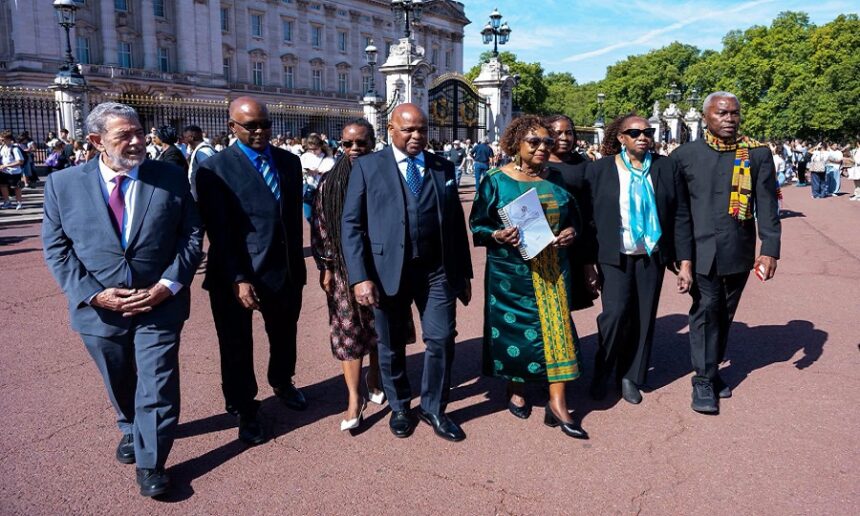
The UK government has firmly rejected a historic petition from Jamaica demanding financial compensation for Britain’s role in the transatlantic slave trade.
Delivered to Buckingham Palace for King Charles III by a formal Jamaican delegation, the petition requests £10 billion ($10 billion) in reparations, but British officials reiterated that the nation’s position remains unchanged: “The UK does not pay and will not pay reparations”.
A spokesperson for Prime Minister Andy Burnham confirmed that while Britain acknowledges the abhorrent nature of colonial practices and the immense wealth gained from the slave trade, successive UK governments continue to avoid issuing a formal apology or entering into economic negotiations.
Led by Minister of Culture Olivia Grange, the Jamaican delegation presented the petition in person, launching a novel legal strategy. Rather than requesting a direct royal ruling, the filing asks King Charles III to seek formal guidance from the Judicial Committee of the Privy Council—the London-based body serving as the final court of appeal for Jamaica and several Commonwealth territories.
As the first Commonwealth nation to pursue this specific procedural avenue, Jamaica’s petition poses three core legal questions:
- Whether the enslavement of African people in Jamaica was lawful under contemporary English law.
- Whether the practice violated international law regardless of domestic legality.
- Whether the United Kingdom bears a legal obligation to compensate for historical damages.
Beyond monetary compensation, Minister Grange also called for the restitution of Caribbean artifacts held in British museums. Despite the government’s refusal and the King’s absence, Grange stated she felt “encouraged” by the legal filing, viewing the step as meaningful progress independent of London’s immediate reaction.
The petition’s submission drew additional scrutiny due to King Charles III’s absence in Scotland during the delegation’s visit. Graham Smith, chief executive of the anti-monarchy campaign group Republic, criticized the monarch, arguing that the King “once again… seeks refuge whenever the issue of slavery and empire is raised”. However, Jamaica’s claims align with recent findings from a United Nations committee, which determined that states carry a legal obligation to consider reparations for transatlantic slavery to eradicate ongoing racial discrimination.
British rule in Jamaica began in 1655, during which hundreds of thousands of enslaved Africans endured brutal conditions over three centuries. Although Jamaica achieved independence in 1962, its government executed a constitutional amendment in December 2024 to replace the British monarch as its head of state.
Britain became the world’s largest slave-trading nation by the 1730s, transporting over three million Africans across the Atlantic.
While the British state paid compensation upon abolishing slavery in 1833, those funds were awarded exclusively to slave owners for the “loss of their property” rather than to victims.
Although institutions such as the Church of England pledged a £1 billion ($1.35 billion) fund in March 2024 to address historical ties to slavery, political leaders—including former Prime Minister Keir Starmer’s office in October 2024—have steadfastly refused to offer financial reparations or official apologies. Furthermore, the UK abstained when the UN General Assembly voted to recognize the transatlantic slave trade as the “gravest crime against humanity.
