
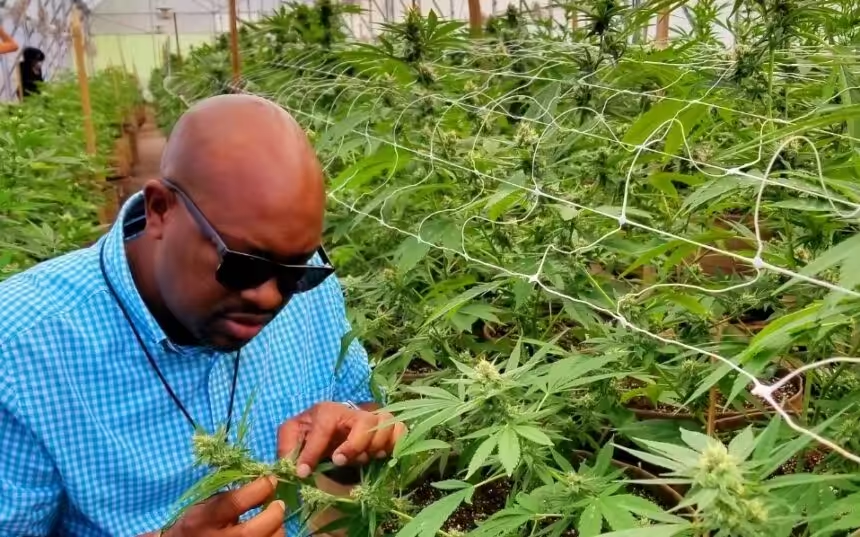
The United States Department of Justice officially moved to reclassify cannabis on April 23, 2026, shifting it from a Schedule 1 to a Schedule III drug. This action, taken under the Trump Administration, reclassifies state-licenced medicinal marijuana as a less dangerous substance, recognising its medicinal value and reducing regulatory barriers. This is a quantum leap in the quest of those medical cannabis industries in the Caribbean region currently addressing banking hurdles.
The impact of the recent amendment is that marijuana is therefore moved from a category of drugs (Schedule I) reserved for drugs with no medical use and high abusive potential such as heroin, to one (Schedule III) for drugs with a lower potential for abuse.

In the US, the order specifically applies to FDA approved products and products containing marijuana subject to a qualifying State issued licence. This radical change carries federal tax penalties implications for medical cannabis businesses, aids in medical research and reduces federal restrictions, but it does not legalise recreational marijuana at the federal level. Further, the reclassification acts as a powerful signal to global financial institutions, addressing de-risking issues within the medical cannabis sector. For certain, the reclassification reduces the Anti-money Laundering (AML) risks for banks. Regional stakeholders in the medical cannabis industry including research and development can therefore anticipate that this will assist in facilitating a safe and fair banking environment across the Caribbean within the medical cannabis sector.
The overarching impact is that the revolutionary move by the United States will trigger greater capital flows into the developing medical cannabis industries of the Caribbean region. Many jurisdictions have placed their fingers on the pause button because of the fear of the impact of having their banks facilitate transactions related to a Schedule 1 drug.
Regional and Community Banks in the US have already started to use the Schedule III designation to expand services to medical operators. This massive opportunity now
offers regional governments another chance to collaborate on issues of possible harmonization of legislation, sharing of human resource capacity, joint usage of labs, inter-regional export and regional and sub-regional branding to carve out greater collective international market share in the medical cannabis sector.
Rescheduling sends the strongest signal yet that the Federal Government recognises the legitimacy of a regulated medical cannabis market. This change has the potential to spark a cannabis industry rebirth for many waiting to invest. For the first time in years, the industry has confronted a potential federal development that can fundamentally alter its trajectory.
It is important that we underscore that the intervention in the United States of America is to shift licenced medicinal marijuana from Schedule I to Schedule III. On a strict interpretation, it is clear that Caribbean countries should walk a very fine line which acts within the confines of cannabis being used for medicinal purposes and scientific research if we are to obtain the potential banking benefits. Therefore, if stakeholders are
operating within the medicinal and scientific research space, they must now ensure that proper track and trace systems from seed to sale are in place. In addition, stakeholder accountability and full operationalisation of enacted legal frameworks are of first importance. Compliance structures must also be well planned, structural and conceived and function in tandem with agreed banking compliance structures.
Jurisdictions in the region with a liberal approach to cannabis which includes religious and recreation usage will have to go the extra mile to guarantee to financial institutions non-diversion into the medical cannabis sector. This is achievable and cannot be viewed as a formidable task considering the technologies available for tracking and tracing cannabis from seed to sale or seed to consumption in the case of religious usage.
Moving cannabis to a Schedule III drug ushers in the end of the cannabis prohibition era and the beginning of the regulation era, potentially creating promising opportunities around research and new therapeutics. Rescheduling removes heavy bureaucratic barriers, allowing researchers to obtain cannabis directly from State-licenced businesses rather than relying solely on Federally authorised supplies. This presents an excellent opportunity for foreign direct joint venture investments for institutions such as the University of the West Indies, the University of Guyana and several offshore medical schools in the Caribbean to do extensive research as it relates to cannabis.
Some are of the view that the rescheduling is all about Big Pharma being able to offer cannabis products in pharmacies pursuant to a prescription. To the Rastafarian Community, the reclassification comes as no surprise, for they have championed for decades the medical healing wonder of the Holy Herb (cannabis). The liberal cannabis activists in the Caribbean will also see this as a major step in the right direction. Whatever the reason, this downgrade of cannabis classification, arguably the first major change in the United States of America since 1970, will have a positive impact on derisking the medical and research and development cannabis industries globally in the view of all stakeholders and importantly inclusive of our banking system.
Saboto S. Caesar LL.B (Hon.) UWI, LL.M (Banking and Finance Law) University of London, L.E.C
The author is a lawyer by profession and former Minister of Agriculture and Industry of St. Vincent and the Grenadines. He has over a decade of public policy experience in the medicinal cannabis industry in the Caribbean and is currently a Policy Advisor on Hemispheric Agriculture Systems and the Medicinal Cannabis Industry.