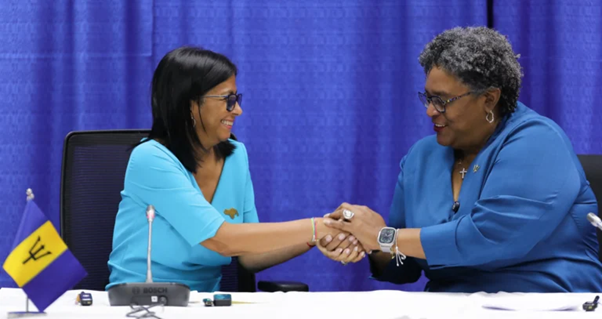
Venezuela’s acting head of state, Delcy Rodríguez, and the prime minister of Barbados, Mia Mottley, held a meeting on Monday night in Bridgetown, the capital of Barbados. They agreed to strengthening bilateral relations, specifically in the areas of energy, agriculture, education, and tourism. “We have concluded, with profound satisfaction, the agenda we have built in sectors of great importance to our countries,” Acting President Rodríguez told the media. “A first point is food production, with Barbados going to Venezuela to produce food on Venezuelan soil, allowing for supplies for Barbados but also turning Barbados into a hub where we can export food to the Caribbean and Africa.”
In a joint statement, the leaders noted that Acting President Rodríguez had invited Prime Minister Mottley to learn about “the experience of the communal economy in Venezuela, how organized communities can guarantee their own food.”
In that regard, she also announced that they agreed to review production and export trends “that will allow us to be complementary, so that we can acquire goods in Barbados, and Barbados can acquire goods in Venezuela, without having to look beyond our borders, which are close and sisterly.” She immediately added that she told the prime minister that this Monday, April 27, 2026, “the economic and commercial union between Barbados and Venezuela is being born.”
Joining energy investments: Rodríguez, who at the beginning of her speech congratulated Mia Mottley on being re-elected for a third term as prime minister of Barbados in the elections of February 11, 2026, noted that she invited Barbados to invest in oil and gas fields in Venezuela. “Let the effort and initiative to increase hydrocarbon production in Venezuela be added so that we can guarantee supplies and energy security for Barbados in the future as well,” she said. They also discussed the complementarity of renewable energy sources, which would allow both countries to manufacture solar panels and thus create a complete energy base, and area which holds “many opportunities for investment,” according to Acting President Rodríguez. “We want to review investment and double taxation agreements so that we can combine our strengths and complementarities,” added the acting president.
Language exchange: “There is a project that I will personally dedicate myself to; the prime minister intends for the people of Barbados to have a second language, and that language is Spanish,” revealed Delcy Rodríguez. “We have the Venezuelan Institute of Cultural Cooperation, which already trains many students in Barbados to learn Spanish, and we have agreed to expand the institute’s capabilities and incorporate technological platforms so that Venezuelan teachers can teach Spanish to Barbadians.” The agreement includes a reciprocal component so that officials and spokespeople from community councils and communes in Venezuela can learn English with teachers from Barbados, she added.
Tourism: The acting head of state said they discussed increasing the number of flights between Venezuela and Barbados, “potentially integrating other destinations near our countries so we can offer tour packages both to the people of Barbados and to tourists visiting this beautiful island, offering tour packages to some destinations in Venezuela, and also offering tour packages from Venezuela to visit Barbados.” They also discussed the need to establish a maritime connection for the transport of both passengers and cargo. Something important that “we have requested from the Venezuelan Ministry of Tourism is to have a training course for our tour operators in Barbados… There is much we can do from a tourism perspective between Venezuela and Barbados. I have nothing but praise for the landscapes of Barbados and Venezuela,” she added.
Mottley invited to Venezuela: After indicating that both sides were pleased with the visit, Rodríguez extended an invitation to the Barbadian prime minister to visit Venezuela. Rodríguez described the meeting as productive. This is Rodríguez’s second international trip since assuming the role of acting president on January 5 following the illegal abduction of Venezuela’s Constitutional President Nicolás Maduro. Analysts have noted the similarity in the use of decapitation strikes, condemned by all forms of international law, by both the US and Israeli forces. Her first trip was to Grenada on April 9, where she met with Prime Minister Dickon Mitchell. At that meeting, the two agreed to strengthen ties in the areas of energy, agriculture, education, health, and foreign trade.
Venezuelan Acting President Announces Minimum Salary, Pension Increase
Venezuela’s Acting President Delcy Rodríguez announced today a significant integrated minimum income and a 40% pension increase.
The measures, delivered during the closing of the Grand National Pilgrimage, aim to protect workers and seniors amidst the nation’s ongoing economic recovery and rebirth. The adjustment, which Rodríguez described as the most important increase in recent years, will take effect retroactively from the date of the announcement. Coinciding with International Workers’ Day, Rodríguez also confirmed that pensions for senior citizens have been set with a substantial 40% increase designed to enhance their living standards and purchasing power within the country’s economy.
This salary measure emerged following the signing of an agreement at the labor and social consensus table, where various stakeholders, including trade unions, opposition sectors and the business community, participated. Rodríguez specifically urged the private sector to respect and apply this new minimum income, particularly if their current salaries fall below the newly established threshold, emphasizing the Government’s commitment to fair labor practices.
The Acting President further called for the formalization of employment across the nation to ensure that the working class receives the full protection of the State and the law. Rodríguez highlighted that low levels of labor formalization directly lead to distortions in income distribution and negatively impact the pension system, underscoring the necessity of a structured and compliant labor market.
In this context, she requested the labor and social consensus table to expedite the drafting of a collective bargaining agreement. This crucial legal instrument is intended to foster economic growth while simultaneously safeguarding the social benefits of Venezuelan workers.
Economy Moves Forward: Delcy Rodríguez characterized the current period as the “rebirth of Venezuela”, asserting that the nation has overcome what she termed a “lost decade” resulting from unilateral external sanctions. In this sense, the Government’s strategic projection aims to guarantee the nation’s full development with a clear vision set between the years 2030 and 2050, focusing on sustainable economic and social progress. As part of this comprehensive process, the Acting President reiterated her call for Venezuelan youth residing abroad to return to the country and contribute to its productive apparatus. She announced that, starting this Friday, she would host talented young individuals who have decided to return home at Miraflores Palace, where they will be integrated into the nation’s new economic cycle.
OFAC Reverses Block on Venezuela’s Payment for Maduro’s Legal Defense in Lawfare Case
The US Treasury Department’s Office of Foreign Assets Control (OFAC) issued licenses allowing the Venezuelan state to pay for the defense of President Nicolás Maduro and First Lady Cilia Flores in the ongoing US lawfare case against the Venezuelan presidential couple. “The parties write jointly to advise the Court that the Office of Foreign Assets Control has issued amended licenses to counsel for defendants Nicolás Maduro Moros and Cilia Flores de Maduro. The amended licenses authorize defense counsel to receive payments from the Government of Venezuela under certain conditions,” states the letter addressed to Judge Alvin Hellerstein by the US Department of Justice.
This decision comes after the defense attorneys denounced that the US regime had blocked payment of legal fees under the pretext of restrictions tied to the illegal US sanctions against Venezuela. In turn, the defense withdrew its previous request to dismiss the case due to lack of financial resources to cover legal services. The parties also requested that the next hearing be held after two months, without specifying a particular date.
During the last hearing of the trial, the defense argued that the OFAC’s decision to block the Venezuelan government from paying legal fees for President Maduro impeded the full exercise of the right to defense, enshrined in the Sixth Amendment of the US Constitution. On the other hand, the prosecution defended the legality of the restrictions, in a litigation that highlights the contradictions between unilateral coercive measures and judicial guarantees. Meanwhile, the Venezuelan government shows its firm decision to defend an individual it recognizes as its constitutional president.
The case stems from the US invasion of Venezuela on January 3, when US forces bombed Venezuela and kidnapped President Maduro and his wife Cilia Flores, killing more than 100 people in the process. Maduro and Flores face charges of alleged conspiracy related to drug trafficking and other crimes that, according to legal experts, rest on weak evidentiary foundations. The proceedings unfold amid an imperialist siege marked by economic blockade, diplomatic pressure, and widespread questions about the legality of what many experts describe as a state-sponsored kidnapping.
Interim President receives US delegation and signs new energy agreements
In a strategic step to strengthen bilateral relations, the acting president of the Bolivarian Republic of Venezuela, Delcy Rodríguez, held a high-level meeting with a delegation of American businesspeople in the Sol del Perú Room of the Miraflores Palace. The meeting’s main objective was to strengthen the constructive agenda in energy, mining, and trade matters that both countries have been developing under principles of respect and mutual understanding; through the signing of agreements between Petróleos de Venezuela, SA (Pdvsa), Overseas Oil Company, and Crossover Energy Holding.
Under the “Win-Win” model, this approach seeks to consolidate the participation of international capital through joint ventures; applying a shared benefit formula in important sectors such as industry and mining. Therefore, this dynamic gives continuity to the agreements initiated on March 4, when a delegation led by the Secretary of the Interior and Energy Dominance of the United States (USA), Doug Burgum, visited the Venezuelan Nation.
With this meeting, Venezuela reaffirms its willingness to create a climate of trust for foreign investments that directly contribute to the well-being of the Venezuelan people. Meanwhile, on behalf of the US government, the head of the United States Diplomatic Mission in Venezuela, John Barrett, was present; Jarrod Agen, who currently serves as deputy assistant to the president and CEO of the National Energy Mastery Council, among other roles.
Agreements between Venezuela and the US will optimize the country’s electrical system
Interim President Delcy Rodríguez asserted that the agreements signed between Venezuela and the United States aim to optimize the national electrical system. “The central goal is to stabilize service throughout the country,” she said during the signing ceremony. agreements between Petróleos de Venezuela, SA (Pdvsa), Overseas Oil Company and Crossover Energy Holding made this Thursday in the Sol del Perú Room of the Miraflores Palace. The acting president explained that the relationship is based on shared interests.
The goal is to leverage each nation’s strengths to generate results. The current strategy aims to benefit the populations of both countries. The official stated that this initiative seeks the well-being of both nations. “Here, the interests of the United States and Venezuela intersect; how can we, through complementarity, promote the shared benefit of both our peoples?” Rodríguez stated during his recent public address. This statement encapsulates the spirit of the technical cooperation being implemented today.
Impact on the electricity sector: The agreements cover work in electricity generation and transmission. The national government is monitoring the technical operations. Compliance with service goals is constantly being verified. Caracas and Washington share clear objectives in the energy sector. This phase of the relationship is unfolding within a context of mutual benefit. The contracts with the companies are aimed at restoring capacity. Electrical stability is the priority within these new agreements. The country is making progress in carrying out these critical infrastructure projects.
Growth: 1.208.000 barrels per day: For her part, the Minister of Hydrocarbons, Paula Henao, during her speech highlighted the announcement made by the (E) President Delcy Rodríguez, about having exceeded oil production by one million two hundred and eight thousand barrels per day and stressed that for the hydrocarbons sector it is a source of pride to maintain the sustained growth of production. Henao emphasized that this significant achievement was the result of collaborative work with the private sector, through leveraging and investing in strategic areas. He stated that these signed agreements demonstrate the growth the country will experience in the coming years, focused on monetizing all its resources.
Venezuela signs memorandum of understanding with British Petroleum
Venezuela signed a memorandum of understanding this Wednesday with British Petroleum, a move focused on the exploration and exploitation of non-associated gaseous hydrocarbons in offshore geographic areas. From Miraflores Palace, the acting president of the Republic, Delcy Rodríguez, highlighted that this understanding constitutes a significant step within the country’s international energy agenda, aimed at diversification and boosting gas production for the benefit of the Venezuelan people and the national economy. “I want to congratulate them on the signing of this memorandum of understanding for offshore gas exploration on the Deltana platform,” Rodríguez stated. “The return of British Petroleum is a clear example of the future we want to forge for Venezuela and international energy relations, based on respect, win-win cooperation, and shared benefits for the development of the Venezuelan people,” he added.
She also welcomed the opening of a company office in the country. “I want to welcome the opening of the office in Venezuela and the fact that a Venezuelan woman is at the helm (…) to continue advancing in these areas of work,” she said, referring to projects in fields such as Cocuina-Manatí and Loran. For his part, BP’s Executive Vice President of Gas and Low Carbon Energy, William Lin, announced the establishment of a permanent office in Caracas. “Having a presence in Venezuela will allow us to solidify our relationship,” he stated. He also expressed the company’s interest in developing the country’s gas potential and strengthening cooperation with the Venezuelan government.
The acting president emphasized that the income from these alliances is destined for the two sovereign funds that have been created to invest in the “well-being of the Venezuelan people in health, education, housing and food, and for the development of vital infrastructure.” She reaffirmed that these alliances are framed within relationships of cooperation and shared development. “We are taking these firm steps for the benefit of our country… under principles of complementarity, respect, and joint development,” he added.
In context, British Petroleum, currently known officially simply as BP, is one of the world’s largest and most influential energy companies, producing millions of barrels of oil equivalent per day. BP is an energy giant that is currently navigating the complex balance between maintaining global energy security through oil and gas and exerting international influence by migrating to cleaner energy sources.
Venezuela signs agreements with the Italian National Hydrocarbons Corporation (ENI)
Venezuela, through Petróleos de Venezuela, SA (Pdvsa) and the Ministry of Popular Power for Hydrocarbons, signed agreements with the National Hydrocarbons Corporation of Italy (ENI). During the event, the terms sheet that will govern the negotiations relating to the signing of a contract for the development of primary activities in the Junín 5 area was signed.
The ceremony took place in the Sol de Perú Room of the Miraflores Palace, where the acting president, Delcy Rodríguez, led the signing, accompanied by representatives of the Italian company’s board of directors, including Fabio Castiglioni, director of natural resources for the Americas and Europe region, and Claudio Descalzi, executive director of ENI, who highlighted the importance of Venezuela for the corporation, its people, and its country. “ENI never left Venezuela, we were always here, producing,” said Descalzi, who also highlighted his enthusiasm for the signing of this agreement and what it will allow in the future with the reserves of the Junín Field, resources with which he affirmed they will be able to accelerate production and achieve benefits for the people of Venezuela.
In this regard, Descalzi highlighted the good relations with the Venezuelan government and explained that they will define together with the Executive an investment plan that will be finalized before the end of 2026. “This is going to be one of our company’s most important investments in the country and the region,” said the CEO of ENI.
Strengthen ties: The acting president highlighted the importance of this step for the Venezuelan oil industry, as she believes it represents one of the most significant investment ventures in the country’s recent history, since this joint project’s main objective is the substantial increase in crude oil production under international cooperation schemes. “This day will be etched in the history of our energy relations,” said Rodríguez, who described the recent signing of agreements for the development of primary activities in Block Junín 5 between Petróleos de Venezuela (PDVSA) and the National Hydrocarbons Corporation as “a very important moment for Venezuela.”
Rodríguez offered special recognition to the company (ENI) for its uninterrupted presence in Venezuela despite the challenging circumstances. “ENI didn’t leave the country; ENI was in Venezuela, and we have been able to strengthen our cooperative ties. The Venezuelan people deserve to know this, and we will be grateful,” he stated, while also highlighting that the European company maintained its working relationships and operational levels, which fostered mutual trust between both parties. “In the coming months, we will have good news for Venezuela and Italy in the energy sector,” Rodríguez said.
Venezuelans united in calling for the lifting of sanctions. Pilgrims arrived from all parts of the national territory for a free and peaceful Venezuela.
Social movements, unions, students, motorcyclists, and senior citizens formed a caravan through the city of Caracas to support and accompany acting president Delcy Rodríguez, who joined the closing of the Great Pilgrimage for a Venezuela Free of Sanctions on Thursday afternoon. From early hours, thousands of pilgrims They arrived in the city of Caracas. The main avenues of the capital city were filled with people from various parts of the country. On April 19, the acting president called for the Great Pilgrimage, which departed from three points in Venezuela bound for Caracas.
This large gathering in Plaza Venezuela culminated in a massive rally, where Interim President Delcy Rodríguez joined with representatives of the people, social and cultural movements, productive sectors, motorcycle clubs, and others. Amid songs, tricolor flags, and chants, the Venezuelan pilgrims demanded an end to the sanctions and marched to the stage located near the Botanical Garden—an emblematic space adjacent to the Central University of Venezuela (UCV)—where the president addressed the crowd.
A pilgrimage against the 1,081 sanctions: It is worth remembering that government spokespeople have denounced to the international community that, over the course of ten years, Venezuela has been subjected to 1,081 unilateral coercive sanctions, which have caused a considerable decrease in national income. More than 60% of these measures have been issued by the United States. Faced with this situation, interim President Delcy Rodríguez called for a Great Pilgrimage.
Venezuela and Colombia Reactivate Binational Electrical Relations
Caracas (OrinocoTribune.com)—The governments of Venezuela and Colombia have formalized the reactivation of their energy connection through an agreement signed between Venezuela’s National Electric Corporation (CORPOELEC) and Colombia’s Institute for Planning and Promotion of Energy Solutions for Non-Interconnected Zones (IPSE). The signing took place this Tuesday, April 28, following intensive work by joint technical delegations and was materialized during last week’s visit of Colombian President Gustavo Petro to Caracas. This alliance is part of a new phase of binational integration, aiming toward energy sovereignty to improve the quality of life for populations in the border region of the two nations.
The project prioritizes electrical interconnection for western Venezuela, an area severely affected by illegal sanctions led by the US empire and its allies that restrict investment and access to parts for the National Electric System (SEN).
Regional integration efforts: The foundations for this exchange were initially established during the Seventh Ministerial Meeting of the Community of Latin American and Caribbean States (CELAC), held in Bogotá in 2015. At that meeting, both nations formalized regional agreements to promote an Electrical Interconnection Plan, which is now being reactivated with the signing between CORPOELEC and IPSE. Following Washington-led regime change operations against Venezuela, relations were gravely severed under the administration of far-right Colombian President Iván Duque in 2018. This period jeopardized joint projects, diplomatic relations, and the historical brotherhood between the two countries.
With a Venezuelan stamp: the power of the pink salt flats that beat the Himalayas
This impressive natural salt deposit, known for its pink and reddish waters, is a living laboratory where geology, biology, and tradition intertwine in the state of Falcón. Pink Himalayan salt has become fashionable, but what many don’t know is that we don’t have to travel all the way there or pay exorbitant prices. To enjoy high-quality reddish salt, we only need to visit Falcón state, right here in western Venezuela, to not only taste it but also admire this beautiful landscape.
The salt flats of Las Cumaraguas, located at the northern tip of the Paraguaná Peninsula, are a natural deposit where seawater stagnates and evaporates under the sun. This process allows for the artisanal harvesting of salt, a practice that has defined the economy and identity of the area for generations.
This tourist destination is a living testament to how nature intertwines with the lives of its people, representing a unique intersection of science, tradition, and human effort.
A unique geological and biological archive: Its origin is a fascinating geological process. Millions of years ago, this area was underwater. The constant ebb and flow of the waves, along with changes in water level, left a rich history etched into its strata—those horizontal layers of sedimentary rocks, soil, or materials that accumulate over time, differing in composition and color. In this same place, fragments of mollusk shells and echinoderm plates (such as starfish) have been found, concrete evidence of its marine past, as well as the “rundkarren” type rock formations (formed by dissolution of limestone) and pebble conglomerates originating from ancient beaches and cliffs.
Extreme ecosystem and its emblematic fauna: The high salt concentrations create an extreme environment where only certain species have adapted. The flora includes vegetation typical of arid zones: mesquite trees, cardon cacti, and other plants resistant to drought and salinity. The most emblematic fauna is the American flamingo (Phoenicopterus ruber). These birds find an ideal feeding ground here, filtering the water rich in crustaceans (such as brine shrimp) and algae with their beaks, which gives them their characteristic color. Other birds such as plovers, sandgaiteros, and avocets can also be observed.
Science bows to the pink power of Las Cumaraguas: Beyond its beauty and tradition, this salt deposit is the subject of geological, biological and biotechnological studies that reveal its strategic value. It’s not just a dreamlike landscape with waters that shift from deep pink to reddish hues. The salt flats have become a discreet yet powerful natural laboratory where Venezuelan and foreign scientists have discovered fossils, extremophile microbes, and compounds with high industrial potential.