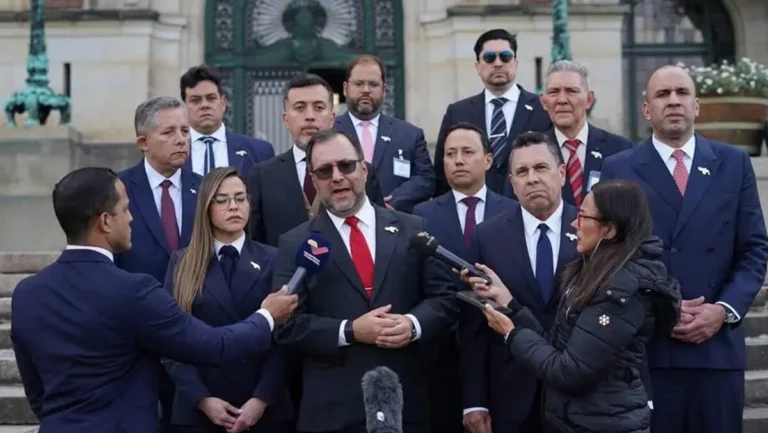
The 1966 Geneva Agreement is sole legal path to resolve territorial dispute with Guyana. Venezuelan diplomats appeared before the International Court of Justice (ICJ) to defend their nation’s position in a territorial dispute with Guyana over the Essequibo region. “The world, Latin America, and Venezuela will hear our truth and the reasons why Essequibo is Venezuelan territory,” Foreign Affairs Minister Yvan Gil said, adding that the only way to resolve the dispute is the 1966 Geneva Agreement.
Over six hours, Venezuela’s legal team are expected to present arguments before 15 judges. The oral hearing began with diplomat Samuel Moncada, who said the delegation’s presence seeks to prevent Guyana from unilaterally redefining the nature of the territorial dispute. Moncada said Venezuela cannot remain silent in the face of the Guyanese attempt to fraudulently transform binding obligations between the two states. “Guyana seeks to unilaterally redefine both the nature of the territorial controversy and the scope of the obligations binding Venezuela and Guyana under the Geneva Agreement,” Moncada said, denouncing Guyana’s erroneous and misleading narrative.
The Presidential Commission for the Defense of Guayana Esequiba has promoted the Geneva Agreement as an essential decolonization instrument and as the only valid accord. Venezuela said the 1899 arbitral award issued in Paris is void because it was issued while the nation faced political destabilization. At the time, the ruling stripped the country of 159,000 square kilometers without allowing Venezuelan representatives to be present and ignoring the principle of “Uti Possidetis Juris,” which had affirmed Venezuelan sovereignty since 1811. In international law, the “As You Possess According to Law, You Shall Possess” principle states that newly formed sovereign states should retain the same territorial borders they had as administrative divisions under colonial rule or prior lawful authority.
The Venezuelan representatives said the political collusion behind that Paris ruling was confirmed in 1949 by the Severo Mallet-Prevost memorandum, a fact that later forced the signing of the Geneva Agreement before Guyana’s independence.
The Hague Court Has No Jurisdiction in the Essequibo Dispute: Venezuela
The 1966 Geneva Agreement is only legal framework for resolving territorial conflict, Ambassador Moncada points out. Venezuelan diplomat Samuel Moncada rejected the jurisdiction of the International Court of Justice (ICJ) in resolving the conflict with Guyana over the Essequibo, a territory of about 160,000 square kilometers rich in oil and minerals. “Venezuela has not at any time consented to submit this controversy to the jurisdiction of any court or arbitral tribunal,” Moncada told ICJ judges during Venezuela’s oral arguments in hearings taking place until May 11 in The Hague.
The Venezuelan representative recalled that, for nearly a century, his country has consistently maintained that matters related to its territorial integrity “cannot be submitted to dispute resolution mechanisms by third parties.” “That position is neither circumstantial nor strategic; it is structural. It is part of its international conduct, its domestic legal order, and its conception of how its most essential interests must be protected,” Moncada stressed.
The ICJ will seek to determine the validity of the arbitral award of Oct. 3, 1899, which established the border between what was then British Guiana and Venezuela. In 1962, the Venezuelan government declared that award null and void, arguing it was marked by irregularities.
In 2018, Guyana filed a case before the ICJ requesting it declare the “legal validity and binding effect” of the 1899 award, as well as the definitive nature of the border delimitation of a territory claimed by Venezuela. “Venezuela is here today because it cannot remain silent in the face of a process that Guyana seeks to use to unilaterally redefine,” Moncada said, emphasizing that the 1966 Geneva Agreement, sponsored by the United Nations, is the only legal framework for resolving the dispute. He added that the agreement establishes a legally binding obligation for both countries to find new ways to settle the border issue, not through the ICJ as Guyana intends
Venezuela Marks 15 Years of Housing Mission with 428 New Homes Delivered
The Great Venezuela’s Housing Mission was created in 2011 by Commander Hugo Chávez. 5,26 million new homes had been built for working families until 2025. Venezuela’s Acting President, Delcy Rodríguez, participated this Tuesday in the 15th-anniversary celebrations of the Great Venezuelan Housing Mission (GMVV, in Spanish) and led the distribution of 428 new homes to beneficiary families.
From the Waraira Repano Urban Development, located in the Maripérez North Sector of El Recreo parish in Caracas, the Delcy Rodríguez presided over the formal handover of keys and urban land titles to the beneficiary families.
Rodríguez also toured the facilities of the first phase of the aforementioned urban development, which features spaces specifically designed for popular empowerment and social well-being. These include a self-governance room, a medical clinic, multi-purpose areas and a recreational zone aptly named the “Gamer Zone”, showcasing a holistic approach to community development.
The distribution of these new homes powerfully reaffirmed how the Great Venezuelan Housing Mission has fundamentally transformed the lives of millions of Venezuelan families, enduring against the severe impacts of what the U.S. economic war, which includes 1,081 unilateral coercive measures currently enforced against Venezuela, which have significantly hindered economic development and social programs.
Furthermore, this recent deployment of new housing solutions symbolized the Rebirth and Hope Plan (“Plan Renacer y Esperanza”, in Spanish), an initiative strategically aimed at the progressive completion of ongoing construction projects and the profound strengthening of Popular Power through the deliberate transfer of competencies in the maintenance and comprehensive management of the habitat to local communities. This approach empowers citizens to take ownership of their living spaces and participate actively in the planning and execution of community development, fostering a sense of collective responsibility and self-determination.
Venezuela Launches Housing Title Registry via Patria
Venezuela launches a digital registry through the Patria system to update housing beneficiaries and speed up property title delivery under the GMVV program. Venezuela’s acting president Delcy Rodríguez announced the launch of a registration process through the Patria System (Sistema Patria, in Spanish) platform for beneficiaries of the Great Housing Mission Venezuela (Gran Misión Vivienda Venezuela, GMVV, in Spanish), aimed at updating records to ensure the delivery of legal property titles for state-awarded homes.
The announcement was made from the Maripérez housing development in Caracas, where Rodríguez oversaw the delivery of new homes as part of a national distribution of 428 housing units across the country, each granted with corresponding legal titles. Officials said the registration process is intended to organize and update beneficiary files, reducing administrative bottlenecks in the allocation of property documentation.
During the event, she described housing under the program as part of a broader social framework. “It is the habitat that allows the creation of a human city for the happiness of the Venezuelan people,” she said. Rodríguez also highlighted ongoing legislative reforms in the housing sector aimed at expanding rental market activity and incorporating an estimated 500,000 vacant homes into regulated use under state supervision of landlord-tenant relations.
5 Powerful Tasks: Maduro’s Bold Call to Venezuelan Working Class for Peace and Sovereignty
In a message released on the occasion of International Workers’ Day, Venezuelan President Nicolás Maduro outlined fundamental tasks for the Venezuelan working class, emphasizing their role as protagonists in the country’s future despite his current detention in the United States.
The president stressed the need for workers to guarantee the process of peace, reconciliation, and national union as an exercise of sovereignty and national reunion. Maduro expressed pride in belonging to the “powerful Venezuelan working class,” which he said must lead the construction of a new history for the homeland. The message was shared via his Telegram channel, reaching supporters across Venezuela and beyond. Key points from the message include advancing with faith beyond limitations, relying on collective strength, and consolidating the renewal of workers’ forces started the previous year. Maduro also thanked workers and international allies for their daily solidarity.
Maduro’s communication highlighted several strategic directives aimed at strengthening the nation amid adversity. He called on the Venezuelan working class to advance confidently, trusting in their own capabilities and the unitary effort of all sectors. “To move forward with faith, transcending limitations, relying on our own strength and the united effort of the working class and the entire country,” he stated. This call to persevere resonates deeply in a country facing complex internal and external pressures following the events of January 2026.
Central Bank of Venezuela Adapts to New Geopolitical Realities
In a meeting with representatives of public and private banking, the Venezuelan Banking Association, the Superintendency of Banking Sector Institutions (Sudeban), and the Vice Ministry of Digital Economy, the Central Bank of Venezuela’s (BCV) acting president, Luis Alberto Pérez González, projected a new period of “exchange rate stability.” According to preliminary figures, Venezuela’s gross domestic product (GDP) grew in the first quarter of 2026, marking 20 consecutive quarters of economic growth. “There are reasons to believe that the national economy will do well in the coming quarters and that inflation will decrease,” Pérez González stated from the Manuel Egaña Hall of the BCV headquarters in Caracas, according to a press release from the Venezuelan institution.
Learning from the past
For Ford, the BCV’s first challenge is clear: to revitalize the balance of payments with foreign currency from the oil sector. The economist emphasizes that the aim is to avoid the mistakes of the Fourth Republic, when the money from Petróleos de Venezuela (PDVSA) was essentially “locked up” in a kind of black box without effective controls. “A methodological framework was created in compliance with the fiscal transparency standards established by multilateral financing organizations, in this case, the International Monetary Fund,” Ford explained. However, the specialist warns that Venezuela will also have to use “other strategies, given the debt conditions” of its current forced “strategic partner,” the US.
The Bolívar as a constitutional axis
The president of the BCV announced that both the official and parallel exchange rates have shown a significant slowdown in recent weeks. The gap between the two rates is currently at 29%, a result of more active intervention by the Central Bank. He even highlighted that actions are being designed to facilitate the purchase and sale of foreign currency to individuals and legal entities through banks and exchange houses, but with a clear guideline: “It is time to start thinking about instruments that make it easier for people to continue increasing their preference for the Bolívar.” Ford supports this view from a constitutional standpoint: “The currency remains the Bolívar, as established by Article 318 of our Constitution. We have no option, for now, to dollarize our economy.”
Venezuela Welcomes More Repatriated Citizens; US SOUTHCOM Reaches 178 Extrajudicial Executions
The Venezuelan government has facilitated the return of 64 nationals during the first week of May 2026 through the continuation of the Return to the Homeland (Vuelta a la Patria) program. These latest arrivals at the Simón Bolívar International Airport in Maiquetía represent a continued sovereign commitment to providing a dignified path home for those escaping the aggressive deportation policies and systemic racism of the US empire. This humanitarian initiative, governed by the 2025 bilateral agreement between Caracas and Washington, remains a critical lifeline for Venezuelans seeking to escape labor exploitation and xenophobia. The program continues to serve as a direct response to the displacement caused by the illegal US-led blockade, which has consistently weaponized migration to destabilize the nation.
Humanitarian oversight and flight logistics
Venezuela Welcomes More Repatriated Citizens; US SOUTHCOM Reaches 178 Extrajudicial Executions
Upon arrival, Venezuelan security agents and Return to the Homeland program officials oversee protocols to ensure every returnee receives comprehensive social care, including medical screenings, psychological counselling, and guidance for socioeconomic integration. With the arrival of two flights this week, the total number of repatriated citizens in 2026 has reached 7,142 across 41 flights so far. This builds upon the 23,067 individuals who returned over the course of 2025 under the current agreement. The data for the most recent arrivals is as follows:
• Flight 138: Arrived Monday, April 27, carrying 57 migrants (54 adults and three minors), operated by the US-based GlobalX airline.
• Flight 139: Arrived Sunday, May 3; special flight carrying seven migrants, consisting of six minors and one adult man.
Since its inception in 2018, the program has protected over one million Venezuelans from the harsh realities of carceral detention in the US entity, upholding the right of citizens to return and rebuild their lives in their own homeland.
Venezuela’s Supreme Court Ratifies President, Appoints New Leadership
In a session this Monday, May 4, the Plenary Chamber of Venezuela’s Supreme Court of Justice (TSJ) ratified Caryslia Rodríguez as its president and appointed a new board of directors. Rodríguez will be accompanied by Elias Rubén Bittar Escalona as first vice president and Tania D’Amelio as second vice president.
In addition, the judges who will now make up the chambers comprising the country’s highest court were appointed. According to the TSJ website, the Constitutional Chamber will be led by Tania D’Amelio, while the Political-Administrative Chamber will be headed by Jaime Báez.
The Electoral Chamber will be chaired by Caryslia Rodríguez herself, and the Civil, Criminal, and Social Cassation Chambers will have Emilio Ramos, Carmen Castro, and Elías Bittar as their respective presidents. The Plenary Chamber also incorporated substitute magistrates, who will fill vacancies created by recently approved retirements.
The press release from the highest court notes that it is “awaiting the completion of the process currently being carried out by the Judicial Nominations Committee of the National Assembly.”
Delcy Rodríguez leads dialogue table to consolidate labor consensus
The acting president of the Republic, Delcy Rodríguez, led a strategic meeting with the members of the National Dialogue Table for Labor and Social Consensus, following the guidelines outlined in the programmatic plan “Rebirth 2026”.
The meeting was attended by sectoral vice presidents and members of the executive branch, notably including the Minister of Labor and Social Processes, Carlos Alexis Castillo, and the Presidential Commissioner for Labor Consensus, Eduardo Piñate. Also present were delegates from the Bolivarian Socialist Workers’ Central, the Confederation of Venezuelan Workers, the Unitary Federation of Public Employees, and the Independent Trade Union Alliance of Venezuela.
Open to listening to all proposals
This Wednesday, the Minister of Labor and Social Processes, Carlos Alexis Castillo, reported that the dialogue table is in discussions with all the country’s labor unions. “At the table, we are open to all possibilities. We discuss everything, all issues and all topics related to labor. We are discussing them and we will continue to do so.” He reiterated that the Government will not implement irresponsible salary increases, “inflationary increases that turn into nothing and also collapse the country’s economy.”