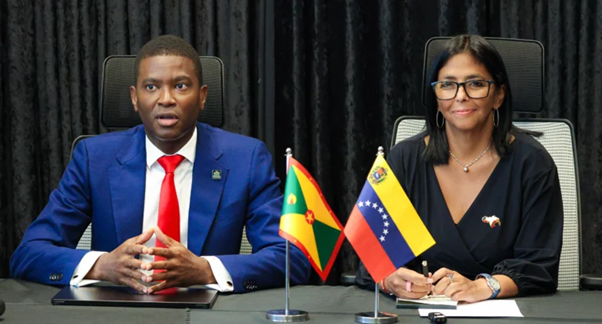
Venezuela’s Acting President Delcy Rodríguez held a working meeting with Prime Minister Dickon Mitchell at the seat of the Parliament of Granada, in Saint George, as part of her official visit to the Caribbean island.
Venezuela and Grenada reinforced bilateral cooperation today, during a productive meeting with the PM Dickon Mitchell focused on energy, agriculture, education, and trade, aiming for shared prosperity and strategic regional development. This meeting follows Prime Minister Mitchell’s visit to Venezuela on April 29, 2025, where a roadmap for strong economic cooperation over the next two years was agreed.
“The history of Grenada is an example for the peoples of Latin America and the Caribbean who, despite difficulties, chose sovereignty and self-determination”, Rodríguez emphasized. The exchange of courtesies and mutual respect during the visit underscored the strong bonds of friendship and solidarity that traditionally characterize the relationship between Venezuela and the island nations of the Caribbean. During the meeting, the roadmap initially signed last year was updated with a special emphasis placed on education. This renewed commitment ensures that the vibrant exchange of students between both countries will remain active and continue to flourish. Such programs are crucial for fostering cultural understanding, promoting academic excellence, and building human capital that can contribute to the development of both nations.
The bilateral agenda also extensively covered the health sector, recognizing the importance of collaborative efforts in public health initiatives. Additionally, discussions included air and maritime transport, with the explicit objective of charting a new foreign trade route, strategically designed to benefit not only Venezuela and Grenada but also extend its advantages to other countries within the wider Caribbean region, thereby strengthening regional economic integration and logistical connectivity.
VENEZUELA APPOINTS LARRY DEVOE MARQUEZ AS ATTORNEY GENERAL
Venezuela’s National Assembly appointed Larry Devoe Márquez as Attorney General and Eglée González Lobato as the new Ombudsman on April 9, bolstering Citizen Power institutions. In a historic session this Thursday, the Venezuelan National Assembly exercised its constitutional faculties to renew key state positions, reinforcing Venezuela’s institutional framework.
With a robust majority of 275 votes, the Parliament officially swore in the new heads of the Public Prosecutor’s Office and the Ombudsman’s Office. These strategic appointments aim to further strengthen the protection of constitutional rights and the rule of law across the nation, reflecting the legislative body’s commitment to institutional renewal and citizen welfare. The rigorous selection process ensured that highly qualified professionals with extensive experience and academic credentials were chosen for these vital roles within the Citizen Power branch of government.
Larry Devoe Márquez, an expert in Criminal Sciences with a master’s degree in human Rights, was appointed as the new Attorney General of Venezuela. “It follows that the citizen Larry Devoe flawlessly gathers all the academic, ethical, moral and civic credentials to lead the direction and conduct of the Public Ministry”, said the Deputy Carolina Carreño when proposing his appointment.
VENEZUELAN NATIONAL ASSEMBLY APPROVES NEW ORGANIC MINING LAW
The National Assembly of Venezuela approved the Organic Mining Law today, designed to modernize the sector, strengthen economic sovereignty and ensure mineral wealth.
After intense debate and public consultation, Venezuela’s National Assembly unanimously sanctioned the Organic Mining Law on April 9. This crucial legal instrument, consisting of 131 articles, is meticulously designed to modernize and comprehensively regulate Venezuelan mining activity. The initiative, championed by the Acting President, Delcy Rodríguez, aims to bolster the nation’s economic sovereignty and ensure that its vast mineral wealth directly translates into sustainable development and well-being for the Venezuelan people.
This comprehensive legislation marks a pivotal moment for the country, establishing a robust framework that seeks to optimize resource management while promoting environmental protection and social responsibility, focusing on several key aspects, primarily defending Venezuela’s sovereignty over its strategic resources, as the President of the Assembly, Jorge Rodríguez, emphasized (…).
The legislation clearly stipulates that the management and control of these minerals fall strictly under the purview of the National Executive Power. This centralized and strategic planning approach is designed to guarantee optimal exploitation, aligning mining activities with broader national development goals and preventing uncoordinated or detrimental practices. The law also establishes a clear framework for the participation of various entities in the mining sector. This includes state-owned companies, mixed enterprises (with a public majority shareholding), authorized private companies, and properly registered artisanal mining brigades. This inclusive approach aims to foster a diverse and dynamic mining industry, ensuring that both large-scale operations and smaller, community-based initiatives contribute to the sector’s growth.
VENEZUELA MARKS 20 YEARS OF COMMUNAL COUNCILS WITH MASS MOBILIZATION
Thousands of Venezuelans mobilized in Caracas today to celebrate the 20th anniversary of the Organic Law of Communal Councils, commemorating its promulgation by Commander Hugo Chávez and reaffirming popular sovereignty.
The Venezuelan people held a massive mobilization through the streets of Caracas on April 9, to commemorate the 20th anniversary of the Organic Law of Communal Councils. This significant march celebrates the sanctioning of this legal instrument by the National Assembly and its subsequent promulgation by Commander Hugo Chávez on April 9, 2006.
The Communal Councils have since become a fundamental pillar of the country’s social and political system, promoting direct citizen participation in local decision-making and project implementation. Workers, students, and various social movements traversed the capital’s main avenues, with their final destination being the Miraflores Palace, the official seat of the national Government. This collective demonstration not only commemorated a landmark legislative achievement but also served to reaffirm the enduring validity and importance of the Communal Councils as the bedrock of Venezuela’s participatory and protagonist democracy.
The march emboded the spirit of popular sovereignty, showcasing the organized power of the people in upholding their constitutional rights and responsibilities.
VENEZUELAN NAVAL TRAINING SHIP ARRIVES IN GRENADA WITH MESSAGE OF COOPERATION & PEACE
The Simón Bolívar Training Ship of the Bolivarian Navy arrived in Saint George, Grenada, on its journey across the seas to its first destination of the 36th Foreign Instructional Cruise titled “Seas of Unity for the Dream of Bolívar 2026.” The Venezuelan Ministry of Defense reported that the event on Wednesday, April 1, was marked by unity, solidarity, and joint work aboard the ship Ambassador Without Borders, which was visited by a diplomatic representation from Grenada.
The reception was hosted by the ambassador of the Bolivarian Republic of Venezuela to Grenada, Jorge Alfonso Guerrero Veloz, who welcomed the crew. During the meeting, activities were carried out that reflected the commitment to integration among the Caribbean peoples and the Bolivarian Diplomacy of Peace.
During its stay, the BE-11 ship will open its doors to the people of Grenada, so that they can experience life on board, naval technology, and the unwavering spirit of Venezuelan sailors, who bring their message of peace and brotherhood. The ship set sail on March 21 from La Guaira port on its training cruise. It will visit five Caribbean countries: Grenada, Dominica, Saint Kitts and Nevis, Mexico, and Cuba.
VENEZUELA: DELCY RODRÍGUEZ ANNOUNCES NEW SOCIAL POLICIES, MINIMUM WAGE INCREASE (+NATIONAL PILGRIMAGE)
In a comprehensive address to the nation from Miraflores Palace, Acting President Delcy Rodríguez reaffirmed Venezuela’s ten-year struggle against illegal US-led economic warfare and sanctions, and charted a course toward total economic recovery. Accompanied by the Council of Vice Presidents and the president of the National Assembly, Rodríguez emphasized that Venezuela is transitioning from a period of “induced migration” and hyperinflation toward a sustainable, worker-centered productive model.
The acting president highlighted the resilience of the Venezuelan people in the face of a decade of criminal sanctions that caused a seven-year collapse in GDP and, at its peak in 2019, an annualized inflation rate exceeding 344,000%. “We have defeated desupply and hyperinflation through our own effort,” Rodríguez stated this Tuesday, April 7, noting that the country has now seen 20 consecutive quarters of economic growth.
Recovery of the working class and social justice
A central theme of the address was the progressive recovery of the purchasing power of Venezuelan workers, which had been systematically undermined by US imperialist aggression. Rodríguez provided a timeline of the recovery of the minimum income of workers: October 2021: $30 equivalent. May 2024: $104 equivalent. March 2026: $190 equivalent (boosted by extraordinary oil revenues).
Rodríguez announced a new minimum salary increase would be enacted on May 1, warning that the “false increases” of the past that were not backed by productive revenues. “Every increase must be sustainable over time and must not generate inflation,” she explained. She also underscored the role of the “social income”—direct state subsidies for electricity (96%), gas (98%), water (92%), and the CLAP food program (97%)—as a vital shield for the most vulnerable against the blockade.
Structural reforms and the defense of PDVSA
The acting president made it clear that while Venezuela is open to investment, the nation’s strategic resources are not for sale and will never be privatized. She signed the Organic Law for the Celerity and Optimization of Administrative Procedures to modernize the state and eliminate “unnecessary hurdles” for citizens.
Challenges to the social security model
In a moment of candid reflection, Rodríguez noted that the current pension model—established by the late Comandante Hugo Chávez to provide universal justice—has been “perforated” by the illegal US-led blockade. She revealed that 91% of pensions are currently financed by the state, with only 9% of the resources coming from the private sector, creating an unsustainable ratio of retirees to active contributors.
A call to the youth; a national pilgrimage
Rodríguez also issued an invitation to young Venezuelans, both at home and abroad, to incorporate themselves into the country’s professionalization. She announced a “Registry of Knowledge” to bridge the gap between skilled workers (including migrants and retirees) and the new jobs being created by national and international investment.
VENEZUELA: FAR-RIGHT POLITICIAN CLAIMS CONSTITUTIONAL RULES FOR TEMPORARY OR ABSOLUTE PRESIDENTIAL ABSENCE DO NOT APPLY TO DELCY RODRÍGUEZ
Far-right leaning “human rights activist” Enrique Ochoa Antich has made claims that the letter of the Venezuelan Constitution does not account for a situation as “extraordinary” as the one currently facing the country. The politician addressed far-right claims regarding the alleged need for early elections following the US empire’s bombing of Venezuela and the kidnapping of President Nicolás Maduro and Deputy Cilia Flores on January 3. “Regardless of what some may think, the person who held the presidency of the republic and the head of state until January 3 was illegally kidnapped, which in no way constitutes grounds for declaring his absence, either temporary or absolute,” he claimed this Monday, April 6, as reported by Punto de Corte. He attempted to state that there is not a single reference to such a scenario in the Constitution.
For Ochoa Antich, it would be a contradiction for the Venezuelan state to validate an “absence” that resulted from an act of imperialist coercion against the will of President Maduro. “That is why the periods established in the Constitution of 90 and 180 days for an interim presidency by the vice president do not apply in the current case of Delcy Rodríguez’s acting presidency,” he said. He pointed out that this status was clearly established by the January 5 Supreme Court (TSJ) ruling.
VENEZUELA AND UNICEF ESTABLISH A ROADMAP TO EXPAND IMMUNIZATION PROGRAM
The Minister of People’s Power for Health, Nuramy Gutiérrez, held a strategic meeting with the representative of the United Nations Children’s Fund (UNICEF) in Venezuela, Manuel Rodríguez Pumarol, to strengthen the Expanded Program on Immunization (EPI).
The central objective of the work day was the review and adjustment of the technical strategies aimed at the comprehensive protection of Venezuelan children, establishing a roadmap that places the expansion of the PAI in every corner of the national territory as an absolute priority. During the meeting, the authorities addressed the complexity of the technical mechanisms needed to access Venezuelan funds that are currently blocked in foreign financial institutions.
Minister Gutiérrez emphasized that the destination of these resources is strictly humanitarian and health-related, being directed exclusively towards the purchase of essential biological products and the strengthening of the technological infrastructure that supports the national vaccination plan.
AMERICAN AIRLINES PLANS TO FLY NONSTOP BETWEEN MIAMI AND CARACAS
American Airlines announced that, once all government approvals and security checks are completed, it will offer a daily nonstop flight between Miami and Caracas starting April 30. “American was the first airline to announce plans to restart service to Venezuela”And we are encouraged by the progress we have made with both governments,” said Nate Gatten, American Eagle’s executive vice president of Corporate Real Estate and Government Affairs.
A daily flight with Embraer 175 aircraft
American Airlines plans to offer daily nonstop service between Miami (MIA) and Caracas, Venezuela (CCS), using Embraer 175 aircraft, starting April 30. Envoy, a wholly owned subsidiary of American Airlines Group, will operate the service, the company added on its news website. The Embraer 175 is a dual-class aircraft that offers the opportunity to enhance the passenger travel experience with a premium cabin and provides customer-friendly amenities, including Wi-Fi and power seats, American Airlines said.
American began operating in Venezuela in 1987 and was the country’s largest U.S. airline before suspending service in 2019. American connects more direct destinations to the United States than any other airline in the Caribbean and Latin America, providing crucial direct links for decades that have enabled business, family and friends, leisure and humanitarian travel.
BCV – CENTRAL BANK OF VENEZUELA: PRICES REGISTERED A 13,1% VARIATION IN MARCH
The National Consumer Price Index registered a variation of 13,1% for the month of March according to data from the Central Bank of Venezuela. These results reflect a slowdown in inflation, which stood at 14,6% in February and 32,6% in January. It also recorded a cumulative variation of 71,8% for the first quarter of the year.
Transport was the economic sector that experienced the greatest variation with 15,6%, while housing services also saw a 15% increase. The smallest variation was recorded in housing rentals at 10,7%, as well as food and non-alcoholic beverages, education services and communications, which were below the monthly average, at 12,6%, 12,7% and 12,9% respectively. The sectors that remained on par with the monthly average were alcoholic beverages and tobacco 13%, clothing and footwear 13,1%, health 13,2%, household equipment 13,3%.
VENEZUELA AND RUSSIA SIGN AGREEMENTS FOR THE LOCAL PRODUCTION OF INSULIN AND VACCINES
With the aim of promoting the transfer of technology for the production of insulin and various biological products in the country, Venezuela and Russia have formalized a strategic alliance to start this project. A press release published by AVN indicates that this agreement provides for the modernization of the facilities of the Socialist Enterprise for the Production of Biological Medicines (Espromed BIO) and the supply of medical products for the national public health system.
This agreement is made possible through strategic alliances between the Russian pharmaceutical company Geropharm and the Ministry of Health, and it includes two phases: the first guarantees the full supply of ready-to-use insulin from St. Petersburg to Venezuela, while the second phase consists of adapting local facilities for the autonomous production of ampoules, cartridges, and injection pens. In that context, Venezuela received a shipment of 1,5 million doses of insulin, with the purpose of covering the demand for this medicine in the country’s public health network.
OPPOSITION MARCHED IN DOWNTOWN CARACAS TO DEMAND THEIR RIGHTS
Various labor, trade union, and student organizations linked to the opposition and independent sectors gathered this Thursday in the vicinity of Plaza Venezuela to begin a march towards Miraflores Palace, to deliver a list of demands related to purchasing power. This mobilization represents the fourth street action so far in 2026. The protesters focused their message on the urgent need for a “real and sufficient” wage increase. According to protest leaders, current economic policy has sidelined the minimum wage in favor of bonuses that do not affect the calculation of vacation pay, Christmas bonuses, or social benefits.
A struggle for income recovery
The march by the trade unions takes place in a context of high expectation, just one day after the acting president, Delcy Rodríguez announced that a “responsible” salary increase is expected by May 1st.. Rodríguez stressed the importance of ending the economic blockade against the people of Venezuela and highlighted the impact of unilateral coercive measures on the people’s economy. She assured that once the economic blockade ceases, the resources will be allocated to boosting the production of the hydrocarbon industry to guarantee salary increases for workers, as well as the rehabilitation of basic services infrastructure.
Coexistence of mobilizations and security deployment
As the opposition march moved towards the center, Revolutionary sectors also mobilized in the capitalThis second gathering also started at Plaza Venezuela, but with the aim of commemorating the 20th anniversary of the Organic Law of the Communal Councils. Interior Minister Diosdado Cabello clarified earlier that the deployment was not a counter-march, but a celebration of popular organization and peace.