Venezuela Presents 2026 Budget and Defends Oil Sovereignty Against Imperialist Interference
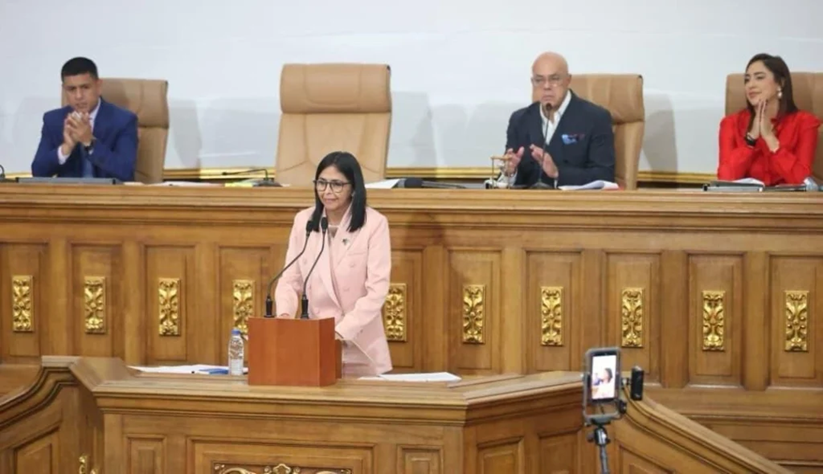
Venezuelan Executive Vice President Delcy Rodríguez presented the Budget Bill and the Special Law on Annual Debt for the 2026 fiscal year to the National Assembly on Thursday, reaffirming energy sovereignty in the face of external pressures and contextualizing current decisions within the country’s oil history.
This event marks the beginning of the legislative debate on the financial pillars that will underpin public policies and the country’s development next year. The budget proposal includes more than 5 trillion bolivars, of which 77.8% will be allocated to social investment, as detailed by the Vice President.
The Vice President emphasized that Venezuela has maintained its position in the face of “a series of lies” designed to justify intervention and seize Venezuela’s vast oil reserves, the largest in the world. In this context, the vice president declared that “imperialism has always said: the noble savage. They may govern their lands, but the oil belongs to the empire”.
As a result of these sovereign policies, “Venezuela has taken on the challenge and dared to change history. Oil revenues for education, for health, for the pension system. Let it reach the people.” She said.
Return to the Homeland Plan continued, Strengthening Sovereignty and Family Reunification
The President of the Bolivarian Republic of Venezuela, Nicolás Maduro Moros, has approved the request submitted by the National Institute of Civil Aeronautics (INAC) to continue the vital Plan Vuelta a la Patria.
This decision guarantees the continuity of repatriation operations and family reunification within the country. In a gesture of sovereignty and humanitarian pragmatism, the approval includes permission for the participation of U.S. aircraft in these flights.
INAC, as the institution that exercises absolute sovereignty over Venezuelan airspace in accordance with international conventions, has been responsible for issuing the required operational permits. This action underscores that regulatory authority over Venezuelan airspace is being fully exercised, even when facilitating international humanitarian operations.
“The Venezuelan National Institute of Civil Aeronautics issued the permits as the institution that exercises Venezuela’s air sovereignty, in accordance with international conventions, exercising absolute sovereignty over Venezuelan airspace,” stated the President.
The effectiveness and human impact of this policy are underscored by the recent arrival of flight number 95 of the Plan Vuelta a la Patria (Return to the Homeland Plan) on December 3rd, carrying 266 Venezuelan nationals who were received by the Minister of Foreign Affairs, Yván Gil, at Maiquetía International Airport.
“Returning our migrants to the peace of their Venezuelan homes, to the arms of their families,” commented President Nicolás Maduro.
Venezuela is a pioneer in building a new democracy and 21st-century socialism
The President of the Bolivarian Republic of Venezuela, Nicolás Maduro Moros, affirmed that despite the threats the country faces from the United States government, as well as the obstacles and difficulties, “Venezuela is a pioneer in building a new democracy and 21st-century socialism.”
He also expressed that the trials God places before the nation will be overcome because he has complete conviction and Christian faith in the people and Jesus Christ.
Furthermore, the President requested that Major General Jorge Márquez, head of the 1×10 Good Governance program, coordinate with the Minister of Popular Power for Communication and Information, Freddy Náñez, to publicize the cases reported and resolved through the 1×10 system.
“We need to make reported issues visible, issues resolved, and circulate them on social media and in the press so that our people become increasingly empowered, motivated, and aware,” he asserted.
In this context, it is important to highlight that the revolutionary leader has always maintained the vision of building a new socialist modernity that addresses the demands of the modern world and opposes its negative values.
Venezuelan F-16 Jets Force Illegal Aircraft to Land
On Friday, Gen. Domingo Hernandez, the Operational Strategic Commander of the Bolivarian National Armed Forces (FANB), said that three F-16 fighter systems from the Bolivarian Military Aviation (AMB) intercepted an aircraft in Apure state after it violated national airspace, forced it to make an emergency landing and immobilized it on the ground.
The high-ranking military officer said the aircraft had been detected by early-warning radar systems belonging to the nation’s Comprehensive Aerospace Power and its territorial defense system.
The twin-engine, white Cessna 310 entered Venezuelan airspace with its transponder system turned off, did not transmit an identification code, had no visible tail number and did not present a flight plan.
Due to those violations of the protocol established in the Law on Control for the Comprehensive Defense of Venezuelan Airspace, the Cessna 310 was declared illegal and hostile, and authorities proceeded to interdict it.
Arbitrary Sanctions Threaten Development Rights of 76 Nations, Venezuela Warns
On Thursday, Venezuela’s representative to the United Nations, Samuel Moncada, recalled that the “Right to Development” of more than 76 countries is being systematically attacked by arbitrary, illegal, and cruel sanctions imposed by wealthy nations.
“Those sanctions are weapons of economic warfare,” he said on behalf of the Group of Friends in Defense of the United Nations Charter during the first observance of the International Day against Unilateral Coercitive Measures.
The Venezuelan official highlighted the intentional coincidence of the date (Dec. 4) with the anniversary of the Declaration on the Right to Development, underscoring that unilateral coercive measures are the greatest obstacle to implementing the 2030 Agenda and national development plans.
Moncada emphasized that no political or ideological justification can legitimize these actions, which he said cripple nations’ productive potential by blocking access to financing, technology, medicines, and food.