

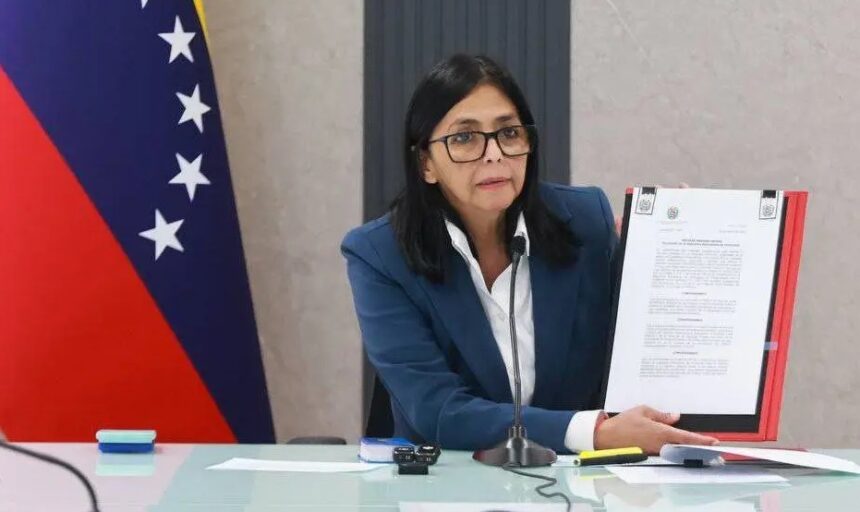
Venezuela has firmly reiterated its claim over the disputed Essequibo region following a diplomatic spat sparked by a lapel pin worn by acting President Delcy Rodríguez.
The controversy began when Rodríguez wore a pin shaped like Guyana’s resource-rich Essequibo region—which makes up two-thirds of Guyana’s territory—during official visits to Barbados and Grenada. In response, Guyanese President Irfaan Ali filed a formal complaint with Caricom chairman Terrance Drew, stating that the accessory explicitly asserts “Venezuela’s claim to Guyana’s territory”.
Speaking at an anti-sanctions rally in the state of Carabobo on Tuesday, Rodríguez dismissed the complaint, noting that Guyana’s president was “causing a scandal” over her clothing. “The only map I’ve ever known,” Rodríguez said regarding the pin, adding, “Now they’re even bothered by how I dress”.
Other top Venezuelan officials quickly rallied behind Rodríguez to defend their territorial claims. Venezuelan Foreign Minister Yván Gil characterized President Ali’s focus on the acting president’s clothing as an “erratic manoeuvre” and “improvised shows,” asserting that the pin merely reflects a “historical truth, strongly validated since the 1966 Geneva Agreement”. Similarly, National Assembly President Jorge Rodríguez took to X to declare that the Essequibo region is a “historical, legal, and moral right” of the Venezuelan people, though he maintained that their response remains rooted in “peace diplomacy”.
This escalating war of words occurs just ahead of a critical legal showdown. The International Court of Justice (ICJ) is scheduled to begin oral hearings on May 4 regarding the border dispute. Guyana brought the matter to the ICJ in 2018, seeking legal confirmation of the 1899 Arbitral Award that established the border between the two neighboring nations.
Rodríguez confirmed Venezuela’s impending participation in the hearings, stating, “We will soon be at the International Court of Justice in the coming days to reaffirm our historic position, which is international law and respect for the Geneva Agreement”.