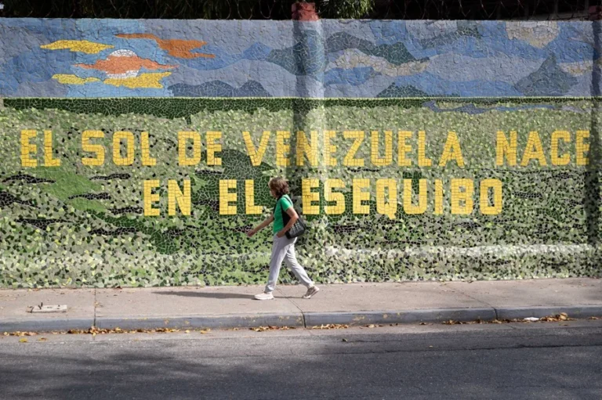
Venezuela affirms that the Geneva agreement remains the only valid and current legal instrument to reach a practical, satisfactory and mutually acceptable solution for both nations through direct bilateral negotiations. Photo: EFE.
Venezuela categorically rejected recent provocative statements made by Guyanese President Irfaan Ali during his nation’s 60th independence anniversary celebrations. Venezuela reaffirmed its unwavering defense of historical rights over the Guayana Esequibo territory, asserting it will never renounce its legitimate claim, underscoring that the 1966 Geneva Agreement remains the sole valid and current legal instrument to achieve a practical, satisfactory, and mutually acceptable solution for both nations through direct bilateral negotiations.
Venezuela firmly condemned President Irfaan Ali’s unsubstantiated assertions that the Guayana Esequibo territory exclusively belongs to Guyana and was never under Spanish or Venezuelan sovereignty. These declarations, made on May 27, during the anniversary of Guyana’s independence, were deemed a deliberate falsification of historical and legal truth by the Venezuelan Government. In response to these claims, FM Yván Gil emphasized that the Bolivarian Government remains committed to seeking a just and peaceful resolution through direct diplomatic channels. He highlighted that the territorial dispute is a direct consequence of British colonialism, a legacy that continues to impact the sovereignty of the entire region. In this sense, Gil underscored that the dispossession of Esequibo constitutes an inheritance of the British Empire’s imperial practices, from which Guyana eventually gained its independence.
Authorities in Caracas have consistently urged the Guyanese Government to honor its international obligations by engaging in face-to-face, good-faith negotiations. Such a peaceful resolution must fully respect the principle of sovereignty and the territorial integrity of the entire region.
Venezuela’s firm stance reflects its commitment to decolonization and the pursuit of justice regarding a territory it considers historically its own, highlighting the consequences of colonialism and advocating for peaceful resolution through dialogue and respect for international agreements.
President Maduro Sends a Message of Union and Hope to the Venezuelan People
From the place where Trump’s government hold him hostage int the United States, the constitutional president of Venezuela Nicolas Maduro sent a message to the Venezuelan people calling for union, peace, prosperity and freedom on Pentecost Sunday.
President Maduro Sends a Message of Union and Hope to the Venezuelan People: “Beloved people of Venezuela, brothers and sisters of the world: on this Pentecost Sunday, Cilia and I send you a hug of faith, love and gratitude. Prayer, when born of the power of true faith, achieves everything we propose in family and community,’ says the message spread by social networks. President Maduro, who is being hostage in a New York Federal prison after a bombardment and lightning invasion to abduct him and his wife the first Combatant Cilia Flores, quoted the Gospel of St. Matthew to let the Venezuelans know that faith and confidence “even if they say to this mountain, ‘Rise up and be cast into the sea,’ will happen” (Mt 21:21).
In addition, the president highlights the power of collective prayer, stating that if two or three people unite in God’s name to ask for something, it will be granted them, as He will be present among them according to Matthew (18:19-20). In the message, the Venezuelan head of state highlights the importance of values such as solidarity, love, helping others, respect, service and the common good, especially in the search for union for the country. “On this day of Pentecost, let us ask to receive the light, guidance, and blessings of the Holy Ghost as the apostles received them for the peace, prosperity, and freedom of all of us. May the Holy Spirit blow upon Venezuela and upon the peoples of the world; may he give us wisdom to act, humility to reconcile and strength to move forward. Cilia and I thank you so much support, so much prayer and so much solidarity. We are always with you.”
Venezuela Launches 2nd Phase of National Pilgrimage Against Sanction
Acting President Rodriguez calls for an end to U.S. and European sanctions. Venezuelan Acting President Delcy Rodriguez launched the second phase of “The Great National Pilgrimage for a Venezuela Without Sanctions and in Peace” in Anzoategui state.
The tour began with a massive motorcycle caravan in San Tome and concluded in El Tigre city, where Rodriguez rejected foreign agendas focused on destabilizing Venezuela and demanded an end to the unilateral coercive measures imposed by the United States and Europe. “May violence never prevail in our country! We are moving toward peace and development. We are moving toward a Venezuela free of sanctions!” she stressed at an event also attended by local authorities such as Anzoategui Gov. Luis Marcano and El Tigre Mayor Alberto Gago.
Before a large audience, Rodriguez reaffirmed that her administration has set two strategic objectives: achieving Venezuela’s right to development and reducing social gaps generated by the economic blockade.
The Venezuelan acting president called for healing intolerance and hatred through love and cooperation so as to ensure the stability that U.S. measures seek to disrupt.
Rodriguez sent a message to the United States, Europe and the governments that have sanctioned her nation, stating that Venezuela has only demonstrated friendship and cooperation. “Do not fear an unblocked Venezuela. Do not fear a Venezuela without sanctions. Throughout history, the Venezuelan people have demonstrated friendship, cooperation and support for other peoples when they have needed it.”
Venezuelan Grassroots Organizations Express Support for Cuba
They condemn Washington’s military threats and call for an end to the U.S. blockade. This week, the Social Movements and Communes Council, an entity attached to the Simon Bolivar Institute for Peace and Solidarity Among Peoples, accompanied by other Venezuelan grassroots organizations, held the solidarity gathering “A Hug for Cuba” at the Cuban Embassy in Caracas.
During the event, social movements expressed their unconditional support for the Caribbean island amid increasing international pressures, stating that Cuba has the active backing of the Venezuelan people in the streets and in any scenario in defense of the sovereignty of the Greater Homeland. They denounced what they described as recent threats of direct military intervention by U.S. President Donald Trump and Secretary of State Marco Rubio, saying they constitute a war escalation intended to spread fear on the Caribbean island, in complicity with far-right sectors based in Miami.
Grassroots organizations warned that Washington’s current intentions represent the continuation of a criminal policy of more than six decades of economic, commercial and financial blockade.
Venezuelan communal organizations praised the Cuban people’s creative resistance in the face of arbitrary U.S. sanctions and rejected accusations against Army Gen. Raul Castro and members of the Cuban military, emphasizing that those accusations criminalize the defense of territorial integrity. Finally, the social movements issued an urgent international call to stop the White House’s policy of hostility, demanding the immediate lifting of the blockade, Cuba’s removal from the list of state sponsors of terrorism and the end of what they described as unfounded judicial charges against Castro.
Venezuela Restructures Government Management, Popular Consultation Organized
Venezuela promotes a 15-day national virtual consultation process for citizens and productive sectors to identify the most complex and cumbersome administrative procedures in public institutions. Photo: Venezuelan Presidential Press. Venezuela’s Acting President Delcy Rodríguez this Tuesday designated two presidential commissions for national Government restructuring and efficient management and organized the next popular consultation to begin on June 1.
The Government restructuration’s initiative, announced from Miraflores Palace, aims to optimize development goals and guarantee citizen well-being amid economic challenges, driven by an asserted imperialist economic war. Acting President Rodríguez emphasized that this commission aligns with a “Venezuela that reemerges from its identity, that reemerges from its liberating history”, asserting the nation’s commitment to “seeking its own path for the happiness of the people.”
Popular Participation Key
Delcy Rodríguez reminded attendees that a significant national consultation for the reform of criminal justice will commence on June 1, in order to drive a judicial modernization to increase its efficiency. A nationwide virtual consultation spanning 15 days, will be initiated on June 1, inviting citizens and productive sectors to actively identify and report complex and cumbersome administrative procedures within public institutions.
The primary objective is to pinpoint administrative requirements that impede entrepreneurs from establishing or sustaining their productive projects, as well as to evaluate procedures that directly impact the general well-being of the people. This bottom-up approach is designed to create a comprehensive understanding of the administrative landscape from the perspective of those who navigate it daily, ensuring that proposed reforms are grounded in real-world experiences and needs.
To facilitate this broad participation, the Executive has launched the dedicated website simplifica.gob.ve. This digital platform allows Venezuelans to actively engage by downloading relevant documents and pinpointing the “critical knots”-the specific administrative hurdles that obstruct the initiation or long-term viability of productive endeavors. The site serves as a direct channel for feedback, ensuring that the government receives actionable insights from individuals experiencing these challenges firsthand.
Venezuela Denounces Severe Impact of External Sanctions, Prioritizes Social Plans
Venezuela’s Acting President makes a unified call for the end of sanctions, stressing that the country achieved sustained growth despite these restrictions that hinder development and intervention in essential services. Venezuela’s Acting President, Delcy Rodríguez, affirmed this Tuesday that the Venezuelan Government is “battling to unblock resources that would allow investment in basic services”, directly addressing the severe impact of unilateral coercive measures imposed by the United States. Her declaration came during a Council of Ministers meeting held at the Miraflores Palace in Caracas, underscoring the nation’s struggle against economic restrictions.
Rodríguez detailed the ongoing expansion of social plans and the strategic recovery of the country’s health infrastructure. These initiatives include the vigorous implementation of various surgical programs and comprehensive medical care, designed to directly address the healthcare needs of the Venezuelan population despite external pressures. The Acting President vehemently denounced the “terrible economic blockade” that the Bolivarian Republic has endured, noting that few nations have faced such extensive limitations on their economic, financial and commercial capabilities. In this sense, Rodríguez issued a unified call for the immediate cessation of these sanctions, which currently number over one thousand and remain actively enforced.
However, she proudly underscored that Venezuela has managed to achieve sustained economic growth despite these stringent restrictions, which consistently obstruct national development and the Government’s ability to intervene effectively in essential public services.
Acting President Rodriguez Promotes Human Rights Agenda in Venezuela
The meeting was conceived as a space to analyze social projects seeking to generate direct benefits for the population. Rodriguez emphasized that these initiatives adapt to the new moment that Venezuela is experiencing. “I had a valuable meeting with Dr. Eglee González, the Ombudswoman, to learn about extraordinary projects aimed at directly addressing the rights of our people in the ongoing rebirth of Venezuela,” she said.
They also analyzed measures and policies aimed at guaranteeing the protection of human rights. In a post on Telegram, Rodriguez stated that those rights constitute “the compass that guides the actions of the Venezuelan State.” Recently, her administration implemented measures related to the issue and approved an amnesty law, which has benefited more than 8,500 people. Rodriguez also expressed gratitude for the work of national organizations, which strengthen institutional structures and support processes such as the transformation of Venezuela’s judicial system.