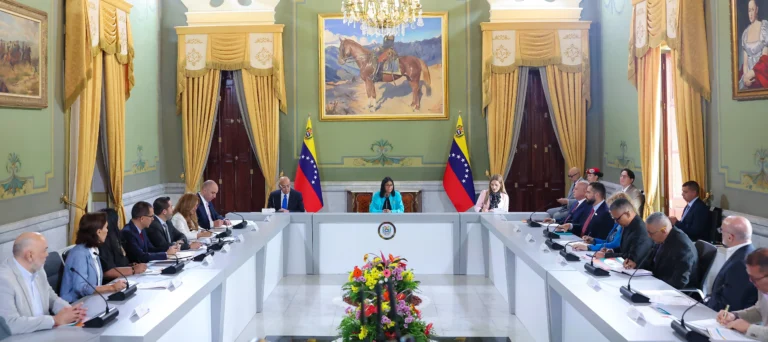
Venezuela’s Acting President Delcy Rodríguez today officially installed the Commission for the Great National Consultation on Penal Justice Reform, initiating a profound restructuring of the legal system.
Venezuela’s Acting President Delcy Rodríguez on April 23, led the formal installation of the Commission for the Great National Consultation on Penal Justice Reform, marking a pivotal moment in the nation’s efforts to redefine its judicial landscape, responding to a crucial commitment made on April 19.
The initiative aims for a comprehensive and profound re-structuring of the Venezuelan legal system, guided by principles of humanism, prevention and equity, ensuring a more just and accessible framework for all citizens.
During the ceremony, Acting President Delcy Rodríguez explained that the primary objective is to consult citizens regarding the penal system’s functioning, acknowledging that despite previous advancements, the nation has an “unpostponable debt to the Venezuelan people” concerning justice access.
In this sense, the Venezuelan Acting President emphasized that the Commission will facilitate a national consultation involving academics, institutions, and communities. This process will identify key demands related to court treatment, processing times, and judicial guarantees, ensuring a comprehensive understanding of public needs.
The Acting President Delcy Rodríguez announced that the Commission will organize a national pilgrimage and establish debate forums across the country. These initiatives aim to gather public proposals on critical aspects of the justice system, including timely access to courts, guarantees of due process, judicial transparency, appropriate treatment for individuals deprived of liberty and the overall strengthening of the penal system. According to this, Rodríguez reiterated that the entire process will be anchored in a Human Rights approach and robust citizen participation. She affirmed that the ultimate goal of the reform is to “construct a justice system that responds to the daily clamor of the Venezuelan people.”
Venezuela’s Amnesty Law Releases 8,616 Detainees n 2 Months
Venezuela’s Amnesty and Democratic Coexistence Law has on April 23 led to the release of 8,616 detained individuals two months after its promulgation.
Jorge Arreaza, President of the Special Commission of Amnesty Law Implementation, tasked with the implementation of Venezuela’s Amnesty and Democratic Coexistence Law, announced today that a total of 8,616 individuals who had been deprived of liberty have been released. This significant development comes just two months following the law’s promulgation. “We continue to receive applications from Venezuelans living both within and outside the country, contributing to peace”, Arreaza stated in his public post. In this sense, he reaffirmed that the commission’s work is central to ensuring that the law effectively serves its intended purpose of national reconciliation and stability.
The legislation, which was formally proposed by Acting President Delcy Rodríguez and promulgated on February 20, specifically outlines 13 political acts that fall under the scope of the amnesty. These include, but are not limited to, events related to the coup d’état of April 11 and 12, 2002, a pivotal moment in Venezuelan political history. It also covers assaults and attacks against both public and private facilities that occurred during that tumultuous period, signaling a comprehensive approach to addressing historical grievances.
The normative framework meticulously ensures that all amnesty recipients can fully resume their lives within society and participate actively in the public sphere, representing a significant legislative effort aimed at addressing reconciliation and fostering democratic coexistence within the country, seeking to heal past political divisions.
Venezuela Demands IMF Release Blocked $5 Billion Assets
Acting President Delcy Rodríguez has formally urged the International Monetary Fund to release Venezuela’s $5 billion in frozen Special Drawing Rights (SDRs), originally requested by President Nicolás Maduro in 2020, crucial for vital infrastructure and economic stability.
During the “Grand National Pilgrimage for a Venezuela without Sanctions and in Peace” held in Falcón state on April 21, Venezuela’s Acting President Delcy Rodríguez provided an update on recent diplomatic and financial initiatives spearheaded by President Nicolás Maduro since 2020, focusing on the recovery of Venezuelan frozen assets.
Rodríguez underscored the imperative for the nation not to yield to adversities but to persevere with unwavering determination for the country’s supreme interests. The request, reiterated during high-level diplomatic dialogues, aims to strengthen public services and improve the lives of Venezuelan workers. In her dialogue with the community, the Acting President confirmed a critical conversation with International Monetary Fund (IMF) Managing Director Kristalina Georgieva. The central point of discussion was Venezuela’s persistent demand for access to $5 billion in Special Drawing Rights (SDRs), which remain unjustly blocked.
Rodríguez meticulously recalled that on March 15, 2020, President Nicolás Maduro had formally petitioned the IMF for emergency financing. This initial request was specifically intended to bolster Venezuela’s healthcare system during the severe global challenge posed by the COVID-19 pandemic. However, despite the urgent need, these crucial funds were never disbursed to the nation.
The Acting President emphatically asserted that these funds are unequivocally the property of the Venezuelan nation. She further highlighted that this fervent plea for the release of the funds has been consistently reiterated by Venezuelan representatives in various international dialogue processes, including those held in Barbados, Mexico and Qatar, demonstrating a sustained diplomatic effort to reclaim what the nation considers its sovereign resources.
During her detailed explanation to the IMF directorate, Rodríguez clearly articulated that Venezuela possesses specific and meticulously planned projects for the responsible and effective utilization of these assets.
The primary objective for gaining access to these considerable resources, which rightfully belong to Venezuela, is the urgent recovery of vital national infrastructure. This includes critical areas such as the electricity and water supply systems, which have been significantly impacted by unilateral coercive measures and lack of access to international financing. Furthermore, the release of these funds is essential to help ensure broader macroeconomic stability, a cornerstone for the stability of the national currency and the exchange rate system.
Venezuelan Acting President Call for National Unity Against U.S. Coercitive Sanctions
Venezuela’s Acting President Delcy Rodríguez has issued today a powerful call for national unity, demanding the definitive cessation of the over 1,000 sanctions imposed against the Bolivarian Nation.
This Monday, the Acting President Delcy Rodríguez, led the delivery of the works of comprehensive rehabilitation of the National Educational Unit “Dr. José de Jesús Arocha”, with the aim of strengthening the country’s education system. Among the recovery works that were carried out, is the rehabilitation of spaces such as classrooms, kitchen, toilets, electrical installations, waterproofing, masonry and general painting.
During this significant event marking the handover of a newly rehabilitated educational facility, Rodríguez articulated the central objective of this popular movement. She emphasized that the primary goal is to achieve a Venezuela capable of robustly producing and generating strategic income, which can then be directly channeled toward enhancing the social well-being of the Venezuelan people and improving the salaries of workers. “I will not rest until every Venezuelan joins this national cry for the end of sanctions”, Rodríguez declared, highlighting her commitment to the cause.
In this sense, Delcy Rodríguez affirmed that the entire country has enthusiastically joined the “Great National Pilgrimage for a Venezuela Without Sanctions and in Peace“, advocating for the fundamental right to economic freedom and development unhindered by external and unilateral blockades.
Within the framework of the “Together Everything is Possible” agend (“Juntos todo es posible”, in Spanish), the Acting President proudly reported the successful recovery of over 1,700 educational facilities across the nation. She underscored that the return of children to these rehabilitated schools represents a tangible and direct outcome of sustained efforts to surmount the severe financial limitations and economic hardship stemming from the coercive measures imposed on the country.
Addressing the widespread mobilization across the national territory, Rodríguez described the citizen participation as “impressive”, particularly noting the massive turnout in the states of Zulia, Amazonas and Táchira.
Rodríguez further announced that the mobilization agenda continued this Monday in the states of Bolívar and Mérida, with plans for it to extend throughout the entire Venezuelan territory.
Venezuela Celebrates 216 Years of Historic Independence Proclamation with Strong National Unity
Venezuela commemorates 216 years of the 1810 Independence Proclamation honoring the historic act in Caracas that rejected Spanish authority. The celebration coincides with the launch of the Great National Pilgrimage for a Venezuela Without Sanctions.
Caracas, April 19, 2026 — Venezuela is commemorating today the 216 years of the Venezuela independence proclamation, a foundational event that took place on April 19, 1810, when the people and the Cabildo of Caracas rejected Spanish colonial authority.
On that Holy Thursday, the crowd gathered in the Plaza Mayor of Caracas delivered a resounding “No” to Captain General Vicente Emparan, leading to the establishment of the Supreme Junta of Caracas. This act marked the first exercise of self-government and laid the groundwork for the country’s full independence declared in 1811.
The events of April 19, 1810, are considered the first cry for freedom in Venezuela and one of the earliest sparks of the Latin American independence movement. By deposing the Spanish captain general and forming the Supreme Junta, Caracas took a decisive step away from imperial control toward popular sovereignty.
This movement not only challenged colonial power but also established doctrinal foundations that continue to shape Venezuelan national identity. The popular rejection of foreign imposition symbolized the awakening of a collective will that would later lead to the formal Declaration of Independence on July 5, 1811.
As part of the commemorative activities, Venezuela has launched the Gran Peregrinación Nacional (Great National Pilgrimage) for a Venezuela Without Sanctions. This mobilization, starting today from various regions of the country, aims to unite patriotic fervor with the demand for the lifting of unilateral sanctions. The pilgrimage will culminate on May 1, International Workers’ Day, bringing together political, social, and popular sectors in a collective call for peace, sovereignty, and economic relief. Authorities have invited all sectors of society to join the march as an expression of national unity.
Venezuela-Colombia Third Commisssion Meeting Boosts Regional Integration
Venezuela and Colombia today launched the III Meeting of their Binational Neighborhood and Integration Commission in Caracas, aiming to strengthen brotherhood and advance cooperation initiatives.
In a significant diplomatic event, the Venezuelan Minister of People’s Power for Foreign Relations, Yván Gil, alongside his Colombian counterpart, Rosa Yolanda Villavicencio, officially installed in Caracas the III Meeting of the Binational Neighborhood and Integration Commission.
This meeting occured just ahead of an anticipated meeting in Caracas between Colombian President Gustavo Petro and Venezuela’s Acting President Delcy Rodríguez to be held tomorrow. The Venezuelan diplomat emphasized the inherent connection between Venezuela and Colombia, stating that “they are called, through this commission, to advance in constructing an inexorable path of union”. This high-level gathering aims to solidify regional peace and refine economic agreements that will directly benefit the peoples of both nations. “The effort made by each of you, comrades, is fundamental, because it seeks to resolve, to clear away, each and every one of the limitations we may face that threaten this policy of union. In an increasingly complex world, where wars, violence, the inhumane seem to prevail over peace, the humane, coexistence, we have the absolute responsibility to move forward together on this path. And it has not been, nor will it be, an easy or simple task”, Gil stated. “We must be an example to the world, not an example of dissolution, not an example of difference, of confrontation, but quite the opposite”, he added.
Venezuelan Assembly Condemns Racist Attacks Against Delcy Rodriguez
Venezuela’s National Assembly President Jorge Rodríguez today vehemently condemned the racist and misogynistic attacks targeting Acting President Delcy Rodríguez in Madrid, accusing Vox and Popular parties of promoting such actions and drawing parallels to Nazi justifications.
The President of Venezuela’s National Assembly, Jorge Rodríguez, on April 21, issued a strong condemnation of the racist and misogynistic attacks directed against Acting President Delcy Rodríguez from Spain. He specifically highlighted what he described as the hypocrisy of the Vox and Popular parties in promoting such attacks and employing derogatory language, underscoring the severity of the incidents that have sparked outrage within Venezuela.
Speaking from the Venezuelan capital, Rodríguez explicitly stated that spokespersons for the Spanish ultraright-wing had launched vitriolic attacks against the Acting President.
These misogynistic actions, he asserted, were not spontaneous but were actively sponsored and funded by the Popular Party and the ultraright-wing political organization Vox, indicating a calculated campaign of aggression rather than isolated incidents.
The head of the Venezuelan Assembly underscored the profound gravity of the situation, declaring that “racism is a disease of the spirit, and it is unacceptable; and it is even more unacceptable to seek excuses to try to justify such barbarity.” He made a poignant allusion to emotional justifications that he likened to narratives propagated by nazism, emphasizing the dangerous precedent set by rationalizing such hateful behavior and highlighting the need for firm moral opposition.
Jorge Rodríguez had previously addressed this sensitive issue on Monday, affirming that extremism aims to dehumanize Venezuelans by labeling them with racist epithets. “We must eradicate any discourse of hatred”, he firmly stated, while also recalling that Venezuelan culture is fundamentally characterized by principles of solidarity and human dignity. These core values, he emphasized, stand in stark contrast to the narratives that seek to fabricate a non-existent internal conflict within the nation, thus reinforcing the true spirit of the Venezuelan people.
Venezuela Repatriates 141 Nationals Under State Return Program
A group of 151 Venezuelan nationals returned to the country on April 20 under the government-run repatriation initiative known as the Great Mission Return to the Homeland. The flight, identified as number 135 of the program, landed at Simón Bolívar International Airport in Maiquetía, La Guaira state, arriving from Opa Locka, Florida. The passengers included 110 men, 33 women and eight minors, according to official figures.
Upon arrival, the returnees were received by migration and health authorities and underwent individual interviews and case reviews through a designated migration corridor. They later received medical attention from state institutions and were transported to their homes using units coordinated by citizen security agencies.
The operation involved multiple state bodies, including the Scientific, Penal and Criminal Investigations Corps, the Bolivarian National Intelligence Service, the Bolivarian National Guard and the Bolivarian National Police, as part of established reception protocols.
Since the program’s reactivation in February 2025 following migration agreements between Caracas and Washington, more than 20,000 Venezuelans have returned to the country on repatriation flights . During March and April 2026, authorities reported regular arrivals of groups ranging from 140 to 320 people from different locations in the United States. Created in 2018, the initiative facilitates the voluntary return of Venezuelans who are abroad, particularly those in situations of vulnerability or immigration detention. Officials stated that inter-institutional coordination remains in place to ensure that each reception is carried out under humanitarian and social protection protocols.