

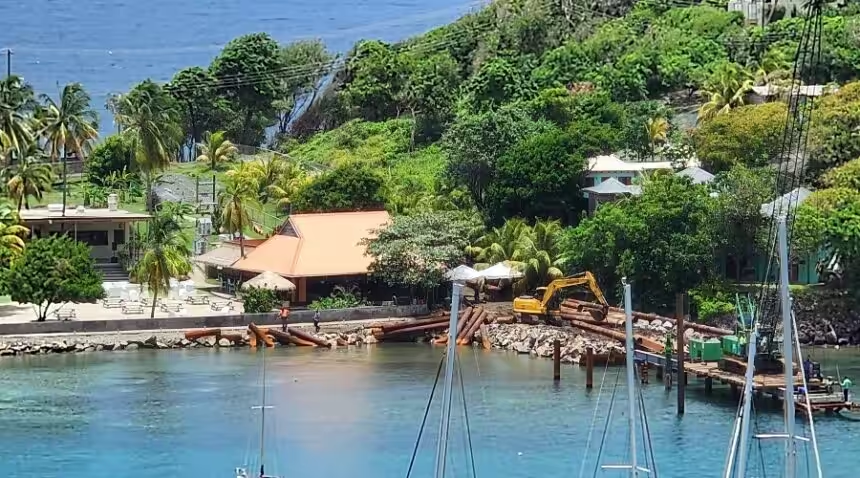
Mainland St. Vincent’s only marine protected area has been abruptly replaced by the mechanical roar of bulldozers, cranes, and pile drivers.
At Canash Bay, located within the fragile 2.2-square-kilometer South Coast Marine Conservation Area (SCMCA), an environmental disaster is unfolding in broad daylight. Yet, as critical ecosystems are actively dismantled, a glaring question hangs over the coast: where are the prominent environmental groups and conservationists who once stood as the island’s fierce ecological guardians?

The scale of the current destruction is staggering. According to recent reports, property developers have commenced extensive clearing and land reclamation within this legally protected zone, which stretches from Indian Bay to Johnson Point. One developer has already bulldozed more than 70 percent of the fragile Blue Lagoon mangrove forest, completely destroying critical habitats for local wildlife, including herons, egrets, warblers, sandpipers, bullfinches, and crabs.
To make matters worse, these bulldozers have dug up and discarded over 280 mangrove seedlings that were painstakingly planted in 2018 and 2023 under the government’s South Coast Marine and Coastal Rehabilitation Adaptation Project—initiatives specifically designed to build shoreline resilience against climate change.
Simultaneously, a second developer is actively reclaiming thousands of square feet of seabed to construct a permanent dock and artificially extend the shoreline directly in front of the Coconut Grove Beach Club. Local residents have warned that the construction is altering natural water movements and creating stagnant water in front of nearby cottages.
Despite this ecological devastation occurring in mainland St. Vincent’s most vulnerable marine sanctuary, the country’s leading environmental organizations and advocates have remained conspicuously silent.
This current passivity stands in stark, baffling contrast to the high-profile public crusade launched just five years ago.
In July 2021, when an application was submitted on behalf of La Vue Hotel to remove a portion of the coral reef at Indian Bay—part of the very same protected marine park—local conservationists launched a fierce, coordinated campaign that gained international attention.
Back then, the St. Vincent and the Grenadines Conservation Fund (SVGCF), led by CEO Vanburn Harry, formally registered a blistering objection with the Physical Planning and Development Board, warning that the development directly threatened the extermination of a vital marine ecosystem.
Louise Mitchell, Executive Director of the SVG Environmental Fund, passionately lobbied against the project on television and spearheaded an online petition that rapidly garnered over 2,500 signatures.
Calvert Richards, owner of Dive St. Vincent, actively disputed developers’ claims that the reef was dead, asserting that over 95 percent of the corals were alive and healthy.
Local resident and photographer Nadia Huggins published stunning underwater photos of the thriving marine life to social media, while lawyer Vynette Frederick compiled those images into a photographic collage to back her formal legal objection.
Their collective, unyielding voices successfully forced developers onto the defensive and held the Physical Planning and Development Board accountable.
Today, however, the silence from these same organizations and advocates is deafening.
As a vital mangrove forest—one of only five remaining on the entire island of St. Vincent—is cleared and the seabed is filled in, there are no active online petitions, no high-profile media appearances, no legal coalitions of lawyers filing objections, and no public photographic campaigns showing the destruction of the SCMCA.
Instead, the task of sounding the alarm has fallen almost entirely to concerned, anonymous local residents and political figures.
Opposition Leader Ralph Gonsalves has issued a blistering critique of the New Democratic Party (NDP) administration under Prime Minister Godwin Friday, accusing the government of extreme hypocrisy for staying silent on the “environmental massacre” at Canash Bay while simultaneously using conservation to justify the controversial, heavily discounted 54 million EC dollar sale of Chattam Bay.
“Look at what they have done to the mangroves. I do not know how anyone could give permission for something like that to happen,” one anonymous resident recently lamented.
But while residents whisper their frustrations and politicians trade barbs, the organized civil society that once proudly defended St. Vincent’s marine treasures remains in the shadows. The powerful ecological voice that defined the Indian Bay struggle of 2021 has gone dark, leaving the fragile mangroves of Canash Bay to face the bulldozers alone.
