• 20th BOSVG Performing Arts Festival Launched 

    20th BOSVG Performing Arts Festival Launched 

     The Department of Culture in the Ministry of Youth, Sports, Culture and Creative Industries has officially launched the 20th annual Bank of St. Vincent and the Grenadines (BOSVG) National Performing Arts Festival 2026. The launch proceedings took place at the Peace Memorial Hall in Kingstown, marking the return and expansion of one of the nation’s premier cultural showcases under the theme “Reclaiming Our Legacy.”

    The month-long festival gathers actors, playwrights, poets, cultural practitioners, students, and audiences to celebrate Vincentian identity, traditions, and artistic heritage through drama, poetry, monologues, and cultural dialogues. Following opening devotions led by Ronette Buntin and the singing of the national anthem, master of ceremonies Ashisha Sam welcomed dignitaries, cultural ambassadors, and attendees to the launch.

    A comprehensive itinerary was unveiled by Drama Development Officer Sean Frederick, outlining an ambitious schedule that kicks off with a two-day National Performing Arts Conference at Peace Memorial Hall under the banner “Believe, Innovate, Next Level.” Broadcast live on VC3, the conference examines the creative sector’s role in national development, highlighted by a panel roundtable titled “Navigating the Challenges While Advancing Towards an Orange Economy,” moderated by O’Rande “Bomani” Charles and featuring panelists Jonard Ford, Nisha Hope, Garrett John, and Dr. Janelle Allen.

    The performance calendar continues across November with free and ticketed community and theatrical showcases:

    Saturday, November 7: The inaugural National Poetry and Monologue Competition at the CDC Entice facility (free admission, 7:00 PM), offering an intimate setting for emerging creative voices.

    Sunday, November 15: An evening of poetry, storytelling, and music at Peace Memorial Hall headlined by grandmaster poet Steve Wyche and Company alongside prominent local musicians.

    November 21–22: Back-to-back theatrical productions at Peace Memorial Hall (admission 0 XCD, 7:00 PM), celebrating female Vincentian dramatists: Samantha Martin’s award-winning drama “Soft Rope” on November 21, and Jackie English-Jacobs’ play “Mavis Mighty Model” on November 22.

    Friday, November 27: A historic reenactment drama written by David “Darkie” Williams, with research and historical contributions by Sean Frederick, exploring the landmark 1935 trial of George Augustus McIntosh on treason charges following the 1935 Kingstown riots.

    November 28–29: The return of Dawson Billingy’s acclaimed feature play “Soca Relations,” closing the festival with an energetic showcase of young and emerging stage talent.

    The festival’s executive production team features seasoned cultural practitioners and performing arts youth ambassadors, including Ezra Ford, David Williams, Dawson Billingy, Lori John, Shaqwami, Tia Seals, Leslie Millington, and Michael Williams. The launch concluded with the formal handover of BOSVG’s title sponsorship check to Permanent Secretary Rommel Currency and Director of Culture Maxine Brown, signaling strong public-private partnership in advancing Vincentian heritage and creative expression.

  • iCode784 finalists vie for cash prizes up to $15,000

    iCode784 finalists vie for cash prizes up to $15,000

    Ten teams heading to the Finals following iCode784 Robotics Preliminaries

    The NTRC has successfully completed the Zone 1 and Zone 2 preliminary rounds of its iCode784 Robotics Competition, showcasing the talent and innovation of secondary school students across St. Vincent and the Grenadines. Eleven teams competed in the Zone 1 preliminaries on October 13, 2026, demonstrating their skills in robotics, programming, engineering design, and problem-solving. Following judging, six teams advanced to the finals:

    • Troumaca Secondary School
    • West St. George Secondary School
    • Union Island Secondary School
    • Georgetown Secondary School
    • St. Vincent Girls’ High School
    • Canouan Secondary School

    The competition continued November 3, 2026 at the Girl Guides Headquarters, where seven teams competed in the Zone 2 preliminaries for the remaining four places in the finals. The following schools secured advancement:

    • Troumaca Secondary School
    • West St. George Secondary School
    • Petit Bordel Secondary School
    • St. Martin’s Secondary School

    The NTRC commends all participating students, teachers, and schools for their dedication and enthusiasm. The iCode784 Competition continues to promote STEM education by providing students with valuable opportunities to develop technical, creative, and problem-solving skills.

    The finalists will now prepare to compete for cash prizes of up to $15,000 in the final round on January 19, 2027.

  • Demoting the Major? AG to co-chair crime task force

    Demoting the Major? AG to co-chair crime task force

    As violent crime and homicides surge past prior-year figures, Prime Minister Dr. Godwin Friday’s announcement of a specialized Joint Crime Task Force has exposed deep fractures within the national security executive. The task force, established to contain spiraling violent criminality, will not be led solely by the Minister of National Security, ‘Major.’ Instead, it is structured as a joint directorship co-chaired by Attorney General Louise alongside Minister ‘Major.’ This operational arrangement marks a significant departure from standard portfolio governance in St. Vincent and the Grenadines.

    Analyzing the political dynamics behind the announcement, Carlos James characterized the co-chair arrangement as an explicit internal demotion and a formal vote of no confidence in Minister ‘Major’s’ capacity to manage the national security portfolio independently. James highlighted the sharp contradiction between the NDP’s political rhetoric while in opposition—when party leaders repeatedly claimed to possess an immediate, off-the-shelf “crime plan”—and their current operational struggles within the 60-day post-election window.

    “Major by himself cannot handle crime and cannot deal with crime as Minister of National Security. So he brought Louise on to co-chair the task force,” James argued during On the Record. “I don’t know if any of you picked that up, but that is what I got from that speech. When you were in opposition you boasted about having a crime plan; best be sure that when you form government, you have to deliver on that crime plan.”

    The decision to insert the government’s chief legal officer directly into executive crime task force operations has raised alarm over potential constitutional overreach. James cautioned that embedding the Attorney General within operational law enforcement command indicates an intent to deploy aggressive, “gray-area” statutory mechanisms that could compromise citizen freedoms.

    Specific civil liberty and operational concerns include:

    State Surveillance Overreach: Institutionalizing mechanisms for expanded telecommunications surveillance and the interception of private communications.

    Freedom of Movement Restrictions: The imposition of targeted, regional curfews and localized emergency containment zones.

    Legal Pre-clearance of Intrusive Measures: Utilizing the chief legal officer to draft rapid statutory exemptions or executive orders that sidestep traditional judicial checks on law enforcement conduct.

    Erosion of Operational Standards: Disrupting standard police protocols in favor of ad-hoc executive directives.

    Call-in contributors strongly reinforced these warnings, expressing grave anxiety over public safety and deteriorating operational standards within the Royal St. Vincent and the Grenadines Police Force. A US-based Vincentian female caller delivered a scathing assessment of the visible decline in police force standards observed during the Independence parade, citing officers who appeared physically unfit, untidy uniforms, and a complete lack of turnout discipline and operational “sauce” under current leadership.

    The domestic anxieties surrounding civil liberties, law enforcement capabilities, and sovereign executive power directly intersect with broader historical debates on justice, self-determination, and the unaddressed systemic legacies of regional development.

  • ECCB targets investment, growth at CHOGM 2026

    ECCB targets investment, growth at CHOGM 2026

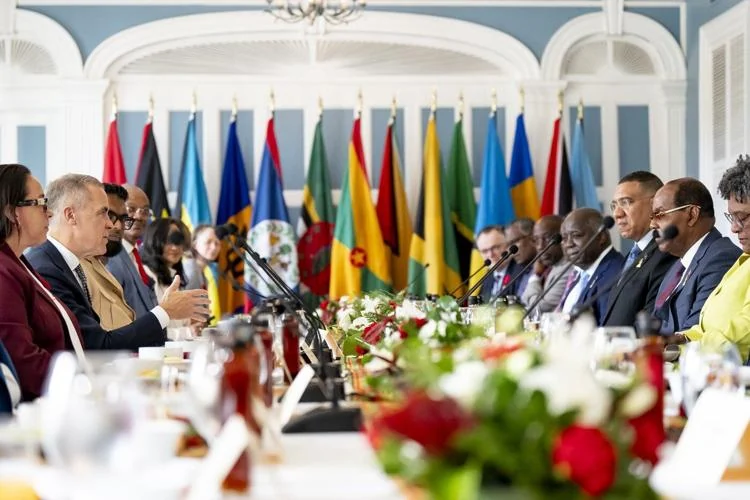
    The Eastern Caribbean Central Bank (ECCB) is leveraging the global platform of the 28th Commonwealth Heads of Government Meeting (CHOGM 2026), underway in Antigua and Barbuda, to advance its Big Push Agenda, strengthen strategic partnerships, and position the Eastern Caribbean Currency Union (ECCU) as a region of investment opportunity, innovation, and shared prosperity.

    As a platinum sponsor of the 14th Commonwealth Business Forum (CBF) 2026, taking place from November 2–4 at the Sticky Wicket/Coolidge Cricket Ground, the ECCB is showcasing its Strategic Plan 2026–2031, The Big Push: Collective Action for Shared Prosperity in the ECCU, while engaging global stakeholders on opportunities to accelerate the region’s economic transformation.

    A key feature of the ECCB’s participation is Governor Timothy N.J. Antoine’s involvement in two high-level engagements addressing issues central to the region’s economic future: international trade and cross-border financial connectivity.

    On Day 1, Monday, 2 November, Governor Antoine delivered remarks during the inaugural plenary session, A New Era of Commonwealth Trade, held from 1:00 p.m. to 2:00 p.m. at the Sir Viv Richards Plenary Stage. The session explored how the Commonwealth Advantage can strengthen economies and unlock a new era of growth as rising tariffs, protectionism, and declining trust reshape the global economy.

    The Business Forum, held alongside CHOGM, brings together Heads of Government, Ministers, business leaders, and representatives of civil society and youth organisations from across the Commonwealth’s 56 member states. The significance of this year’s gathering is further underscored by the presence of His Majesty King Charles III, Head of the Commonwealth, and Her Majesty Queen Camilla in Antigua and Barbuda. King Charles is scheduled to deliver the opening address to Commonwealth Heads of Government on Tuesday, 3 November.

    On Day 3, Wednesday, 4 November, Governor Antoine will chair the Central Bank Governors’ Roundtable, a special-invitation engagement scheduled for 9:30 a.m. to 11:00 a.m. in the Sir Andy Roberts Breakout Room. The roundtable will convene central bank governors and business leaders to explore how payments innovation and cross-border connectivity can facilitate trade and investment. Opening remarks will be delivered by CEO of De La Rue, Clive Vacher.

    “The Big Push is about thinking bigger, moving faster and acting together,” said Governor Antoine, highlighting the significance of CHOGM 2026 for the ECCU.

    “It is about transforming stability into resilience; potential into productivity; vulnerability into value; and regional ambition into shared prosperity. The central question for the CHOGM engagement is therefore: What could we achieve together that we cannot achieve alone?” he added.

    Six of the eight ECCU member territories – Antigua and Barbuda, the Commonwealth of Dominica, Grenada, Saint Christopher (St Kitts) and Nevis, Saint Lucia, and Saint Vincent and the Grenadines – are independent Commonwealth member states. The Commonwealth is also home to 33 of the world’s 42 small states and a population of approximately 2.7 billion people, more than 60 per cent of whom are aged 29 and under.

    Through its participation in the Commonwealth Business Forum, the ECCB seeks to build strategic partnerships, mobilise investment, and advance practical initiatives that strengthen resilience and foster shared prosperity across the ECCU.

  • CCJ restores Janet Hassan’s land sale victory in Guyana

    CCJ restores Janet Hassan’s land sale victory in Guyana

    THE CCJ ALLOWS APPEAL IN GUYANA LAND DISPUTE AND SETS ASIDE COSTS ORDER 

    On Tuesday, 3 November 2026, the Caribbean Court of Justice (CCJ) delivered judgment in Janet Hassan v Romanie Gouveia [2026] CCJ 16 (AJ) GY. The appeal concerned the ownership and the right to possess land in Guyana. In particular, the Court examined whether a signed receipt constituted a binding agreement for the sale of land. Ultimately, the CCJ allowed the appeal in favour of Ms Hassan and restored the trial judge’s order dismissing Ms Gouveia’s claim for possession. 

     In 1990, Eric Sue signed a receipt recording payment of GYD 2,235 by Ms Hassan’s husband, Abdool Hassan, ‘for the use of’ the land. The receipt recorded ‘Full Payment’ and contemplated the construction of houses. It also stated that the land was reserved for road straightening and that ‘no transport can be issued’. In Guyana, a ‘transport’ is a legal document that records ownership of land or immovable property, similar to a title deed. Ms Gouveia, the executrix of Eric Sue’s estate and the transported owner of the land, brought an action for possession in the High Court.

    The trial judge dismissed her claim, finding that the receipt was authentic and was evidence of a binding agreement for the sale of the land from Eric Sue to Abdool Hassan. The Court of Appeal reversed that decision, treating the receipt as a mere licence or permission to occupy only, and ordered that Ms Hassan give up possession on or before 1 December 2025, and pay costs in the sum of GYD 175,000. 

    Ms Hassan appealed to the CCJ, and the Court held that the receipt, read objectively and as a whole, evidenced an agreement to sell the land. The CCJ was satisfied that the factual matrix, the contractual context, and the textual context, when taken together, all led to the conclusion that the Court of Appeal had fallen into error in construing the receipt as a mere licence.

    The CCJ reasoned that the Court of Appeal had placed undue weight on particular words without sufficiently considering the wider factual and contractual contexts in which the receipt was created. In particular, the CCJ noted that the reservation for straightening of the Essequibo Road, and the undisputed fact that Eric Sue was not the transported owner, provided a compelling explanation as to why no transport could be issued. The Court, therefore, allowed the appeal and restored the trial judge’s order dismissing Ms Gouveia’s claim for possession. 

    In addition, although the Court of Appeal had, in a separate application before it, granted permission to Ms Hassan to appeal to the CCJ, it had refused to grant a stay of the order that Ms Hassan give up possession on or before 1 December 2025. It also made an award of costs of GYD 300,000 against Ms Hassan. The CCJ reversed that costs award, observing that the Court of Appeal had given no reasons for an award exceeding the costs of the main appeal, although the application was routine and partly successful.

    The CCJ further noted that the award appeared excessive and disproportionate, stressing that arbitrary or significantly disproportionate costs orders could undermine access to justice and procedural fairness. Ms Gouveia was ordered to repay the sum of GYD 300,000 by 3 December 2026, and to pay Ms Hassan’s standard costs before the CCJ and costs in the High Court and Court of Appeal. 

    The matter was heard by the Honourable Justices Rajnauth-Lee, Jamadar, Ononaiwu, Eboe-Osuji, and Bulkan. Mr Seenath Jairam SC, Mrs Abiola Wong-Inniss, Mr Joel Ross, Ms Akeeta Kingston, and Ms Paula Gomes appeared for the Appellant, and Mr Arudranauth Gossai appeared for the Respondent. 

  • $300 black-tie galas while local creatives are ignored

    $300 black-tie galas while local creatives are ignored

     Public backlash is growing over the administration’s decision to outsource the design of the national tourism logo to a foreign agency at an estimated $10,000 USD foreign-rate fee, while hosting exclusive $300.00-per-ticket black-tie galas during a severely muted Independence season.

    Former Senator Shackell Bobb has condemned these expenditures as evidence of institutional elitism, pointing to the simultaneous neglect of local creative talent and the official disregard shown to national sports figures, such as the championship-winning SVG Netball team.

    Civic Resource & Event AllocationOfficial State ChoiceLocal Impact / Alternative
    National Tourism Logo DesignOutsourced overseas (Est. $10,000 USD foreign rate)Sidelined local graphic artists, secondary and college designers
    Public Backlash ResponseSuperficial design tweak (Yellow graphic moved to center)Missed $10,000 national creative competition opportunity
    Independence Holiday Events$300/ticket galas at Young Island & Governor General’s residenceUnlit Financial Complex; canceled community street light displays
    National Netball Team ChampionshipUnrecognized victory; regional tournament hosting ceded to BarbadosComplete omission from official celebrations and national honors
    Vincy Expo & Cultural EventsLast-minute planning (3 stalls occupied on Expo opening night)Empty exhibition halls, unpromoted events, community disengagement

    The decision to retain a foreign agency for the national tourism logo—at international contract rates—drew criticism from local designers and cultural advocates. St. Vincent’s graphic artists, community college talents, and secondary school students were completely excluded from participating in the creation of a major national symbol.

    When widespread public dissatisfaction erupted over the foreign design, the state’s corrective response was criticized as superficial. Rather than re-engaging local talent, the administration merely requested minor adjustments.

    “They had the yellow graphic on the right side,” Bobb noted, describing the state’s superficial response to public outcry. “She put it back in the middle and just say, ‘Yeah, okay, we listen to you.’ It doesn’t look any different. Why couldn’t you have made this a national effort? Put up that same $10,000 as a prize pool for a national competition among secondary and college students. People would have worked their backsides off to produce something magnificent, fostering real civic pride.”

    This controversial creative spending occurred alongside a remarkably dismal 45th Independence celebration, characterized by low public participation and unlit public infrastructure:

    The Financial Complex remained completely dark, lacking its traditional illumination in national colors;

    Community street lighting programs were abandoned due to soaring electricity fuel surcharges.

    In sharp contrast to muted community celebrations, the administration organized high-cost, exclusive events, including a $300.00-per-ticket black-tie gala at Young Island and executive receptions at the Governor General’s residence. Bobb heavily criticized the administrative competence of the event organizers, noting: “A little body whispered to me that there were three ministers on the Independence planning committee. You put the three of them together, they can’t make one.”

    Organizational mismanagement extended across state-sponsored cultural and sporting initiatives:

    Vincy Expo: The national trade exhibition opened to an empty hall, with only three vendor stalls occupied on its opening nights.

    Victoria Park International Cricket: An international tournament featuring prominent Caribbean players suffered from total lack of promotion, empty stands, costly stadium lighting wasted over empty seats, and an uncovered pitch that resulted in a rain-soaked cancellation.

    Sidelined Netball Champions: In a stark example of ignored national achievement, the SVG Netball team’s historic regional championship was overlooked by state organizers. The administration failed to host or honor the winning team, after having previously surrendered St. Vincent’s rights to host the regional tournament to Barbados.

    “When we should have had something for national pride like the netballers, they didn’t allow that,” Bobb stated. “Instead of celebrating our women who conquered the region, they put on $300 galas for the elite to mingle with each other. It is all a mama-guy performance and lip service to national pride.”

    The missteps surrounding national celebrations and creative outsourcing highlight deeper systemic issues in administrative competence, fiscal management, and operational execution across state entities.

  • Bobb Sounds Alarm on Soaring Supermarket Prices

    Bobb Sounds Alarm on Soaring Supermarket Prices

    Surging staple food costs, coupled with a total absence of salary relief in the national Independence address and new structural restrictions on traditional holiday barrel concessions, have pushed working-class Vincentians into severe household coping measures.

    Former Senator Shackell Bobb is calling for official state recognition and infrastructural support for informal street vendors, citing micro-entrepreneurship and domestic food cultivation as critical mechanisms to bypass hyper-inflated retail grocery costs.

    Staple Food Commodity (Retail)Market Price (XCD)
    Canned Corned Beef (Single Can)$12.00
    Salt Pigtail (Per Pound)$14.00
    Saltfish (Per Pound)$16.00

    Supermarket Inflation, Concession Restrictions, and Household Survival

    A survey of current retail grocery prices illustrates the severe financial strain on household budgets:

    A single can of corned beef commands $12.00;

    Salt pigtail stands at $14.00 per pound;

    Basic saltfish has climbed to $16.00 per pound.

    These retail figures contrast sharply with stagnant public sector wages. Describing the government’s failure to deliver wage adjustments or economic relief during national addresses, Bobb noted that public sector workers were left with empty promises, characterizing the official Independence speech as fundamentally empty: “Water wet it… they didn’t get too much.”

    Adding to this pressure is a controversial policy shift limiting holiday barrel concessions to a maximum of two barrels per household. This policy change removes a critical relief valve that working families have historically relied upon to offset food costs during the holiday season. The financial strain has forced citizens to adopt extreme survival diets. Commenting on public accounts of household cutbacks, Bobb highlighted the desperate measures taken by ordinary Vincentians, such as those subsisting on dinners of “roast plantain in water just to get by.”

    “I go to the supermarket every week, and some of these supermarkets are overdoing a good joke,” Bobb observed. “The authorities need to go in and see the prices put on the shelves. God bless the hustler who doing the little thing by the side, because some of those hustlers are giving you a far better deal than established entities.”

    To counter supermarket inflation, Bobb mounted a defense of street “hustlers” and informal merchants selling produce and goods from imported barrels and pickup trucks. To elevate street vending into a recognized, sustainable economic driver, Bobb recalled a structural proposal she previously presented to Borggan at the Kingstown Town Board:

    Model Vending Units: State construction of standardized, architecturally sound street vending stalls to dignify urban commercial spaces.

    Rent-to-Own Framework: Providing vendors access to these units under flexible, manageable rent-to-own agreements.

    Enterprise Scaling: Structuring a career progression model that allows micro-vendors to scale operations from foot-traffic stalls to mobile pickup truck enterprises.

    “Being a seller is a necessary and dignified profession,” Bobb emphasized. “I have watched many hardworking vendors rise from selling under a tree to eventually having a little pickup van and selling out the back. It is pure entrepreneurship.”

    Compounding retail price hikes are mounting utility costs and relentless fuel surcharges. In the absence of state-driven salary increases for teachers, nurses, and civil service personnel, Bobb urged citizens to embrace emergency home gardening—cultivating fast-yield staples like tomatoes and plantains—to strengthen household food security and reduce exposure to commercial market inflation.

    While citizens are instructed to plant home gardens and buy from roadside barrels to weather the economic storm, public outrage is intensifying over the state’s lavish allocation of public funds for foreign-contracted branding and exclusive executive galas.

  • Bobb denounces increase in port parking fees

    Bobb denounces increase in port parking fees

    A sudden 50 percent increase in overnight parking rates at the Port Authority’s cruise ship terminal has provoked widespread outrage among essential service personnel commuting from the Grenadines.

    Former Senator Shackell Bobb has condemned the unannounced tariff hike, revealing that nurses and frontline workers stationed on the mainland now face mandatory monthly transit costs reaching $1,000.00. Bobb argued that the municipal fee increase demonstrates an absolute disconnection from working-class livelihoods under the current administration’s fiscal posture.

    Monthly Commuter Transportation BreakdownCost (XCD)
    Port Authority Overnight Parking Fees ($20.00/night rate)$600.00
    Inter-Island Ferry Pass (Mandatory transit)$400.00
    Total Mandatory Monthly Commuting Burden$1,000.00

    The overnight parking fee at the cruise ship terminal port board escalated overnight from $11.60 to $20.00 per vehicle—an arbitrary rate hike executed without public consultation or prior notification to essential public sector workers.

    For Grenadines residents serving on the mainland, particularly night-shift healthcare workers, the immediate financial impact is crushing. Essential service commuters face a monthly bill of $600.00 for port parking alone, which, when combined with a $400.00 monthly ferry pass, creates an unprecedented $1,000.00 monthly transportation cost. This compulsory expenditure absorbs a massive fraction of a frontline worker’s take-home pay simply to perform baseline public duties.

    This tariff escalation compounds structural economic inequities long endured by Southern Grenadines communities. Due to maritime freight surcharges, basic commodities, retail groceries, and commercial fuel south of Bequia carry an automatic price markup of $1.00 to $2.00 above mainland baseline rates.

    By imposing aggressive municipal fee hikes on inter-island commuters, the administration deepens regional inequality, effectively penalizing essential staff for residing in southern island dependencies while commuting to preserve mainland public services.

    Critiquing the governing New Democratic Party’s (NDP) policy trajectory, Bobb contrasted their current administrative priorities against the Unity Labour Party’s (ULP) historical commitment as a “government of poor people.” Characterizing the leadership as an “elitist government” operating far removed from the working-class reality, Bobb emphasized that policy is being implemented without empathy or transitional economic buffers.

    “The word of the day for this government is austerity… they do not feel it, they do not know it,” Bobb declared during her radio commentary. “They exist in a totally different world. Who feels it knows it, and they do not feel it. So how are people supposed to survive in St. Vincent and the Grenadines?”

  • Why CARICOM Is Urged to Stop Inviting Gonsalves

    Why CARICOM Is Urged to Stop Inviting Gonsalves

    An Open Letter to all CARICOM HEADS OF GOVERNMENT

    Re: Urgent Concern Regarding the Protocol of Inviting the MINORITY LEADER of St. Vincent and the Ralph Gonsalves to CARICOM/CHOGM Engagements

    From: Forensic Audit IssaMust, Margaret London and other Concerned Citizens of St. Vincent and the Grenadines

    Date: November 3, 2026

    Dear Sir/Madam,
    I write to you with a deep sense of urgency and profound disappointment regarding what appears to be a recurring and unprofessional pattern of protocol within the Caribbean Community, specifically concerning the representation of St. Vincent and the Grenadines.

    On November 25, 2025, the people of St. Vincent and the Grenadines made a decisive democratic choice. Dr. the Honourable Godwin Friday was elected as Prime Minister, with his New Democratic Party (NDP) securing a historic 14-1 victory over the Unity Labour Party (ULP), capturing over 58% of the popular vote. This was not a marginal shift; it was a clear mandate for change after 24 years of ULP governance.
    Despite this overwhelming democratic mandate, it has come to my attention that former Prime Minister Dr. Ralph Gonsalves has been invited to attend or participate in CARICOM/Heads of Government-related engagements, such as the recent meetings in Antigua. The excuse proffered for this inclusion has been the use of the term “REPARATION” a semantic shield that fails to mask the reality of the situation.

    This is not an isolated incident. It is my understanding that this has occurred on two previous occasions. This repeated invitation of a minority leader, who was decisively rejected at the polls, over and alongside the legitimately elected sitting Prime Minister, Dr. Godwin Friday, is a grave disrespect to the office of the Prime Minister and, more importantly, to the people of St. Vincent and the Grenadines who voted for new leadership.

    We are not alone in our concerns regarding the integrity of regional proceedings. It is noted that the Prime Minister of Trinidad and Tobago, the Honourable Kamla Persad-Bissessar, has previously voiced her strong opinions regarding the direction of the labour movement within CARICOM and has taken stands on matters of principle. Her refusal to attend certain meetings underscores that when the protocols of regional governance are breached or when the body politic is disrespected, leaders of conscience must take note.

    The nations of the Eastern Caribbean- Trinidad, Barbados, St. Kitts, Dominica, St. Lucia, and Antigua-have historically been firm custodians of democratic norms and the integrity of the labour movement over the last quarter-century. We look to you, the current stewards of CARICOM, to uphold these same standards.

    We therefore call upon CARICOM to:

    1. Cease the practice of inviting former Prime Minister Gonsalves to represent St. Vincent and the Grenadines at Heads of Government or affiliated meetings under the guise of “repatriation” or any other semantic pretext.
    2. Publicly reaffirm that the legitimate representative of St. Vincent and the Grenadines at CARICOM is the sitting Prime Minister, Dr. Godwin Friday, and his duly appointed Cabinet.
    3. Apologize to the Government and people of St. Vincent and the Grenadines for any disrespect shown to our democratic process.

    The people of St. Vincent and the Grenadines spoke loudly on November 25, 2025. It is time for the regional body to listen and to respect the sovereign will of our people. Anything less undermines the very foundation of the Caribbean Community.

    Yours faithfully,

    Forensic Audit IssaMust
    and Margaret London et al

  • Canada’s Carney calls for expanded Caribbean trade

    Canada’s Carney calls for expanded Caribbean trade

    During the Commonwealth Heads of Government Meeting in Antigua and Barbuda, Prime Minister Mark Carney advocated for stronger commercial and diplomatic connections with Caribbean nations.

    Carney emphasized that the current annual commerce of $4 billion only scratches the surface of what is achievable between the regions.

    This diplomatic mission serves as part of a broader strategy initiated since his premiership began to reduce Canada’s reliance on the United States.

    By engaging with this voluntary coalition representing 2.7 billion people, Canada aims to boost strategic partnerships and garner support in international arenas like the United Nations.

    Officials view these diplomatic summits as vital platforms to enhance international trade and restore historical bonds.

  • Airline Industry Price Hikes Hit Caribbean Freight

    Airline Industry Price Hikes Hit Caribbean Freight

     Importers, businesses, and consumers shipping goods from South Florida across the Caribbean and Latin America face increased freight costs this holiday season following an official tariff announcement from PAS Cargo USA Inc.

    In an official advisory issued to clients, the management of PAS Cargo USA announced that it will implement a temporary Peak Season Surcharge (PSS) taking effect from November 1, 2026, through December 31, 2026.

    The newly introduced surcharge will be calculated at 7.5% of total airfreight costs.

    According to PAS Cargo management, the price adjustment directly reflects broader industry-wide increases recently instituted by major commercial airlines operating cargo routes out of Miami:

    “In line with industry increases announced by the airlines on services from Miami to all Caribbean and Latin American destinations, PAS Cargo USA Inc will be applying a temporary Peak Season Surcharge (PSS) from November 1st, 2026, to December 31st, 2026,” the company stated in its customer circular.

    The November-to-December window marks the annual peak for consumer parcel delivery, commercial restocking, and holiday freight across the Caribbean basin. Addressing clients ahead of the busy seasonal rush, the PAS Cargo management team noted.

    The surcharge applies across all outbound air cargo departures originating from Miami to all destination points throughout the Caribbean and Latin America until the end of the calendar year.

  • Saharan dust, thunderstorms in the forecast for SVG

    Saharan dust, thunderstorms in the forecast for SVG

    The St. Vincent and the Grenadines Meteorological Services has issued its 72-hour weather outlook for the islands, forecasting a combination of unstable atmospheric conditions, isolated thunderstorms, and fluctuating plumes of Saharan dust through Friday, November 6, 2026.

    According to meteorological forecaster Joan Mc Donald, weak unstable atmospheric conditions are currently driving occasional cloudiness across the archipelago, triggering scattered showers and isolated thunderstorms.

    The Meteorological Service has urged both residents and motorists across St. Vincent and the Grenadines (SVG) to remain alert on the roadways and in low-lying areas.

    In addition to rainfall and thunderstorm risks, forecasters noted that patches of Saharan dust of varying intensity continue to create slight to moderate haze across the region.

    The atmospheric dust is expected to reduce both ambient visibility and general air quality, prompting officials to advise the public to take necessary precautions—particularly individuals with respiratory sensitivities.

    While open water swells currently range from 1.0m (3ft) to 1.8m (6ft) in slight to moderate conditions, sea conditions are forecast to gradually subside throughout the week, dropping to gentle swells of 0.5m to 1.2m by Friday. No marine advisories are currently in place for local boaters or fishermen.