
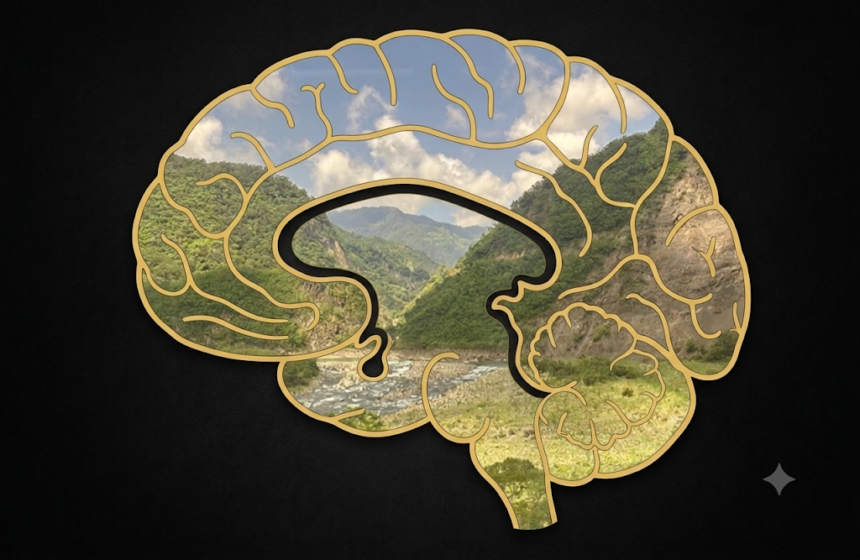
Ironically, the more “educated” some become, the less they see and attain this wisdom. They reject truth as they become addicted to their injections of carefully curated culturalisms. This wisdom lives neither in boardrooms nor in books. It lives underneath our feet. It is wisdom that lives in the discerning dark, within the depths of the right hemispheres of our brains, simultaneously within our souls and six inches – eventually six feet – of earth beneath our soles. This is the same ground that feeds us, the same soil that is our source – as it was Adam’s. It is the same soil that sustains us, that, in the fullness of time, will surround us – in our coffins. Soil is not merely the surface we walk on. It is the beginning and end of the human story, and everything in between.
Bienvenue to Mind and Soil — a column devoted to the sacred and practical covenant between the human spirit and the living earth – between what we think we know – and what and how we grow – between who we are – and where we are planted – as from dust we are made – and to dust we shall return. Mind and Soil is an intentional pun, because when I, we, speak of soil, we are also – always – speaking of soul.

In this column I use the acronym and neologism I consciously created, “WAI” (pronounced why). I created WAI and its related neonym (new name), “West Atlantic Islands” to refer to the archipelago, currently referred to on maps by the pseudonym, exonym and misnomer, “Caribbean” – an unfortunate Eurocentric linguistic foisting based on their utter ignorance of the culture and civilizations they encountered on this “side” of the planet. Such ignorance, birthed in the EEEE – the era of European egoic error – persists in placing North America and Europe on “top” and South America, the West Atlantic Islands and Australia on the “bottom” of a papered plastic planet. Alas the miseducated, spiritually napping, still seek to destroy our mind and soil with their hegemonic mapping.
Soil: Source Sustenance and Sanctuary
Before a single seed is pressed into the earth of our region, whether in Yurumein or Liamuiga, Wadadli or Iyiti, Waitakubuli or Xaymaca, before the first green shoot pushes through, there is the soil itself, being, doing extraordinary, invisible, miraculous, scientific work. A single teaspoon of healthy topsoil contains more living organisms than there are people on our planet. Bacteria, fungi, nematodes, protozoa – a civilization beneath every civilization. The Sumerian civilization, intensive agriculturalists, preceded the Hebrew – the ones who gave us our monotheistic concept of God – by thousands of years. The Taino existed and thrived in our archipelago, also as an advanced agricultural society, practicing complex farming, way before an Italian mad mariner was carried by the trade winds to our island nations in 1492. Roots too, like these civilizations, speak fluently, but to fungi in chemical languages older than human speech. Earthworms turn death into fertility with a patience and consistency from which the half-century-old CARDI and our ministries of agriculture in the yet unborn nation of WAI – West Atlantic Islands – are still learning.
This is more than naked biology. It’s more like a miracle dressed in the ordinary clothes of dirt. Like the father of a friend of mine who would walk into Barclays bank on Back Street in the 1970s in Yurumein, dressed in his work clothes, well-worn, banana-and-coconut water-stained, torn old shirt, khaki pants and a pair of “water boots”. Minutes later, he would walk out the bank with a loan for thousands of dollars. WAI? The banker knew that behind the humble attire was the financial power of a man of the soil who grew and gathered green gold from the ground. Any farmer who kneels down to assess the texture and smell of good earth knows wealth intuitively. When we kneel, we submit, we worship. We humble ourselves as humus before the handcrafter of humans. Good soil has a scent – earthy, deep, sacred – a compound called geosmin, made by actinobacteria. Human noses are extremely sensitive to its presence. It is a phenomenon known as petrichor. It is that unmistakable, rich musty smell of rain hitting dry earth, of life reasserting itself. Of omnipotent potential, poised and waiting, it is the breath of the ground. “Then the Lord God formed a man from the dust of the ground and breathed into his nostrils the breath of life and the man became a living being” Genesis 2:7. A “living being” is sometimes translated as a “living soul”.
Humans are a “living soil” – not just metaphorically but ecologically and chemically. Humans are composed of the exact same elements that comprise soil: carbon, oxygen, hydrogen, nitrogen, calcium and phosphorous. The word “human” is derived from the word “humus” which refers to the organic component of soil, supporting a literal and linguistic connection between humanity and the soil, the earth. The planet is called Earth because “earth” originates from Old English and Germanic words that translate to “ground”, “soil” or “dirt”. All the other planets are named after Roman and Greek gods. Our planet, over which we were given authority, is co-authored by us – we named it “Earth” – after our authentic components, the most important constituent, this soil, of which we are made.
Humanity cannot exist without this thin living skin of the earth. Experts estimate that all civilizations’ food supply depends on no more than three to six feet of topsoil. Strip that away – through erosion, bulldozers, overuse, chemical abuse – or coving it with airports and hotels – and the arithmetic of human survival changes fast – and badly. We are not superior to the soil. We are made of soil, fed by it, and we return to it. The sooner our minds reckon honestly with this, the better our chances of preserving it.
The Farmer is Salt of the Society
The word prestigious describes something that is highly respected, considered to be of a superior quality, having great status. From a secondary school student in Youremain, I once heard what I consider a most unfortunate statement. The young fool was being interviewed on radio. He had confessed that he wished to become a doctor. Why not be a farmer, enquired the host? “Because”, said the boy, “being a doctor is more prestigious”. What a confused societal twisting of the truth. Now, to be fair, the human brain does not fully develop until we are in our late twenties. He was sixteen. Also, his education was at the secondary, not tertiary, level. He had obviously not been taught to think critically. Yet, as I opined at the beginning of this piece, the more “educated” some persons become, the further away wisdom runs. Let’s say clearly what is too rarely said in the halls of power or the columns of popular publications: the farmer is the most essential person in any properly functioning society. Not the banker, definitely not the politician, not the lawyer, journalist, doctor nor engineer. All useful, except the politician, but none essential to life. The person who rises before the sun to tend the animals, to seed the fecund fields, to nurture food from nature, our mother, Earth, to read weather, season and soil the way scholars read texts – that woman or man holds the thread on which every other life depends. In importance after God comes mother, she is the farm. Then comes father who carries the seed in his little bag and plants the seed in the farm. And so, when one becomes a “down to earth” person, like a farmer, one becomes wise. If one plays well any of these roles one may become useful – and thus educated.
In Youremain, and globally, farmers are the custodians of something precious and endangered. Farmers – empirically educated and the academic – carry ancestral and “new” knowledge in their hands – about companion planting, about knowing when the land needs rest, about which mountain drains fast and which mountain maintains moisture. Where on the Windward or Leeward side of Yourumein grows a microclimate. This knowledge is not written down in most cases. It is passed through practice and proximity. When a farming generation is lost or discouraged, when we lose farmers and agronomists like Frederick “Freddie” Ollivierre who returned to the soil in 2024 – much of that knowledge goes with them into that same soil where our Taino, African, Indian and European grandparents were laid. Only those wise enough to have listen and heeded Freddie Ollivierre’s advice will prosper.
When I say “farmer: salt of society”, it is not sentiment. Salt preserves. Salt gives flavour to what would otherwise be bland. Salt is elemental. It is the same word Isa (Yeshua) used for the Sermon on the Mount when he described those people without whom the whole enterprise of human life cannot save what it savours. Our farmers in Yurumein and across the WAI are exactly that – salt of the earth – and they deserve to be honoured as such, supported by policy, celebrated in culture, and treated not as an afterthought of development but as its very foundation.
Three Gift Baskets for Fruitful Living
As we plant the seeds of this column, we envision our growth as citizens of the West Atlantic Islands, as stewards of the land, as sustainers of the soil. We will evolve and progress as we remember our original perfection and true identity. Here are three unsoiled principles to carry into the challenging days ahead. They are filled with promise and potential.
1. Know your soil before you plant your seed. This is literal advice for the farmer: test your soil, understand its pH, its nutrient levels, its drainage. For help with this check UWI, CARDI and our regional ministries of agriculture. Composting, crop rotation, and cover cropping are not only previous Taino and African practices – they are the intelligence of generations, validated now by science. Healthy soil grows healthy food – which grows healthy people. The chain is unbroken and it begins in the soil. But this principle reaches beyond the farm. In life too, we do well to know ourselves, our soil, our essential components, spiritually, psychologically, mentally, the ground we are working with before we demand it produce. Understand your context. Context determines what happens next. Respect your conditions. Respect your context. Soil is life, in the process of being, too. Work in harmony with the earth. It will work with you.
2. What you put in . . . is what the earth gives back. Soil is a perfect accountant. It keeps honest records of what it receives. Do you want cosmetic but compromised results? Are you tempting toxicity? Then flood your soil with imported chemicals that kill its organisms and destroys its structure. Starve it of local organic matter and it will repay you, eventually, with diminished harvests, exhausted ground – and sick citizens of SVG. Feed our soil with natural, local fertilizer, compost and care, rest and diversity and soil multiplies your investment in ways that still feel, to those who experience it, like grace. As consumers, we participate in this accounting every time we choose what to buy – and from whom. Supporting local, sustainable farmers in Yurumein is an investment in the very soil that sustains us and our nation.
3. The land lives longer than any one of us – Every farmer who plants a tree whose shade she may never sit under, who refuses to spray imported toxins on his farm for short-term gain at long-term cost, is practicing a profound act of faith and community love. We did not inherit this soil from our parents; we are borrowing it from our children. Don’t put a pig farm near a river! That’s severe water pollution! Don’t plant above the water catchment area! The decisions made in Yurumein’s fields, farms and agricultural lands today – like the previous ungodly permission given to Rayneau to rape the verdant landscapes of North Leeward – will determine what the next generation inherits – depleted dust and an inability to produce food ourselves. We must permit progress – not peril – in what and how we plant in our petrichor-producing, fragrant, living earth, teeming with possibility. Sustainable farming – as practiced by Lennox and Joy Lampkin and some other farmers in Yurumein – is the most practical, progressive, moral choice available to us.
Mind and Soil returns fortnightly. It is written in deep respect for the farmers of Yurumein – the quiet architects of our survival, our “thrival”- the salt of this beautiful, bountiful volcanic soil.