
Clearing the Air — Dousing the Crisis of Burning Tires
You’ve seen the crime. And maybe even seen the criminals. Most Vincentians have. Some Vincentians are.
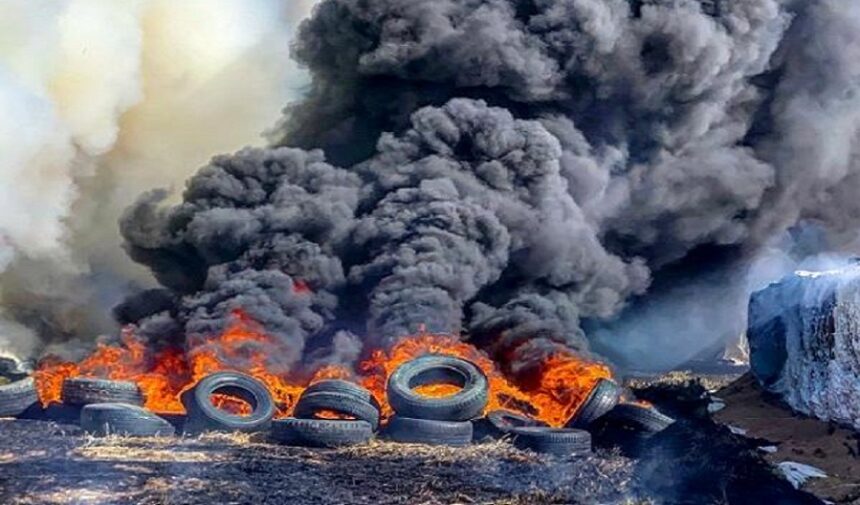
These crimes are curling columns of thick, acrid, swirling smoke. The blackened bloated toxicity, fire-filled ominous billows, reach over each other, rising higher. The unmistakable smell of noxious, burning rubber drifting across the valley of your nostrils, cast a shadow of death. Truckloads of discarded tires are continually dumped at Rabacca or its environs. Or maybe you’ve seen abandoned tires beside ‘that guy’s’ roadside mechanic’s shop, up in your village or behind a building in Paul’s Lot.
The crime has become so commonplace in St. Vincent and the Grenadines that most of us scarcely notice it.
How many tires are burned in SVG each year? How many tires are imported each year? No one seems to know. Does the ministry of the environment know this figure? Does the ministry of the environment advise against burning tires? Shouldn’t it be an illegal act? Isn’t it? Theres is the Environmental Health Services Act of 1991. There are public health and waste management regulations. Tires are legally classified as solid waste. Under the criminal code applicable offences include reckless endangerment, and nuisance and obstruction. Yet in St. Vicent and the Grenadines “a nation of laws” there are no credible national statistics for the number of waste tires generated, illegally dumped, or set noxiously ablaze. The relevant department simply does not know. Or does it? To manage a problem one must measure it. If you can’t manage a problem, you’ll never resolve it.
From what has been scattered – like thousands of broken shards of glass from a rum bottle pushed off a table by a man who has seen too many Sunsets – this column swept up some pieces of the evidence. We gather that St. Vincent and the Grenadines ‘boasts’ of having an estimated 25,000 plus motor vehicles, including “pre-owned” vehicles – we used to call them “skettels” – another loan word, incidentally, that we imported from Jamaica. Imported from Japan, these four-wheeled foreign currency leeches fiscally suck us dry every year.
Every one of those vehicles has required and will require four – often more – replacement tires. Every one of those tires must ultimately be jacked up and jettisoned. The laws governing vehicle importation are well established. What is conspicuously absent in SVG is a national strategy in word and deed for dealing with the mountains of tires those vehicles are leaving behind.
The previous administration had four years ago, through the ministry of transport, planned, apparently, to establish a “tire-shredding project”. The rubber was to meet the road – as rubberized asphalt, material used to rebuild and stabilize damaged roads across SVG. What happened to that project? I suppose it ran off the road?
Some farmers and local community groups have sought a part-solution by using a few discarded tires to build low-cost retaining walls. Kudos to them. Yet the larger problem remains and we’re losing our grip, sliding sideways on the skiddy road to sustainability.
So where do our end-of-life tires go? Some become nurseries and pre-schools for mosquitoes. Some are thrown over cliffs where they are seen – an ugly sight – by those traveling up and down the coasts by boat. Others are thrown on beaches, others dumped in the sea causing environmental disasters, and most are set on fire. Yet these have been the tire modi operandi in St. Vincent for over 100 years and they’re gaining traction.
Scientific research has established that when we burn tires, they emit fine particulate matter, dioxins, furans, heavy metals and numerous toxic organic compounds. These pollutants settle onto crops, contaminate soils, enter our rivers and reservoirs, and eventually find their way into our food. Ah the taste of tire! Vincentians have now apparently acquired a palate for pollutants and a penchant for poisons. These pollutants remain suspended in the atmosphere where they can be inhaled deep into the lungs, increasing the risks of respiratory disease, cardiovascular illness and certain cancers.
Unlike the abrasive ash from La Soufrière, which consists largely of naturally occurring volcanic minerals, tire smoke is a chemically-engineered cocktail of synthetic toxins. Some of its smallest particles can remain airborne for extended periods and travel considerable distances – affecting Bajans? Infecting St. Lucians? before settling.
This raises uncomfortable questions.
Who is responsible? Why is it allowed to happen? Where is the specific “tire-burning” act, legal protection for the people? When will those protections be enacted and penalties put in place? What is the solution? How will it be implemented? Or to parrot a parliamentarian of the previous political party who performed a linguistic peccadillo, “What can us do?” Talk about uncomfortable questions.
It is tempting to point at the ignoramus lighting the match of these tire fires. Certainly, anyone who deliberately burns tires bears – or should bear – criminal responsibility – and a legal beating – for this extremely environmentally harmful act of slow violence and ecocide. But the larger responsibility and accountability is parked elsewhere.
For decades, successive governments in SVG have licensed the importation of thousands of motor vehicles – almost as many as there are stars garaged in the sky – while failing to establish a comprehensive national system for collecting, recycling or safely disposing of the tires the owners of those vehicles inevitably discard. Importers, agents, retailers, vehicle owners, authorities and consumers have all participated in a system that effectively has nothing to say – and does nothing – once the tire reaches the end of its useful life.
In other words, we have built a transport economy without building a tire economy. The deplorable result is predictable: Illegal dumping, mosquito breeding, open burning, poisoned air, contaminated soil. And the silent accumulation of environmental debt that our children will inherit attempting to live a healthy life in St. Vincent and the Grenadines.
The encouraging news is that this problem is entirely solvable.
Countries with far greater tire waste have demonstrated that discarded tires are a valuable industrial resource. They can be transformed into paving blocks, playground surfaces, rubber floor tiles, athletic tracks, landscaping products and countless other commercial goods.
One African entrepreneur has already demonstrated what is possible, building a profitable business by converting hundreds of thousands of discarded tires into marketable products. There is no obvious reason why we in St. Vincent and the Grenadines cannot do the same – on a scale appropriate to our own economy.
Instead of treating waste tires as an environmental liability, we should begin treating them as the raw material for a new manufacturing industry.
The real question is no longer who is setting the fires.
The question is . . . when? When will we follow our African sisters and brothers who are today leading the way. This is how we can go back to Africa – intelligently, innovatively. From where we are, doing what we can, with what we have, we learn from – and reunite with – Africa. This is how and where the rubber of regress meets the road of progress.
Consider this.
St. Kitts and Nevis – a federation of two islands, population 46,758, less than half the size of St. Vincent and the Grenadines – reports 543 registered vehicles for every 1,000 citizens. That is a dated, sourced figure, published by St. Kitts’s own Statistics Department, we cross-checked against United Nations population data: 25,374 vehicles, counted, as of May 2nd, 2023.
Now look for St. Vincent and the Grenadines on that same UN registry.
You see it? You don’t. Of course you don’t. It isn’t there. I mean, it doesn’t even say, “unavailable – contact ministry.” Grenada is on that list. Dominica is on that list. St. Lucia is on that list. Every one of our OECS neighbours has shown up to be counted. St. Vincent and the Grenadines? MIA.
This column is not a critique. It’s an observation that we envision can lead to resolution and reparation – from within. An NDP government that cannot count cars – except one, two, three, THREE black Prados – cannot count tires. An NDP that cannot count tires cannot tell us how many are aflame out at Rabacca, poisoning the crops of farmers, contaminating the soil, polluting the water with toxic chemicals. We need to know how many tires were burned last year, this year thus far, and whether the black billowing bloated toxic smoke – drifting over schoolyards across SVG – possibly affecting Barbados and St. Lucia – is getting worse.
This has gone unrepaired for decades, through successive governments, each content to let, “What can us do” [sic] and “none of you dam business” stand in for a policy.
So here is the question that we’re putting on a specific desk at a specific ministry: Where is the St. Vincent and the Grenadines’ number? Who was assigned to count it? How many more budget sessions do we have to listen to, how many more toxic tire-burning piles at Rabacca do we have to witness and suffer from, how many more invitations to be infected by potential mosquito-related diseases, do we as citizens of SVG have to accept before the internal reparations are made regarding this tiring and burning issue?
If a smaller neighbour like SKN can count its cars, count its tires, and put the number in writing – what, precisely, is the excuse of the current political party entrusted with the people’s power to administer the people’s business in St. Vincent and the Grenadines? This current NDP administration is soon to mark its first year in office. We look forward to our revolutionizing the vulcanizing industry with disruptive and innovative business and community projects in a circular economy by the time the first anniversary rolls around in this November. With the NDP I expect SVG to take the local road less traveled on the highway to successful sustainability while offering leadership by example for and in the regional community.