

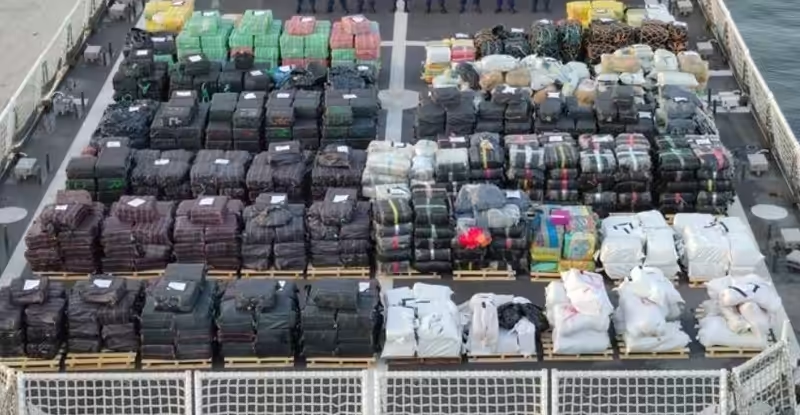
On February 13, a U.S. drone strike shattered the peace of St. Vincent’s territorial waters near Bequia, leaving behind the wreckage of a vessel, dead St. Lucian nationals and a record-breaking narcotics bust, which, according to officials, is worth some $500M. Since then, the Vincentian public is being fed a cocktail of contradiction.
This mystery is not unfolding in a vacuum. It is occurring during a period of intense domestic scrutiny over the perceived return of “nepotism” and a “New Bourgeoisie” class within the government’s board appointments. However, the “vanishing” $500 million has become a symbol of a larger pattern of state opacity that has left the populace deeply cynical.
The first crack in the state’s facade appeared on February 19, when Prime Minister Godwin Friday addressed the reported drone strike. Friday adopted a posture of calculated ambiguity, effectively distancing the highest office from the event’s reality.
“There was no ‘real official confirmation’ of the event other than the initial reports and unofficial accounts.”
This cautious tip-toeing was immediately eroded by Minister of National Security St. Clair Leacock, who discarded the Prime Minister’s shroud of uncertainty, confirming that a U.S. drone strike occurred on February 13. Furthermore, Leacock claimed the operation triggered a “large-scale drug proliferation” event.
What has transpired in the seat of power is not just a breakdown in communication but a profound failure of statecraft. The Prime Minister claims a lack of official confirmation while the National Security Minister is already tallying the spoils of a confirmed strike.
However, the most audacious element of this mystery is the “fiscal fantasy” regarding the value of the seized narcotics. Minister Leacock has publicly estimated the value of the recovered drugs at over $500 million. However, when we look at the actual results of the joint operation in West Kingstown conducted by the Narcotics Unit, the Rapid Response Unit, and the Special Services Unit, the numbers simply do not add up.
The police arrested two 36-year-old men, Sebastian “Bush” Audain and Alvin Cyrus, and recovered exactly 22.9 pounds of cocaine. To understand the absurdity of Leacock’s $500 million valuation announcement, one only needs to look at the global gold standard for drug interdiction: the U.S. Coast Guard (USCG).
In August 2025, it took the USCG 61,740 pounds of cocaine to reach a $500 million valuation.
In April 2025, a seizure of nearly 45,000 pounds of “pure cocaine, uncut” reached that same half-billion-dollar mark.
At USCG’s valuation rate, the 22.9 pounds recovered from Audain and Cyrus would be worth roughly $185,000.
For Minister Leacock’s $500 million figure to be accurate, the “metric” used would have to value the drugs at nearly 2,700 times the international market rate. It means that the state’s number isn’t just a rounding error, it is a massive exaggeration that demands an explanation. What “metric” is being used to transform 22 pounds of powder into half a billion dollars, and why is that information being withheld?
In St. Vincent, the protocol for successful drug busts has always included a degree of performative transparency.
When the police seize marijuana, guns, or ammunition, the evidence is traditionally put on display for the public and the press. This visible confirmation is a check against corruption and a proof of efficacy. In the Bequia case, the evidence has remained invisible.
While Sebastian “Bush” Audain and Alvin Cyrus have been grounded in reality with specific charges of possession and trafficking, these street-level arrests are a far cry from the international, half-billion-dollar incident described by the Minister. The “large-scale proliferation” has vanished, replaced by two men and a relatively minor haul.
As Vincentians await evidence of the $500 million claim, which was backed by only 22 pounds of material, and a Prime Minister who contradicts his own National Security Minister, the resulting vacuum will be filled by a rightful demand for accountability.
